Teaching & Learning
- The WAU (formerly Columbia Union College) bulletin does not mention AI tools specifically for coursework or assignments
- It states that students must follow each instructor's course-level academic integrity policy, and unauthorized materials, plagiarism, and reuse of work across courses are treated as academic dishonesty
Be familiar with and uphold the WAU Academic Integrity Policy and the policy of each instructor.
CHEATING: Intentionally using or attempting to use unauthorized materials, information or study aids in any academic exercise.
PLAGIARISM: Intentionally or knowingly representing the words or ideas of another as one's own in any academic exercise.
Using material from the internet or other online service without proper documentation.
Submitting substantial portions of the same work for credit in more than one course without the knowledge and approval of all instructors involved.
- The bulletin does not define AI-specific rules for exams or assessments
- It does prohibit unauthorized materials or study aids during examinations and says students may be required to verify their work in a monitored setting
Be prepared to offer verification of work and demonstrate abilities in a
monitored setting.
CHEATING: Intentionally using or attempting to use unauthorized materials,
information or study aids in any academic exercise.
Possessing unauthorized notes, study sheets or other materials during an
examination or other academic exercise.
Research
Academic Integrity
- The bulletin does not provide AI-specific disclosure or citation instructions
- It does require proper documentation when using outside sources, including internet or online services, and requires instructor approval for reusing work across courses
Copying from another source without quotation marks and appropriate
documentation.
Paraphrasing words, ideas or sequence of ideas from another source without
appropriate documentation.
Using material from the internet or other online service without proper
documentation.
Submitting substantial portions of the same work for credit in more than one
course without the knowledge and approval of all instructors involved.
- The bulletin does not mention AI-detection tools
- It requires students to be prepared to verify their work, requires faculty to report all instances of academic dishonesty to the provost, and sets out penalties that can include assignment or course grade reductions, an XF grade, suspension, dismissal, expulsion, and degree revocation
Be prepared to offer verification of work and demonstrate abilities in a
monitored setting.
File with the provost a written report of all instances of academic dishonesty
(as determined by the instructor after informal discussions with student,
even if resolved internally within department) with a copy for the student
(as more specifically set forth in the procedures).
CONSEQUENCES: Violations of academic integrity may be imposed singularly
or in any combination. Possibilities include:
Reduction in or failing assignment grade.
Reduction in course grade.
XF grade (see explanation below).
Academic Suspension from school, including “XF” grade in course (right
of appeal in the following semester).
Academic Dismissal from school, including “XF” grade in course (right of
appeal after two semesters).
In the event the student elects to withdraw from the class, the alleged act
of academic dishonesty will be pursued to its conclusion and any final
consequence (including assignment of an “XF” grade, suspension, dismissal or
expulsion) shall be unaffected by such drop or withdrawal.
An awarded degree may be revoked for violations of the Academic Integrity
Policy of Washington Adventist University that occur before the awarding
of the degree, but are discovered after the degree has been awarded, where
the violation is sufficient to justify the awarding of an “XF” grade, or the
suspension or permanent dismissal of the student.
Institutional & Administrative
- The bulletin does not define AI use by faculty or staff
- It does require faculty to uphold the academic integrity policy, place course-specific academic integrity rules in every course outline, discuss those rules with students, and report academic dishonesty cases to the provost
Faculty Responsibilities
Be familiar with and uphold the WAU Academic Integrity Policy.
Include, in every course outline, academic integrity policies relating to the
particular course.
Discuss course policies on first day of each class and reaffirm the importance
of academic integrity within the educational process.
File with the provost a written report of all instances of academic dishonesty
(as determined by the instructor after informal discussions with student,
even if resolved internally within department) with a copy for the student
(as more specifically set forth in the procedures).
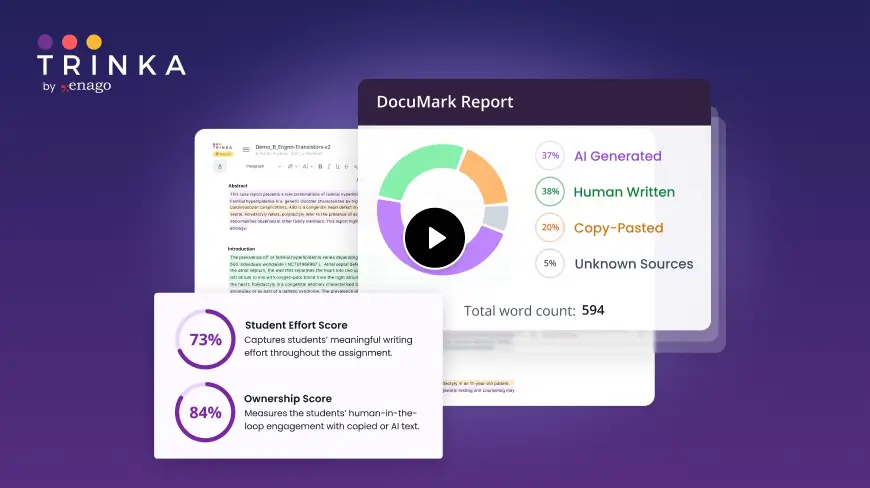
DocuMark: Responsible AI Use for Academic Integrity
Knowing your institution's AI policy is step one. DocuMark helps enforce it fairly by empowering universities to manage AI-generated content, prevent cheating, and support student writing through responsible AI use.
Common Questions About Columbia Union College's AI Policies
Columbia Union College has defined AI policies in 5 of 12 categories, with an overall coverage score of 42%.
The bulletin does not provide AI-specific disclosure or citation instructions. It does require proper documentation when using outside sources, including internet or online services, and requires instructor approval for reusing work across courses.
The bulletin does not mention AI-detection tools. It requires students to be prepared to verify their work, requires faculty to report all instances of academic dishonesty to the provost, and sets out penalties that can include assignment or course grade reductions, an XF grade, suspension, dismissal, expulsion, and degree revocation.
No explicit data protection or approved AI platform policy is currently defined in the available policy sources.