Teaching & Learning
- University guidance states that students may not use generative AI to complete assignments unless the course instructor has clearly granted permission (including written permission)
- Unauthorized AI use for assignments is treated as unauthorized assistance and/or plagiarism, and some school-level policies indicate it is a conduct code violation when used without permission
* Absent a clear statement from a course instructor granting permission, the use of Generative AI tools to complete an assignment or exam is prohibited. The unauthorized use of AI shall be treated similarly to unauthorized assistance and/or plagiarism (page 11 of Standards and Discipline).
The use of generative Artificial Intelligence (AI) tools to complete an assignment or exam is prohibited unless students have a written statement from the course instructor granting permission. Unauthorized use of AI shall be treated similarly to unauthorized assistance and/or plagiarism and is subject to Dean’s Discipline.
CBS faculty acknowledge the availability of generative AI tools as well as their potential benefits and drawbacks. The faculty will indicate in course syllabi and in expectations for individual assignments whether the use of generative AI such as ChatGPT is permitted in their course(s).
- Unauthorized AI use is treated similarly to unauthorized assistance and/or plagiarism, and may be subject to discipline
- University guidance states that using generative AI to complete an exam is prohibited unless the course instructor has clearly granted permission, and some school-level policy specifies written instructor permission
* Absent a clear statement from a course instructor granting permission, the use of Generative AI tools to complete an assignment or exam is prohibited. The unauthorized use of AI shall be treated similarly to unauthorized assistance and/or plagiarism (page 11 of Standards and Discipline).
The use of generative Artificial Intelligence (AI) tools to complete an assignment or exam is prohibited unless students have a written statement from the course instructor granting permission. Unauthorized use of AI shall be treated similarly to unauthorized assistance and/or plagiarism and is subject to Dean’s Discipline.
- The same policy states students have an affirmative duty to ask the instructor for clarification if they are unsure whether a use is permitted
- At least at the school level (Columbia Law School), the policy allows certain study-support uses of generative AI by default unless an instructor prohibits them (e.g., exam outlining, summarizing arguments, brainstorming ideas or a bibliography)
Some uses of Generative AI are allowed, unless prohibited by your instructor. For example, you may use a tool like ChatGPT to help prepare an exam outline or to summarize arguments regarding a legal controversy. Also, you may use Generative AI to brainstorm ideas or a bibliography for a paper, or to help identify typographical errors (but not to write, edit, revise, or translate your text).
Note: you have an affirmative duty to ask your instructor for clarification if you have any doubt about whether your intended use of Generative AI is permitted.
- No additional programming-specific permissions or restrictions (beyond instructor permission for assignments/exams) are defined in the provided sources
- University guidance treats generative AI use for completing coursework as prohibited unless an instructor grants permission, and the university-wide AI policy explicitly includes software code as a type of generative AI output
* Absent a clear statement from a course instructor granting permission, the use of Generative AI tools to complete an assignment or exam is prohibited. The unauthorized use of AI shall be treated similarly to unauthorized assistance and/or plagiarism (page 11 of Standards and Discipline).
“Generative AI” includes any machine-based tool designed to consider user questions, prompts, and other inputs (e.g., text, images, videos) to generate a human-like output (e.g., a response to a question, a written document, software code, or a product design). Generative AI includes both standalone offerings such as ChatGPT, Gemini, NotebookLM, and offerings that are embedded in other software, such as Github’s Copilot.
Research
- Researchers are responsible for the accuracy of AI-created content included in research outputs and must use caution
- For research activities, the university policy requires transparency about generative AI use in research outputs (including in methods or acknowledgements as appropriate)
- Researchers are also expected to follow journal, funding agency, and professional society policies (with an example that some journals prohibit AI-generated text/figures/images/graphics)
* As with other tools and research methods, individuals who use Generative AI in research must be transparent regarding its use, in describing methods, acknowledgements, or elsewhere, as appropriate.
* Researchers are responsible for the accuracy of any content created by AI that is included in any research output and must use caution in utilizing AI output in research.
* Researchers are expected to follow the policies of journals, funding agencies and professional societies through which they report their research. For example, some journals, such as Science, explicitly prohibit text, figures, images or graphics generated by ChatGPT or any other AI tools.
- Teachers College IRB guidance also indicates that researchers must assess and disclose AI use in human subjects research, including for transcription and qualitative analysis
- The university research guidance prohibits uploading unpublished research data or other confidential information into a generative AI tool, and it explicitly notes risks when using interview data for analysis because subjects could be identified and quotations could become public
* Researchers must avoid uploading, or using as input, any unpublished research data or other Confidential Information into a Generative AI tool.
* This also includes the Personal Information of research subjects. For example, inputting interview data to perform preliminary analysis creates the possibility that quotations or other information from research subjects could become public, and potentially, that subjects could also be identified.
Whether you’re using AI to help draft interview guides, transcribe data, analyze qualitative responses, or generate survey content, TC IRB requires researchers to proactively assess and disclose AI use in human subjects research.
- For Teachers College human-subjects research, the IRB guidance states researchers must proactively assess and disclose AI use
- Separately, the Columbia research announcement relays that NIH prohibits peer reviewers from using generative AI technologies for analyzing and formulating peer review critiques
- The university policy states that research use of generative AI must be transparent and that researchers are responsible for the accuracy of AI-created content included in research outputs
* As with other tools and research methods, individuals who use Generative AI in research must be transparent regarding its use, in describing methods, acknowledgements, or elsewhere, as appropriate.
* Researchers are responsible for the accuracy of any content created by AI that is included in any research output and must use caution in utilizing AI output in research.
Whether you’re using AI to help draft interview guides, transcribe data, analyze qualitative responses, or generate survey content, TC IRB requires researchers to proactively assess and disclose AI use in human subjects research.
NIH prohibits NIH scientific peer reviewers from using natural language processors, large language models, or other generative Artificial Intelligence (AI) technologies for analyzing and formulating peer review critiques for grant applications and R&D contract proposals.
Academic Integrity
- In instruction-focused guidance, faculty are encouraged (where permitted by the course) to have students acknowledge and cite AI use
- The university policy requires disclosure when generative AI is used to produce written materials or other work product and instructs community members to be transparent when relying on AI output
- Some school-level policy (CBS) states students should disclose AI use and, when AI is permitted, requires proper citation including platforms and how they are used; failure to cite completely may be reported as an honor code violation
* Disclose the use of Generative AI tools: Columbia community members who leverage Generative AI to produce any written materials or other work product must disclose that those materials and that work product is based on or derives from the use of Generative AI. Always be transparent if you are relying on the output of a Generative AI tool.
If permitted by the course, encourage students to acknowledge and cite any use of AI applications.
As a general rule, students should disclose to faculty if they are using generative AI platforms and in what manner they are using them in coursework.
If faculty permit generative AI in their course, students will be instructed how to use and properly cite such tools in their work. Citation information will include what platforms students are using and how they are using them. Failure to properly and completely cite AI-generated responses may be reported as a violation of the CBS Honor Code.
- University guidance cautions that AI detection tools carry risks of misidentification and should be used carefully; it states AI detection should be treated as a guideline and not a grading metric
- University guidance and school-level policy also state that unauthorized AI use for assignments/exams is treated like unauthorized assistance/plagiarism and may be considered an honor code violation subject to disciplinary processes
Important note about AI detection tools: Since the introduction of AI tools, there has been a parallel rise in tools claiming accurate detection of AI-generated work. As with any form of detection software, there are risks of misidentification, which can have consequences in the classroom. These products are best used with careful consideration and as one of many ways to work with students.
As with other plagiarism detection tools, AI detection should be treated as a guideline and not a grading metric.
The unauthorized use of AI shall be treated similarly to unauthorized assistance and/or plagiarism (page 11 of Standards and Discipline).
The use of generative AI without faculty permission will be considered a violation of the CBS Honor Code. Suspected violations of this nature will be reported to Student Conduct in the Center for Student Success and Intervention (CSSI).
Institutional & Administrative
- Instructional guidance recommends that faculty set clear expectations via the syllabus and develop course-specific AI policies
- The provided sources do not define specific rules for faculty/staff using AI for grading or feedback, but they do address faculty communication and policy-setting expectations for classroom use
- University guidance states that Columbia community members who use generative AI to produce written materials or other work product must disclose that the work product derives from generative AI
* Disclose the use of Generative AI tools: Columbia community members who leverage Generative AI to produce any written materials or other work product must disclose that those materials and that work product is based on or derives from the use of Generative AI. Always be transparent if you are relying on the output of a Generative AI tool.
At minimum, it is recommended that faculty share clear expectations at the beginning of each semester through the syllabus, policy distribution, and class discussion on the appropriate use of AI tools.
It is recommended to develop a course policy about the use of AI tools and what faculty consider to be appropriate and inappropriate in their classes.
- CUIMC guidance specifies approved AI tools and indicates that sensitive data (including PHI) is permitted only on designated platforms, with additional approval requirements for research protocol use
- CUIT attestation language states that only Columbia University approved generative AI tools may be used with PHI, sensitive, or proprietary data, and prohibits using other available generative AI tools with such data
- University research guidance prohibits uploading unpublished research data or other confidential information into generative AI tools, and warns that inputs may become part of an AI’s data universe and risk privacy/IP
* Researchers must avoid uploading, or using as input, any unpublished research data or other Confidential Information into a Generative AI tool.
When a researcher inputs unpublished work of any kind into a Generative AI tool, the unpublished work becomes part of the universe of data in the AI.
Sensitive Data
Permitted only on the ChatGPT Education and approved Microsoft CoPilot* platforms. Research protocol use requires IRB, and TRAC/ACORD approval.
Please be aware that the above statements refer only to Columbia University approved generative AI tools such as the Columbia University Enterprise version of ChatGPT and not to any openly available ChatGPT or LLM. Per the Columbia University Policy on Generative AI, you are not permitted to use any other available generative AI tool with PHI, sensitive or proprietary data.
- CUIMC guidance describes a governance and review process for AI-related requests, including routing research use cases through existing IRB processes and review as appropriate
- The provost policy states the university has convened a working group of faculty and senior administrators (the “AI Team”) to develop policies and guidelines and notes the policy is a “work in progress” that will be updated regularly
Please note that this policy is a “work in progress” as the technology, the law and the Columbia community usage evolves.
The Office of the Provost has convened a working group of faculty and senior administrators from various parts of the University to develop policies and guidelines around the responsible use of these Generative AI tools (the “AI Team”).
Based on our collective experience with Generative AI use at the University, we anticipate that this guidance will evolve and be updated regularly.
Reviews of AI-related requests are based on the use case and nature of the request.
Requests should be submitted through the existing IRB process(es) and will be routed to the CUIMC AIGC for review as appropriate.
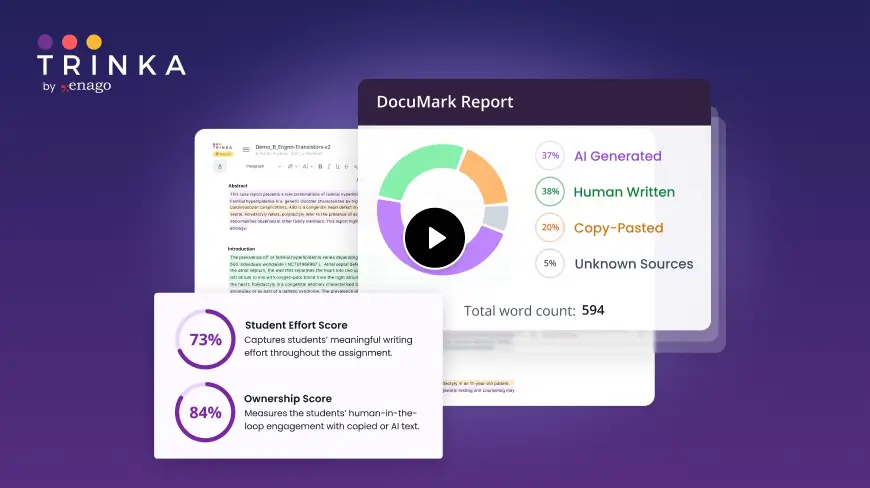
DocuMark: Responsible AI Use for Academic Integrity
Knowing your institution's AI policy is step one. DocuMark helps enforce it fairly by empowering universities to manage AI-generated content, prevent cheating, and support student writing through responsible AI use.
Common Questions About Columbia University's AI Policies
Columbia University has defined AI policies in 12 of 12 categories, with an overall coverage score of 100%.
The university policy requires disclosure when generative AI is used to produce written materials or other work product and instructs community members to be transparent when relying on AI output. In instruction-focused guidance, faculty are encouraged (where permitted by the course) to have students acknowledge and cite AI use. Some school-level policy (CBS) states students should disclose AI use and, when AI is permitted, requires proper citation including platforms and how they are used; failure to cite completely may be reported as an honor code violation.
University guidance cautions that AI detection tools carry risks of misidentification and should be used carefully; it states AI detection should be treated as a guideline and not a grading metric. University guidance and school-level policy also state that unauthorized AI use for assignments/exams is treated like unauthorized assistance/plagiarism and may be considered an honor code violation subject to disciplinary processes.
University research guidance prohibits uploading unpublished research data or other confidential information into generative AI tools, and warns that inputs may become part of an AI’s data universe and risk privacy/IP. CUIMC guidance specifies approved AI tools and indicates that sensitive data (including PHI) is permitted only on designated platforms, with additional approval requirements for research protocol use. CUIT attestation language states that only Columbia University approved generative AI tools may be used with PHI, sensitive, or proprietary data, and prohibits using other available generative AI tools with such data.