Teaching & Learning
- Connecticut College does not publish a single university-wide rule in the provided sources about whether students may use AI for graded coursework
- Instead, the institution states that faculty will be supported in deciding when AI tools are appropriate for their pedagogy and in modifying assignments or adding AI components, so expectations for coursework use are at instructor discretion
Enhance Professional Development for Faculty: Through faculty development workshops, course development support, and new technologies, the initiative will equip faculty with the critical frameworks to decide when and if AI tools are appropriate for their pedagogy.
Support Course Revisions: Faculty members will receive stipends to modify assignments within existing courses, create new assignments, or update existing courses to address the implications of AI or pilot AI components.
Through professional development workshops, course development support and new technologies, faculty members who believe their courses would benefit from AI—or are interested in exploring whether they would—will be given the tools and knowledge needed to incorporate it into their teaching and research practices.
Stipends will be available for faculty members who wish to modify assignments within existing courses, create new assignments, update existing courses to include significant AI components or create new AI-focused courses.
- The college provides access to BoodleBox for students and faculty, and an example in the news coverage describes a faculty-created ChatGPT-based tutor for students
- The provided sources show that Connecticut College is promoting AI-supported learning tools for students and encouraging ethical AI literacy, but they do not impose a specific binding rule for personal study use
A generative AI platform designed specifically for higher education, BoodleBox provides a secure, FERPA-compliant environment for students and faculty to access and use multiple AI models (such as GPT-4, Claude, and Gemini) through a single interface.
In her new role, she'll lead campus-wide initiatives to foster AI literacy, ethical considerations, and thoughtful integration of AI across our liberal arts curriculum, working closely with faculty, students, and staff to address both the practical applications and broader implications of AI in education.
An early adopter, Zimmer uses AI as a tool to enhance his teaching and help students absorb the material in a way that best works for their learning style. By uploading his textbook, notes and previous tests into ChatGPT 4.0 and inputting his own written instructions for the length and level of answers to provide, he created a private interactive tool for his students called Marc’s Chemistry Tutor.
Research
- Connecticut College does not publish an explicit policy governing AI use in research writing or manuscript preparation
- Faculty interested in AI for research are supported through the AI@Conn initiative and professional development resources
- However, its data-classification and SaaS risk policies implicitly apply: any third-party AI tool used to process internal or restricted research data must meet the college's SaaS risk standards, and restricted data, including human-subjects research data, must not be stored in non-approved platforms
Third Party hosted applications that store Internal and Restricted data must meet Connecticut College's Third Party Software as a Service (SaaS) risk standards.
h. Research data involving human subjects that are subject to the Common Rule (Federal Policy for the Protection of Human Subjects, 46 CFR 101 et seq).
Through professional development workshops, course development support and new technologies, faculty members who believe their courses would benefit from AI—or are interested in exploring whether they would—will be given the tools and knowledge needed to incorporate it into their teaching and research practices.
- The data policies do state that research data involving human subjects is restricted data and that third-party hosted applications storing internal or restricted data must meet SaaS risk standards
- The provided sources say the college is supporting AI-related research and integrating AI into research practices, but they do not set a specific rule for using AI in research data collection, analysis, or interpretation
Promote Collaborative Research: The initiative will support existing student-faculty summer research programs with projects focused on AI, providing stipends and resources to foster innovative research that will contribute to their scholarly work.
Through professional development workshops, course development support and new technologies, faculty members who believe their courses would benefit from AI—or are interested in exploring whether they would—will be given the tools and knowledge needed to incorporate it into their teaching and research practices.
AI@Conn will also provide stipends and resources to support student-faculty summer research projects focused on AI.
h. Research data involving human subjects that are subject to the Common Rule (Federal Policy for the Protection of Human Subjects, 46 CFR 101 et seq).
Third Party hosted applications that store Internal and Restricted data must meet Connecticut College’s Third Party Software as a Service (SaaS) risk standards.
- The clearest explicit requirement in the provided policies is that human-subjects research data is treated as restricted data
- The provided sources frame AI use in research as something that should be approached ethically and with attention to safety, but they do not define rules for AI use in grant proposals, IRB applications, ethics declarations, or research-integrity filings
“The idea is that this dedicated position will help oversee academic AI interests and support various departments. This will allow Computer Science faculty and other campus experts to focus on the research and creation of AI, whereas the AI fellow will help with faculty development and address issues like ethical concerns and safety,” Gardzina explained.
h. Research data involving human subjects that are subject to the Common Rule (Federal Policy for the Protection of Human Subjects, 46 CFR 101 et seq).
Academic Integrity
- Connecticut College does not publish an explicit university-wide AI disclosure or citation requirement
- However, the college's provision of BoodleBox is specifically designed to maintain transparency in student-AI interactions, suggesting an institutional expectation of transparency when AI is used
- Specific disclosure rules are left to individual instructors under the instructor-discretion model; the Honor Code's trust-based framework also implicitly requires honest representation of one's work
Faculty can leverage BoodleBox to design structured assignments, build custom AI assistants, and maintain transparency in student-AI interactions.
Created by Connecticut College students in 1922, the Honor Code is a system based on trust and mutual respect. Connecticut College students uphold academic excellence and high community standards by practicing responsible citizenship that protects the core principles of the College.
- The provided sources do not contain AI-specific detection or enforcement rules
- The only relevant institutional statement is the general Honor Code, which says students are expected to uphold academic excellence and responsible citizenship, without mentioning AI detection tools or AI-related penalties
Created by Connecticut College students in 1922, the Honor Code is a system based on trust and mutual respect. Connecticut College students uphold academic excellence and high community standards by practicing responsible citizenship that protects the core principles of the College.
Institutional & Administrative
- Connecticut College explicitly supports faculty and staff use of AI in teaching-related work and broader campus activities
- Faculty are being trained to decide when AI is appropriate for pedagogy, may redesign courses and assignments around AI, and can use BoodleBox to build assignments and custom AI assistants; the sources do not address grading, recommendation letters, or administrative communications specifically
Enhance Professional Development for Faculty: Through faculty development workshops, course development support, and new technologies, the initiative will equip faculty with the critical frameworks to decide when and if AI tools are appropriate for their pedagogy.
Support Course Revisions: Faculty members will receive stipends to modify assignments within existing courses, create new assignments, or update existing courses to address the implications of AI or pilot AI components.
In her new role, she'll lead campus-wide initiatives to foster AI literacy, ethical considerations, and thoughtful integration of AI across our liberal arts curriculum, working closely with faculty, students, and staff to address both the practical applications and broader implications of AI in education.
A generative AI platform designed specifically for higher education, BoodleBox provides a secure, FERPA-compliant environment for students and faculty to access and use multiple AI models (such as GPT-4, Claude, and Gemini) through a single interface. Faculty can leverage BoodleBox to design structured assignments, build custom AI assistants, and maintain transparency in student-AI interactions.
To support web conferencing needs, Connecticut College provides Zoom Meeting licenses to all full-time teaching faculty and most staff, depending on their job function.
- BoodleBox is identified as the approved, FERPA-compliant AI platform for students and faculty
- Connecticut College requires that all SaaS applications proposed for college use undergo a risk assessment before purchase or deployment
- College Gmail is safe for internal and public data but not restricted data; Google Drive acceptability depends on proper data labeling and classification
All Software as a Service (SaaS) applications or products proposed for integration with College systems and for the use of the College community must be reviewed to ascertain compatibility with College systems and to ensure that the College does not face unreasonable risks using the product. IS will work with the originating department to conduct a risk assessment before a purchase or utilization decision can be finalized.
A generative AI platform designed specifically for higher education, BoodleBox provides a secure, FERPA-compliant environment for students and faculty to access and use multiple AI models (such as GPT-4, Claude, and Gemini) through a single interface.
Third Party hosted applications that store Internal and Restricted data must meet Connecticut College's Third Party Software as a Service (SaaS) risk standards.
h. Research data involving human subjects that are subject to the Common Rule (Federal Policy for the Protection of Human Subjects, 46 CFR 101 et seq).
Connecticut College Gmail, including attachments — Safe for Internal and Public data; NOT safe for Restricted Data.
- Connecticut College has an explicit institutional AI strategy through AI@Conn, a three-year initiative focused on integrating AI into academic programs and shaping long-term AI literacy and adoption
- The provided sources also show governance structures for technology projects more generally, including the iConn Steering Committee and the Enterprise Systems Advisory Committee, and describe a fellowship role to support academic AI interests across departments
AI@Conn is a three-year critical inquiry initiative designed to assess the role, validity, and impact of artificial intelligence in our academic programs.
Overall, the initiative seeks to preserve the integrity of human creativity and critical thought by intentionally engaging in these activities.
AI@Conn is a three-year initiative aimed at exploring the role of artificial intelligence within a liberal arts education. The insights gained from this project will guide the College in shaping a long-term strategy for AI literacy, fostering partnerships, and pursuing additional funding opportunities.
Artificial intelligence (AI) is rapidly changing the way people work, learn and conduct research. To prepare students for the challenges and opportunities of an increasingly AI-driven world, Connecticut College has launched a three-year initiative, “AI@Conn: Empowering Liberal Arts Education with AI,” to integrate AI tools and topics into academic programs and enhance teaching, research and engagement with technology across campus.
A cornerstone of the initiative is the creation of a two-year fellowship. The Harold F. Wiley Fellow in Artificial Intelligence will bring specialized knowledge to the College to support faculty in AI-related projects, assist in course development and lead summer workshops.
The iConn Steering Committee has oversight of the Enterprise Systems Advisory Committee (ESAC) and will help ensure that information technology projects are being planned appropriately and resources are being deployed in a way that most effectively ensures information security and supports the strategic priorities and efficient operations of the College.
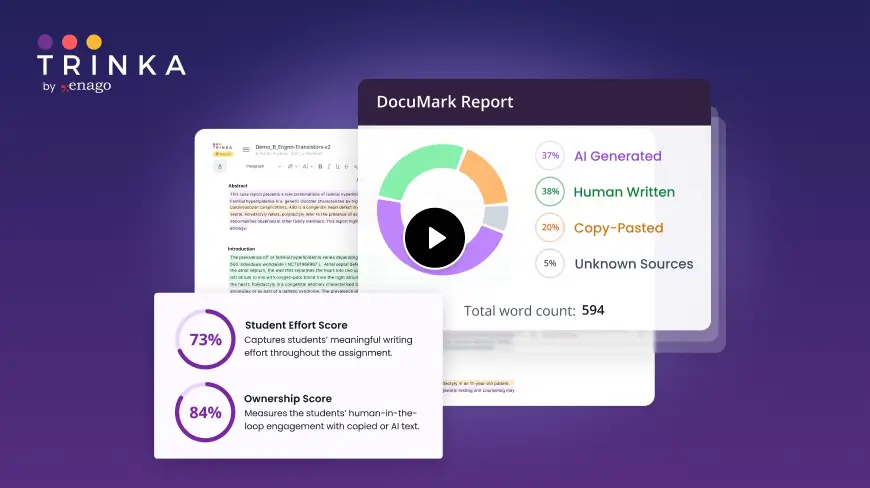
DocuMark: Responsible AI Use for Academic Integrity
Knowing your institution's AI policy is step one. DocuMark helps enforce it fairly by empowering universities to manage AI-generated content, prevent cheating, and support student writing through responsible AI use.
Common Questions About Connecticut College's AI Policies
Connecticut College has defined AI policies in 10 of 12 categories, with an overall coverage score of 83%.
Connecticut College does not publish an explicit university-wide AI disclosure or citation requirement. However, the college's provision of BoodleBox is specifically designed to maintain transparency in student-AI interactions, suggesting an institutional expectation of transparency when AI is used. Specific disclosure rules are left to individual instructors under the instructor-discretion model; the Honor Code's trust-based framework also implicitly requires honest representation of one's work.
The provided sources do not contain AI-specific detection or enforcement rules. The only relevant institutional statement is the general Honor Code, which says students are expected to uphold academic excellence and responsible citizenship, without mentioning AI detection tools or AI-related penalties.
Connecticut College requires that all SaaS applications proposed for college use undergo a risk assessment before purchase or deployment. Its data-classification policy identifies research data involving human subjects as restricted data and specifies that third-party hosted applications storing internal or restricted data must meet the college's SaaS risk standards. BoodleBox is identified as the approved, FERPA-compliant AI platform for students and faculty. College Gmail is safe for internal and public data but not restricted data; Google Drive acceptability depends on proper data labeling and classification.