Teaching & Learning
- Cornell also provides course policy guidance and icons for instructors to communicate when AI is permitted, restricted to approved tools, requires attribution, is prohibited, or is assignment-specific
- Cornell indicates that whether generative AI is allowed for graded coursework and assignments is generally determined at the course/instructor level, and students are responsible for clarifying expectations with their instructor before using AI
Whether or not generative AI use is permitted for assignments in your course, it is critical you adhere to Cornell’s Code of Academic Integrity.
If you are unsure of any policy or assignment-specific directions – including whether or not a tool is considered generative AI and acceptable for use in a course assignment – it is your responsibility to clarify this with your instructor prior to using the technology or completing your assignment.
Communicating clear expectations about how you do - or do not - want students to use generative AI tools in your class is important.
All AI uses permitted unless otherwise specified.
Instructor approved AI tools only.
All work produced using GenAI should be described and attributed following instructor guidance.
Policies on GenAI use are assignment-specific. Look to individual assignment prompts for guidance.
"To ensure development and mastery of the foundational concepts and skills in this course, the use of generative artificial intelligence (AI) tools is prohibited."
- Cornell’s committee report recommends against using generative AI for summative evaluation of student work (i.e., grading), framing it as a faculty responsibility rather than an AI-assisted activity
- Cornell’s provided materials emphasize that instructors should set clear course policies on generative AI use and that AI policies may be specified at the assignment level; however, the provided sources do not state a university-wide rule specifically addressing student AI use during exams/quizzes
Communicating clear expectations about how you do - or do not - want students to use generative AI tools in your class is important.
Policies on GenAI use are assignment-specific. Look to individual assignment prompts for guidance.
While GAI may have selective utility in assisting in providing feedback for low-stakes formative assessment (for example in practice problems), we currently do NOT recommend it be used in summative evaluation of student work. Evaluation and grading of students is among the most important tasks entrusted to faculty, and the integrity of the grading process is reliant on the primary role of the faculty member.
- Cornell’s teaching resources describe ways students might use generative AI as a study aid (e.g., quizzing, explanations, feedback, reflection)
- These statements are presented as exploratory suggestions rather than a binding rule, and they do not specify a universal permission for using AI in graded work
Students might explore using Generative AI to:
Engage in dialogue where the GenAI tool quizzes the student about course content.
Explore ideas.
Get further explanation of a course topic.
Get instant and actionable feedback.
Reflect on their learning or engage in metacognitive learning.
- The provided sources do not define a Cornell-wide policy specifically addressing student use of generative AI for code generation or programming assignments
- Cornell’s general guidance indicates that permissibility of AI use in assignments depends on course/instructor policy and that students must clarify expectations with their instructor
If you are unsure of any policy or assignment-specific directions – including whether or not a tool is considered generative AI and acceptable for use in a course assignment – it is your responsibility to clarify this with your instructor prior to using the technology or completing your assignment.
Research
- The guidance provided is framed as recommendations and examples rather than a mandatory, research-wide rule
- Cornell’s teaching resources and attribution guidance discuss citing LLM-generated material and suggest that instructors may ask students to include AI use in sections such as methods, but the provided sources do not define a Cornell-wide research policy specifically governing AI use for drafting/editing scholarly manuscripts, theses, or dissertations
When using material generated from an LLM in course materials or in assignments that students submit, transparency is key, and these instances should be properly referenced.
For example, consider:
Asking students to include an AI-generated source in the methods section of their research paper.
- Separate IT guidance restricts what kinds of Cornell data may be entered into specific AI tools (e.g., Microsoft 365 Copilot Chat), including prohibitions on medium- and high-risk data
- Cornell’s teaching resources mention that faculty might explore using generative AI to assist in research tasks such as analyzing large datasets and identifying patterns, but the provided sources do not define a Cornell-wide research policy governing AI use for research data collection/analysis
Faculty might explore using Generative AI to save time and improve their course materials:
Assist in research tasks including analyzing large datasets, identifying patterns, and generating insights and research directions
Only enter low-risk data (information that the university has made available or published for the explicit use of the general public). All medium- and high-risk data is prohibited.
- Cornell’s Graduate School research misconduct page states that community members must report suspected research misconduct, but it does not mention AI
- The provided Cornell sources do not define AI-specific rules for research ethics filings (e.g., IRB applications, grant proposals) or research integrity declarations
All members of the Cornell community have a responsibility to report suspected research misconduct. If you suspect research misconduct, you must report it.
Academic Integrity
- Cornell’s teaching guidance emphasizes transparency and proper referencing when LLM-generated material is used in course materials or student submissions, and it provides examples of what disclosure might include (e.g., prompts, model, date, version)
- Cornell also provides attribution guideline resources instructors can adapt for their courses to help students disclose AI use related to coursework and assignments, and Cornell’s committee report recommends faculty follow attribution guidelines when using GAI for course materials
When using material generated from an LLM in course materials or in assignments that students submit, transparency is key, and these instances should be properly referenced.
Having students provide the text or prompt they used for the LLM to generate a response and include what LLM model, date, and version they used.
If you permit AI use in your course, the approaches below can be adapted for your course to help students clearly disclose their AI use related to course work or assignments
We recommend that instructors also follow the guidelines of attribution if they choose to use GAI to produce course materials.
- The provided sources do not define an institutional requirement to use AI-detection tools or name specific detectors
- Cornell’s Code of Academic Integrity states that determinations of violations are made by the Academic Integrity Hearing Board and that violators are subject to penalties under the Code
- Cornell’s AI & Academic Integrity guidance advises instructors to treat initial impressions of generative-AI-related violations as a starting point for deeper inquiry supported by objective and verifiable evidence before proceeding with hearings
The authority to determine whether a specific action shall be treated as a violation of the Code of Academic Integrity lies with the Academic Integrity Hearing Board. Those who violate the Code of Academic Integrity will be subject to penalties under this Code and may also be subject to penalties under state and federal laws.
Instructors should use their initial impressions of potential violations involving generative AI as a starting point for deeper inquiry, supported by objective and verifiable evidence, before proceeding with academic integrity hearings.
Institutional & Administrative
- The IT AI guidelines caution against using non-Cornell free AI tools for processing institutional academic or administrative information
- Cornell’s teaching resources note that faculty might explore using generative AI to generate course materials and draft items like syllabi statements or course policies
- Cornell’s committee report recommends attribution when faculty use GAI to produce course materials and states it does not recommend use of GAI for summative evaluation (grading) of student work, while noting potential utility for low-stakes formative feedback
Faculty might explore using Generative AI to save time and improve their course materials:
Generate content and course materials including lesson plans, quiz questions, sample problems, or writing scenarios
Draft learning objectives, course descriptions, syllabi statements, or course policies
We recommend that instructors also follow the guidelines of attribution if they choose to use GAI to produce course materials.
While GAI may have selective utility in assisting in providing feedback for low-stakes formative assessment (for example in practice problems), we currently do NOT recommend it be used in summative evaluation of student work.
Free AI tools that are not offered by Cornell do not provide any material protection of data and should not be used to share or process institutional academic or administrative information.
- Cornell also describes SandboxAI as a data-protected AI tool with limited access requiring a request
- Cornell IT’s AI guidelines state that free AI tools not offered by Cornell should not be used to share or process institutional academic or administrative information due to lack of data protection
- For Microsoft 365 Copilot Chat, Cornell specifies that only low-risk data may be entered and that all medium- and high-risk data is prohibited; it also lists multiple regulated categories (e.g., FERPA, HIPAA) as prohibited
Free AI tools that are not offered by Cornell do not provide any material protection of data and should not be used to share or process institutional academic or administrative information.
FERPA
Prohibited
HIPAA
Prohibited
High-Risk Identifiers
Prohibited
GLBA
Prohibited
Human Subjects
Prohibited
Restricted Research Data
Prohibited
Only enter low-risk data (information that the university has made available or published for the explicit use of the general public). All medium- and high-risk data is prohibited.
Access is currently limited. If you have an institutional problem that requires data-protected AI to help solve, please submit a request to access this tool.
The SandboxAI is currently in an exploratory phase and not yet widely available.
- Cornell’s Center for Teaching Innovation states that Cornell’s response to generative AI in education is built around seven core principles intended to guide instructor decision-making and discussion
- Cornell also notes that a Cornell administration-assembled committee (Spring 2023) developed guidelines and recommendations for the use of Generative AI for education at Cornell, producing a final report
Cornell’s response to generative AI in teaching and learning is built around seven core principles.
In Spring 2023, the Cornell administration assembled a committee to develop guidelines and recommendations for the use of Generative AI for education at Cornell.
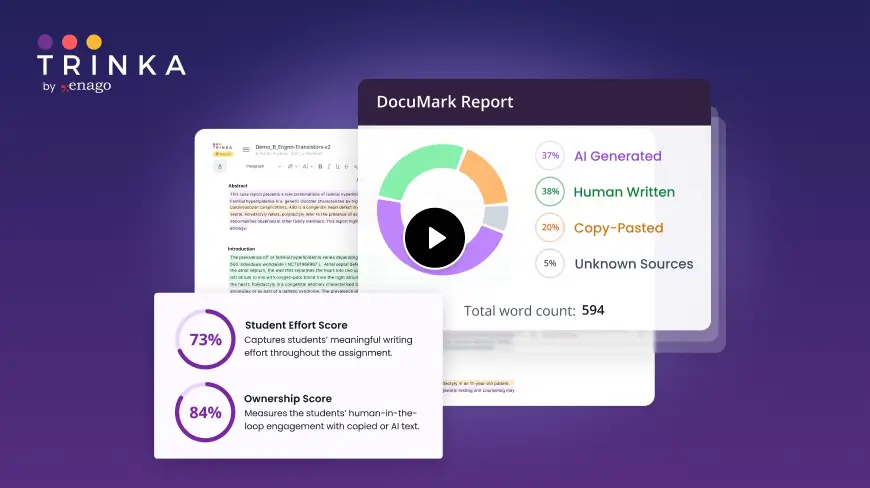
DocuMark: Responsible AI Use for Academic Integrity
Knowing your institution's AI policy is step one. DocuMark helps enforce it fairly by empowering universities to manage AI-generated content, prevent cheating, and support student writing through responsible AI use.
Common Questions About Cornell University's AI Policies
Cornell University has defined AI policies in 12 of 12 categories, with an overall coverage score of 100%.
Cornell’s teaching guidance emphasizes transparency and proper referencing when LLM-generated material is used in course materials or student submissions, and it provides examples of what disclosure might include (e.g., prompts, model, date, version). Cornell also provides attribution guideline resources instructors can adapt for their courses to help students disclose AI use related to coursework and assignments, and Cornell’s committee report recommends faculty follow attribution guidelines when using GAI for course materials.
Cornell’s Code of Academic Integrity states that determinations of violations are made by the Academic Integrity Hearing Board and that violators are subject to penalties under the Code. Cornell’s AI & Academic Integrity guidance advises instructors to treat initial impressions of generative-AI-related violations as a starting point for deeper inquiry supported by objective and verifiable evidence before proceeding with hearings. The provided sources do not define an institutional requirement to use AI-detection tools or name specific detectors.
Cornell IT’s AI guidelines state that free AI tools not offered by Cornell should not be used to share or process institutional academic or administrative information due to lack of data protection. For Microsoft 365 Copilot Chat, Cornell specifies that only low-risk data may be entered and that all medium- and high-risk data is prohibited; it also lists multiple regulated categories (e.g., FERPA, HIPAA) as prohibited. Cornell also describes SandboxAI as a data-protected AI tool with limited access requiring a request.