Teaching & Learning
- For assessed coursework, use of generative AI is not uniformly allowed or banned across the university
- Students may use AI only where the assessment brief or module teaching team explicitly authorises it, and any use outside those parameters can be treated as poor academic practice or academic misconduct
In using generative artificial intelligence (AI), students must ensure they are acting with academic integrity in line with University policy and for each assessment check the instructions and marking criteria set by the module teaching team in order to know whether and how they can use these technologies.
Poor academic practice can involve but is not limited to... using technologies such as artificial intelligence (AI) to generate content that is presented as one's own original work when this is not permitted.
Academic misconduct can involve but is not limited to... using technologies such as artificial intelligence (AI) to generate content that is presented as one's own original work when this is not permitted, or using technologies such as translation software in a manner that is not permitted.
- Use of AI in examinations is addressed through general exam-conduct rules rather than a standalone AI rule
- In exams, students must not access unauthorised materials or devices, and any AI-enabled resource would only be permitted if specifically authorised in the exam instructions
Students are expected to complete examinations in conditions that do not permit them to gain an unfair advantage over other students.
Students shall not bring into the examination room any unauthorised books, notes or other materials, including electronic devices capable of storing and retrieving text, or capable of communicating or connecting to the internet unless specifically authorised to do so in the assessment details.
Any allegation of cheating in an examination or test will be dealt with according to the Academic Conduct Regulations.
- The provided sources do not set out a separate university-wide policy specifically governing non-graded personal study uses such as tutoring or revision support
- The university recognises that students may use generative AI in their studies, but it ties acceptable use to academic integrity rules and to assessment-specific instructions from module teaching teams
In using generative artificial intelligence (AI), students must ensure they are acting with academic integrity in line with University policy and for each assessment check the instructions and marking criteria set by the module teaching team in order to know whether and how they can use these technologies.
Research
- For postgraduate research students, AI may be used in research writing only within strict limits
- Students remain fully responsible for the content, may not list AI as an author, must not use AI to generate original scholarly text presented as their own critical contribution, and must acknowledge permitted uses such as editing, formatting, transcription, translation, or idea generation where relevant
Responsibility for any material generated by AI and included in a thesis remains with the student and there should be human oversight and intervention to ensure that the material is accurate and not plagiarised.
Students may use AI-based software for proof-reading and formatting, but should be aware of data privacy concerns and understand that some software allows providers to claim rights over any uploaded content.
The following are examples of the use of AI in PGR students' theses which are not considered appropriate because they displace the intellectual work expected of PGR students. Please note that these examples are not exhaustive: the use of AI to create original text, to generate drafts of substantive parts of the thesis, or to significantly alter drafts of substantive parts of the thesis where the content generated by AI is represented as the student's own critical analysis, argument, interpretation or scholarly contribution.
The use of AI should always be acknowledged. Students should declare in their thesis where and how AI has been used if this is not obvious from the context. Such declarations should be sufficiently clear that an examiner can understand what has and has not been generated by AI.
AI tools cannot be listed as authors on a thesis or publication because they cannot take responsibility for the work.
Students should be encouraged to use AI tools with caution, ensuring they retain ownership of the ideas and arguments in their theses.
- For postgraduate research, AI use in data handling and analysis is permitted only with caution and human oversight
- Students must consider confidentiality, copyright, bias, and verification risks before uploading data or relying on AI-generated outputs, and they remain responsible for checking accuracy and avoiding fabrication or distortion of results
PGR students should carefully evaluate whether data can be lawfully and ethically uploaded to AI tools. Personal data, confidential information, sensitive research data, unpublished manuscripts or copyright-protected material should not be uploaded to publicly available AI systems unless there is a clear legal basis and appropriate approvals.
Students should be aware that AI systems may reproduce biases, fabricate references or facts, or provide inaccurate summaries or analyses.
Responsibility for any material generated by AI and included in a thesis remains with the student and there should be human oversight and intervention to ensure that the material is accurate and not plagiarised.
The following are examples of the use of AI in PGR students' theses which are not considered appropriate because they displace the intellectual work expected of PGR students. Please note that these examples are not exhaustive: ... the use of AI to analyse data or images where the student does not understand, verify and critically evaluate the output; ... the use of AI to fabricate data, sources or references.
- The university links AI use in research to existing research integrity duties for postgraduate researchers
- Students must use AI responsibly, comply with ethics, data protection, and intellectual property requirements, and avoid any AI use that replaces their own scholarly judgment or produces fabricated material
These guidelines are intended to support postgraduate research (PGR) students and staff in the responsible and ethical use of Artificial Intelligence (AI) in research degrees.
PGR students and supervisory teams are expected to use AI tools in ways that are consistent with the principles of research integrity, academic honesty, transparency and accountability.
Use of AI must comply with all relevant legal and regulatory requirements including data protection law, intellectual property law, confidentiality obligations and the University's ethics processes.
The use of AI should always be acknowledged.
The following are examples of the use of AI in PGR students' theses which are not considered appropriate because they displace the intellectual work expected of PGR students. Please note that these examples are not exhaustive: ... the use of AI to fabricate data, sources or references.
Academic Integrity
- Disclosure of AI use is required in postgraduate research theses when the use is not already obvious from context
- More broadly, students are directed to follow academic integrity rules and assessment instructions to determine whether and how AI can be used, but the provided taught-student sources do not give a detailed university-wide citation format for AI in coursework
The use of AI should always be acknowledged. Students should declare in their thesis where and how AI has been used if this is not obvious from the context. Such declarations should be sufficiently clear that an examiner can understand what has and has not been generated by AI.
In using generative artificial intelligence (AI), students must ensure they are acting with academic integrity in line with University policy and for each assessment check the instructions and marking criteria set by the module teaching team in order to know whether and how they can use these technologies.
- Undisclosed or unauthorised AI use may be handled under the university's academic integrity and academic conduct processes
- The sources explicitly frame unpermitted AI-generated content as poor academic practice or academic misconduct, but they do not set out a specific institutional position on AI-detection software
Poor academic practice can involve but is not limited to... using technologies such as artificial intelligence (AI) to generate content that is presented as one's own original work when this is not permitted.
Academic misconduct can involve but is not limited to... using technologies such as artificial intelligence (AI) to generate content that is presented as one's own original work when this is not permitted, or using technologies such as translation software in a manner that is not permitted.
Any allegation of cheating in an examination or test will be dealt with according to the Academic Conduct Regulations.
Institutional & Administrative
- For research degrees, staff are expected to support responsible AI use through supervision and oversight rather than delegate scholarly judgment to AI
- The provided sources do not set out a broader university-wide policy for faculty use of AI in grading, feedback, lesson planning, or administrative communications
These guidelines are intended to support postgraduate research (PGR) students and staff in the responsible and ethical use of Artificial Intelligence (AI) in research degrees.
PGR students and supervisory teams are expected to use AI tools in ways that are consistent with the principles of research integrity, academic honesty, transparency and accountability.
Responsibility for any material generated by AI and included in a thesis remains with the student and there should be human oversight and intervention to ensure that the material is accurate and not plagiarised.
- The sources emphasize privacy and legal compliance, but they do not identify a university-wide list of approved AI platforms
- The university warns postgraduate researchers not to upload personal data, confidential information, sensitive research data, unpublished manuscripts, or copyrighted material to public AI systems unless there is a lawful basis and appropriate approvals
PGR students should carefully evaluate whether data can be lawfully and ethically uploaded to AI tools. Personal data, confidential information, sensitive research data, unpublished manuscripts or copyright-protected material should not be uploaded to publicly available AI systems unless there is a clear legal basis and appropriate approvals.
Students may use AI-based software for proof-reading and formatting, but should be aware of data privacy concerns and understand that some software allows providers to claim rights over any uploaded content.
Use of AI must comply with all relevant legal and regulatory requirements including data protection law, intellectual property law, confidentiality obligations and the University's ethics processes.
- Coventry University has an institutional AI agenda centered on research, innovation, and skills development through its AI Coventry University Group
- For research degrees, it has also issued formal AI guidelines grounded in research integrity, transparency, accountability, and compliance with law and university ethics processes
AI Coventry University Group brings together our cutting-edge AI-related activity from across our research, innovation and student skills offerings.
Our mission is to accelerate the practical application of AI at scale, driving productivity, inclusive growth, and social impact in partnership with business, public sector and communities.
These guidelines are intended to support postgraduate research (PGR) students and staff in the responsible and ethical use of Artificial Intelligence (AI) in research degrees.
PGR students and supervisory teams are expected to use AI tools in ways that are consistent with the principles of research integrity, academic honesty, transparency and accountability.
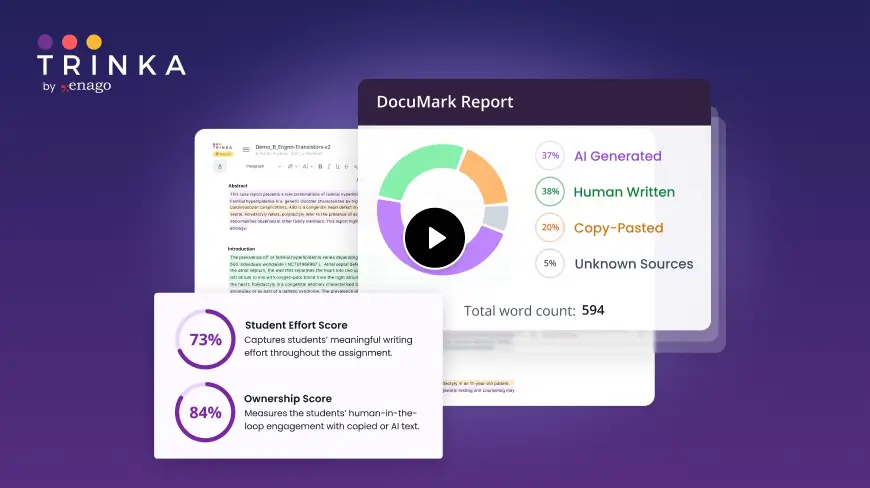
DocuMark: Responsible AI Use for Academic Integrity
Knowing your institution's AI policy is step one. DocuMark helps enforce it fairly by empowering universities to manage AI-generated content, prevent cheating, and support student writing through responsible AI use.
Common Questions About Coventry University's AI Policies
Coventry University has defined AI policies in 11 of 12 categories, with an overall coverage score of 92%.
Disclosure of AI use is required in postgraduate research theses when the use is not already obvious from context. More broadly, students are directed to follow academic integrity rules and assessment instructions to determine whether and how AI can be used, but the provided taught-student sources do not give a detailed university-wide citation format for AI in coursework.
Undisclosed or unauthorised AI use may be handled under the university's academic integrity and academic conduct processes. The sources explicitly frame unpermitted AI-generated content as poor academic practice or academic misconduct, but they do not set out a specific institutional position on AI-detection software.
The university warns postgraduate researchers not to upload personal data, confidential information, sensitive research data, unpublished manuscripts, or copyrighted material to public AI systems unless there is a lawful basis and appropriate approvals. The sources emphasize privacy and legal compliance, but they do not identify a university-wide list of approved AI platforms.