Teaching & Learning
- Use of generative AI in assessed coursework is at instructor and assessment-brief discretion
- If a brief permits AI use, students must acknowledge and reference it; submitting assessment work created by AI without permission or acknowledgement is treated as academic malpractice
The guidelines presented here are for general use and students need to check their assessment briefs for the appropriate use of generative AI (GenAI) in their module assignments. If assessment briefs permit the use of GenAI for any aspect of work, this will need to be acknowledged and referenced. The University currently endorses the use of Microsoft CoPilot and Adobe Firefly. The guidance provided refers to the use of CoPilot and Firefly.
Work submitted for assessment that has been created by GenAI without permission or acknowledgement, will be classed as malpractice and the academic regulations apply.
There may be legitimate uses of generative AI in your subject area that are outlined on your module assessment brief or that you can discuss with your tutors. Using GenAI to generate work that is submitted for assessment without any acknowledgement and against any directives from tutors, is a form of malpractice.
- This applies across assessments generally rather than setting exam-specific permitted uses
- The university does not set a separate AI rule specifically for exams in the provided sources, but it treats attempts to gain an unfair advantage in any form of assessment as malpractice, including unattributed AI-generated content
F10.1The University regards any attempt by a student to gain an unfair advantage in assessment as a serious academic offence that undermines the academic standards of the University. Academic malpractice in any form of assessment will be penalised and may lead to the award not being conferred or to the termination of a student’s registration on the programme.
F10.2 Malpractice includes all forms of cheating, plagiarism, collusion, fabrication and falsification and impersonation. (including unattributed content created by artificial intelligence or any other content generating technology).
vii. unattributed content created by artificial intelligence or any other content generating technology.
- AI use for study support is permitted only within the limits set by assessment briefs and tutor guidance
- The university explicitly presents approved tools and examples such as summarising readings, generating ideas, supporting revision, summarising notes, and practising tests and exams, while directing students to use approved platforms and protect data
Before interacting with generative AI for academic study, check your assessment brief and discuss with your tutors whether using generative AI is permitted and/or recommended in specific module assignments.
Depending on what is stated on assessment briefs and agreed with your tutors regarding generative AI, below are some activities that some people have found useful for academic study.
The University of Cumbria approved AI tools are Copilot, Firefly and Blackboard AI. Prompts and responses are not stored
Because of this, you can use Copilot for tasks like:
* Summarising readings
* Generating ideas
* Supporting revision
Summarising essays and longer pieces to read quickly
Summarising class notes:
Practising tests and exams:
Research
- For research outputs, AI use must be clearly acknowledged and cannot be represented as solely the author's work
- The research ethics policy also warns that many publishers do not currently accept manuscripts wholly or partly written with GAI tools, and that producing such non-disseminable outputs may breach ethical approval
There should be no representation of GAI-created or GAI-augmented reportage of research outcomes as the exclusive work of the author(s). This will be taken to constitute academic malpractice, in line with Article F10.2 of the University’s Malpractice Regulations, which states:
a. Malpractice includes all forms of cheating, plagiarism, collusion, fabrication and falsification and impersonation (including unattributed content created by artificial intelligence or any other content generating technology).
It should be further noted that many publishing houses and other gatekeepers to research dissemination will not currently accept manuscripts wholly or partially written using GAI tools. Producing outputs that cannot be disseminated may, in some circumstances, constitute a breach of ethical approval, not least as participants may then consider that they have been actively misled about data usage and distribution.
Appropriate acknowledgement must also be made of the use of Generative Artificial Intelligence, AI Agents and the involvement of external organisations who have contributed to the research through funding or in-kind support.
- Human participants must be fully informed about intended AI use and its consequences, and research data handling remains subject to data protection, retention, confidentiality, and auditability requirements
- When AI is intended for any part of a research project, ethics applications must disclose and describe that use in depth, including the tool's storage and retention policy and any likely future commercial exploitation
Applications for ethical review should reveal - and describe in depth - any intended usage of GAI tools in any part of a proposed research project, including:
a. A clear statement on the storage and retention policy of the technology being used.
b. A statement (where relevant) pertaining to any likely commercial exploitation of this incidence of GAI-usage in the future, in line with the Third-Party Interactions and Reputational Protection section of this policy.
All human research participants should be made fully aware of any intended usage of GAI tools in any part of a research project, the exact character of this usage, and any likely consequences of this usage.
The lead researcher in any research project is responsible for compliance with all relevant legal requirements, including the Data Protection Act 2018, and to ensure that copyright is not breached.
Where data collection is undertaken, research data must be recorded in a durable and auditable form so that it can be recovered readily.
- The university requires AI use in proposed research to be disclosed in ethics review applications and communicated to human participants
- It prohibits presenting AI-created or AI-augmented research outputs as exclusively the author's work and requires clear acknowledgement of AI contributions under its research integrity standards
Applications for ethical review should reveal - and describe in depth - any intended usage of GAI tools in any part of a proposed research project, including:
All human research participants should be made fully aware of any intended usage of GAI tools in any part of a research project, the exact character of this usage, and any likely consequences of this usage.
There should be no representation of GAI-created or GAI-augmented reportage of research outcomes as the exclusive work of the author(s). This will be taken to constitute academic malpractice, in line with Article F10.2 of the University’s Malpractice Regulations, which states:
Ensure clear and honest attribution and acknowledgement of the direct and indirect contribution of colleagues, collaborators, Generative Artificial Intelligence (GAI), AI Agents and others.
Academic Integrity
- In research, the university also requires acknowledgement of AI contributions in both general research conduct and published outputs
- Disclosure and attribution are required whenever AI use is permitted in assessed student work, and unattributed AI-generated content is treated as malpractice
If assessment briefs permit the use of GenAI for any aspect of work, this will need to be acknowledged and referenced.
Work submitted for assessment that has been created by GenAI without permission or acknowledgement, will be classed as malpractice and the academic regulations apply.
vii. unattributed content created by artificial intelligence or any other content generating technology.
Ensure clear and honest attribution and acknowledgement of the direct and indirect contribution of colleagues, collaborators, Generative Artificial Intelligence (GAI), AI Agents and others.
Appropriate acknowledgement must also be made of the use of Generative Artificial Intelligence, AI Agents and the involvement of external organisations who have contributed to the research through funding or in-kind support.
- The university uses Turnitin to compare submitted work with online sources and previous student submissions, but states that Turnitin does not determine plagiarism
- Undisclosed or unattributed AI use in assessment is handled as malpractice under academic regulations, with penalties that may include non-conferment of the award or termination of registration; panels may also request a viva or exam
Turnitin is a system used by the University to compare submitted work with online sources and previously submitted student work.
Turnitin does not decide whether plagiarism has occurred
It highlights text matches and links to original sources
Work submitted for assessment that has been created by GenAI without permission or acknowledgement, will be classed as malpractice and the academic regulations apply.
Academic malpractice in any form of assessment will be penalised and may lead to the award not being conferred or to the termination of a student’s registration on the programme.
In some cases, the panel may request a viva or exam to assess your understanding of the work.
Institutional & Administrative
- The university identifies approved AI tools and directs students to use them where possible
- It states that prompts and responses are not stored in the approved tools, data is encrypted, inputs are not used to train AI models, and sensitive or confidential information must not be shared with any GenAI tools; for summarising university-access materials, only Copilot should be used
The University currently endorses the use of Microsoft CoPilot and Adobe Firefly. The guidance provided refers to the use of CoPilot and Firefly.
In line with data protection, no sensitive or confidential information should be shared with any GenAI tools, including CoPilot and Firefly.
The University of Cumbria approved AI tools are Copilot, Firefly and Blackboard AI. Prompts and responses are not stored
* Data is encrypted
* Your inputs are not used to train AI models
Our agreement with Microsoft means that CoPilot is not storing data or using it for training purposes. Therefore only CoPilot should be used for summarising activities using sources created by others, whether that be journal articles from OneSearch or assessment briefs created by tutors. Any materials to which you have access as a University of Cumbria student should not be uploaded to any chatbot, apart from CoPilot.
- The university states that its AI guidance is evolving and currently provides general guidance rather than a fixed comprehensive strategy in the provided sources
- It notes current endorsement of selected tools and says guidance will continue to develop as the institution explores opportunities and challenges of generative AI
The guidelines presented here are for general use and students need to check their assessment briefs for the appropriate use of generative AI (GenAI) in their module assignments.
Like other universities, University of Cumbria continues to explore the opportunities and challenges of GenAI. The situation with GenAI is constantly evolving and guidelines will continue to develop accordingly.
The University currently endorses the use of Microsoft CoPilot and Adobe Firefly.
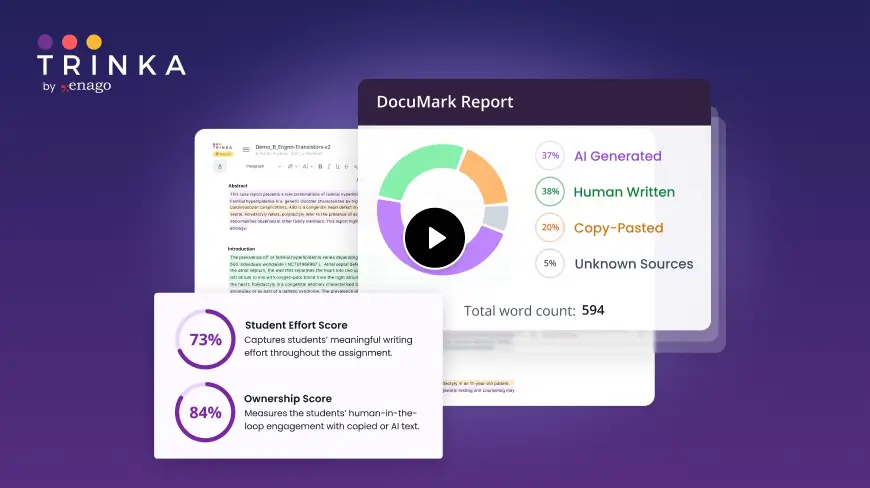
DocuMark: Responsible AI Use for Academic Integrity
Knowing your institution's AI policy is step one. DocuMark helps enforce it fairly by empowering universities to manage AI-generated content, prevent cheating, and support student writing through responsible AI use.
Common Questions About Cumbria University's AI Policies
Cumbria University has defined AI policies in 10 of 12 categories, with an overall coverage score of 83%.
Disclosure and attribution are required whenever AI use is permitted in assessed student work, and unattributed AI-generated content is treated as malpractice. In research, the university also requires acknowledgement of AI contributions in both general research conduct and published outputs.
The university uses Turnitin to compare submitted work with online sources and previous student submissions, but states that Turnitin does not determine plagiarism. Undisclosed or unattributed AI use in assessment is handled as malpractice under academic regulations, with penalties that may include non-conferment of the award or termination of registration; panels may also request a viva or exam.
The university identifies approved AI tools and directs students to use them where possible. It states that prompts and responses are not stored in the approved tools, data is encrypted, inputs are not used to train AI models, and sensitive or confidential information must not be shared with any GenAI tools; for summarising university-access materials, only Copilot should be used.