Teaching & Learning
- Use of AI for coursework and graded assignments is governed by the specific assignment policy set in the syllabus or by the instructor
- Using AI to generate assignment content without written instructor authorization, or submitting AI-generated or AI-altered work as one's own without proper citation, is treated as academic dishonesty
Any use of generative AI tools must be in line with the usage policy for specific assignments as defined in the course of the syllabus and/or communicated by the course instructor.
Using artificial intelligence tools to generate content for assignments or exams, including but not limited to language models or code generators, without written authorization from the instructor.
Submitting content generated by another person or an AI tool or any other source as solely your own work as your own, including, but not limited to, material obtained in whole or in part from commercial study or homework help websites, or content generated or altered by AI or digital paraphrasing tools without proper citation.
Unauthorized use of AI-generated content; or use of AI-generated content, whether in whole or in part, even when paraphrased, without citing the AI as the source.
- AI use in exams and assessments is prohibited unless the instructor has provided written authorization
- The university treats unauthorized AI use during exams, as well as unauthorized use of devices or technologies to generate information during an examination, as cheating
Cheating is the unauthorized use or attempted use of material, information, notes, study aids, devices, artificial intelligence (AI) systems, or communication during an academic exercise.
Using artificial intelligence tools to generate content for assignments or exams, including but not limited to language models or code generators, without written authorization from the instructor.
Unauthorized use during an examination of notes, prepared answers, or any electronic devices such as cell phones, computers, smart watches, or other technologies to copy, retrieve, generate or send information.
- The only explicit rule is that AI use must follow course or instructor rules when tied to academic work
- The university states that students must learn to use AI responsibly and ethically, but it does not provide a specific standalone policy on AI for personal studying, tutoring, or other non-graded learning support in the provided sources
Any use of generative AI tools must be in line with the usage policy for specific assignments as defined in the course of the syllabus and/or communicated by the course instructor.
Preparing students to learn from and use AI responsibly and ethically is critical to the University’s mission, to ensuring academic integrity, to securing the rigor of the University’s academic programs.Further, students must become facile with the use of AI to learn effectively in today’s world and to prepare for their AI-assisted careers and lives in the future.
- AI code generation is not separately regulated from other AI use
- The university states that code generators may not be used for assignments or exams without written instructor authorization, and assignment-level rules are set by the syllabus or instructor
Any use of generative AI tools must be in line with the usage policy for specific assignments as defined in the course of the syllabus and/or communicated by the course instructor.
Using artificial intelligence tools to generate content for assignments or exams, including but not limited to language models or code generators, without written authorization from the instructor.
Research
Academic Integrity
- When AI use is permitted, students must cite AI-generated content rather than presenting it as their own work
- The university's policy specifically identifies failure to cite AI-generated content, including paraphrased AI output, as plagiarism or unauthorized use
Submitting content generated by another person or an AI tool or any other source as solely your own work as your own, including, but not limited to, material obtained in whole or in part from commercial study or homework help websites, or content generated or altered by AI or digital paraphrasing tools without proper citation.
Copying another person’s or an AI tool’s actual words or images without the use of quotation marks and citations attributing the words to their source.
Unauthorized use of AI-generated content; or use of AI-generated content, whether in whole or in part, even when paraphrased, without citing the AI as the source.
- Hunter College enforces AI-related academic misconduct through its academic integrity process and may impose sanctions ranging from course failure to suspension or expulsion
- CUNY policy also requires colleges to subscribe to an electronic plagiarism detection service, and Hunter requires faculty to report suspected violations through an online Academic Integrity Form within 30 days of discovery
Hunter College upholds the right to promote academic integrity on its campus as an educational institution of the City University of New York. The College has the responsibility to review all charges of academic dishonesty and implement sanctions, including, but not limited to, failing the course, official transcript notation, suspension or expulsion from the College when it has been determined that academic dishonesty did occur.
Each college shall subscribe to an electronic plagiarism detection service and shall notify students of the fact that such a service is available for use by the faculty.Colleges shall make faculty aware of the availability of such services and faculty should inform students of their use.
To initiate the procedure for addressing an allegation of academic dishonesty, faculty members must complete the online Academic Integrity Form indicating the recommended academic sanction, which involves a grade penalty (i.e., a reduced grade). Disciplinary sanctions may only be pursued by the Dean of Students if the case merits them.
The faculty should submit the online reporting form within 30 days of discovery of the academic dishonesty.
Faculty members must submit the online form within 30 days of discovery of the academic dishonesty.
Institutional & Administrative
- However, the sources do not define a broader policy on faculty or staff use of AI for grading, feedback, recommendation letters, or administrative work
- The provided sources show that faculty are given AI-related classroom resources and are expected to set assignment-specific AI rules in their syllabi or course communications
Any use of generative AI tools must be in line with the usage policy for specific assignments as defined in the course of the syllabus and/or communicated by the course instructor.
engage with AI tools in the classroom
Generative AI in the Classroom
Examples of AI Assignments
Generative AI Resources page
Overview of Faculty Engagement with Generative AI at Hunter
CUNY's Academic Integrity Policy with Revisions about Gen-AI: Academic Integrity Policy – The City University of New York
- The most explicit institutional direction is that CUNY revised its academic integrity policy to address AI and that Hunter points faculty to that revised policy in syllabus guidance
- The provided sources indicate institutional acknowledgment of AI and support materials for classroom use, but they do not set out a formal Hunter-wide AI governance framework, committee structure, or strategic roadmap
EXPLANATION Revision to the 2022 Academic Integrity Policy is necessary because the current policy does not address the advent of Artificial Intelligence and its use by students at CUNY.Preparing students to learn from and use AI responsibly and ethically is critical to the University’s mission, to ensuring academic integrity, to securing the rigor of the University’s academic programs.Further, students must become facile with the use of AI to learn effectively in today’s world and to prepare for their AI-assisted careers and lives in the future.
CUNY's Academic Integrity Policy with Revisions about Gen-AI: Academic Integrity Policy – The City University of New York
engage with AI tools in the classroom
Overview of Faculty Engagement with Generative AI at Hunter
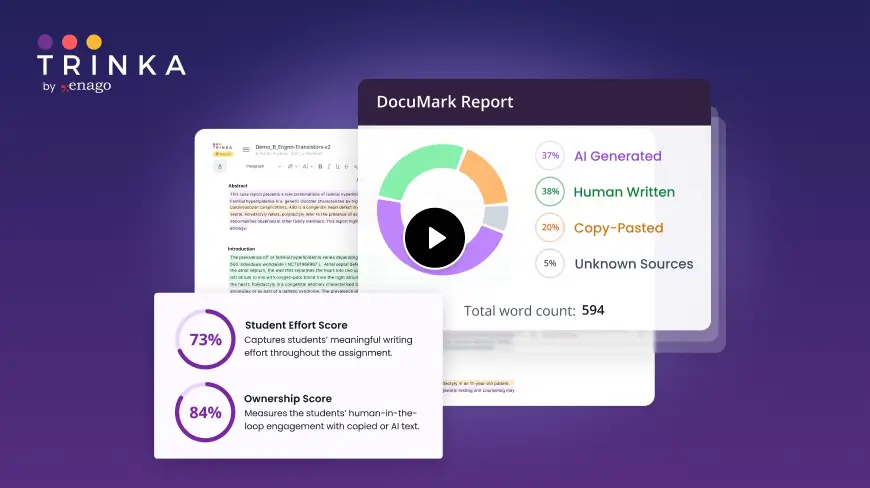
DocuMark: Responsible AI Use for Academic Integrity
Knowing your institution's AI policy is step one. DocuMark helps enforce it fairly by empowering universities to manage AI-generated content, prevent cheating, and support student writing through responsible AI use.
Common Questions About CUNY Hunter College's AI Policies
CUNY Hunter College has defined AI policies in 8 of 12 categories, with an overall coverage score of 67%.
When AI use is permitted, students must cite AI-generated content rather than presenting it as their own work. The university's policy specifically identifies failure to cite AI-generated content, including paraphrased AI output, as plagiarism or unauthorized use.
Hunter College enforces AI-related academic misconduct through its academic integrity process and may impose sanctions ranging from course failure to suspension or expulsion. CUNY policy also requires colleges to subscribe to an electronic plagiarism detection service, and Hunter requires faculty to report suspected violations through an online Academic Integrity Form within 30 days of discovery.
No explicit data protection or approved AI platform policy is currently defined in the available policy sources.