Teaching & Learning
- Use of AI for coursework and graded assignments is governed by the instructor’s policy for the specific assignment
- Without written authorization, using AI to generate assignment content or submitting AI-generated material as one’s own is treated as academic dishonesty, and students are responsible for following their instructors’ stated parameters
Any use of generative AI tools must be in line with the usage policy for specific assignments as defined in the course of the syllabus and/or communicated by the course instructor.
* Using artificial intelligence tools to generate content for assignments or exams, including but not limited to language models or code generators, without written authorization from the instructor.
* Submitting content generated by another person or an AI tool or any other source as solely your own work as your own, including, but not limited to, material obtained in whole or in part from commercial study or homework help websites, or content generated or altered by AI or digital paraphrasing tools without proper citation.
It is the student’s responsibility to know and oblige their instructors’ parameters regarding the use of Generative AI in completing assignments.
- Unauthorized use of AI or other technologies during an examination is classified as cheating under the CUNY academic integrity policy
- AI use in exams and formal assessments is not generally allowed unless the instructor has given written authorization and the course policy permits it
Any use of generative AI tools must be in line with the usage policy for specific assignments as defined in the course of the syllabus and/or communicated by the course instructor.
* Using artificial intelligence tools to generate content for assignments or exams, including but not limited to language models or code generators, without written authorization from the instructor.
* Unauthorized use during an examination of notes, prepared answers, or any electronic devices such as cell phones, computers, smart watches, or other technologies to copy, retrieve, generate or send information.
- Students are told they must follow those instructor parameters when using generative AI in connection with their coursework
- The university does not set a separate university-wide rule for AI as study help, but Queens College states there is no specific CUNY or QC classroom AI policy beyond the academic integrity policy and places responsibility on instructors to set course parameters
Currently, there is no specific CUNY or QC policy on the use of artificial intelligence in the classroom outside of some specific mentions of AI in the CUNY Academic Integrity Policy.
This means that, as instructors, we have a lot of flexibility and responsibility to consider how and when the use of generative AI is acceptable in our classes and to clearly communicate these parameters to our students as we prepare them for potential integrations of these technologies in work and life.
It is the student’s responsibility to know and oblige their instructors’ parameters regarding the use of Generative AI in completing assignments.
- AI code generation is treated under the same academic integrity rules as other AI-generated assignment content
- Using code generators for assignments or exams requires written instructor authorization, and otherwise falls under prohibited cheating
Any use of generative AI tools must be in line with the usage policy for specific assignments as defined in the course of the syllabus and/or communicated by the course instructor.
* Using artificial intelligence tools to generate content for assignments or exams, including but not limited to language models or code generators, without written authorization from the instructor.
Research
Academic Integrity
- The governing assignment-specific AI rules are set through the syllabus or instructor communications
- When AI use is permitted, students must properly cite AI-generated or AI-altered content and may not present it as solely their own work
Any use of generative AI tools must be in line with the usage policy for specific assignments as defined in the course of the syllabus and/or communicated by the course instructor.
* Submitting content generated by another person or an AI tool or any other source as solely your own work as your own, including, but not limited to, material obtained in whole or in part from commercial study or homework help websites, or content generated or altered by AI or digital paraphrasing tools without proper citation.
* Copying another person’s or an AI tool’s actual words or images without the use of quotation marks and citations attributing the words to their source.
* Unauthorized use of AI-generated content; or use of AI-generated content, whether in whole or in part, even when paraphrased, without citing the AI as the source.
- Academic dishonesty involving AI is enforceable through the university’s academic integrity process, with penalties that can include failing grades, suspension, or expulsion
- CUNY requires colleges to subscribe to an electronic plagiarism detection service and notify students that faculty may use it, and Queens College has an Academic Integrity Violation Form that documents referrals, departmental resolution, and Student Affairs judicial action
Academic dishonesty is prohibited in The City University of New York. Penalties for academic dishonesty include academic sanctions, such as failing or otherwise reduced grades, and/or disciplinary sanctions, including suspension or expulsion.
3. Each college shall subscribe to an electronic plagiarism detection service and shall notify students of the fact that such a service is available for use by the faculty.Colleges shall make faculty aware of the availability of such services and faculty should inform students of their use.
Case referred to the Office of the VP for Student Affairs for documentation purposes only
Case referred to the Office of the VP for Student Affairs for judicial action.
Case resolved by Department. No judicial action requested.
Faculty Members will be notified and asked to meet and discuss the case with a Student Conduct Officer.
Institutional & Administrative
- Queens College does not provide a binding university-wide classroom AI rule for faculty in the provided sources
- Instead, it states that instructors have flexibility and responsibility to decide when AI is acceptable in their classes and must clearly communicate those parameters to students; CETLL also provides a best-practices guide with sample syllabus statements and assignments
Currently, there is no specific CUNY or QC policy on the use of artificial intelligence in the classroom outside of some specific mentions of AI in the CUNY Academic Integrity Policy.
This means that, as instructors, we have a lot of flexibility and responsibility to consider how and when the use of generative AI is acceptable in our classes and to clearly communicate these parameters to our students as we prepare them for potential integrations of these technologies in work and life.
From our discussions with the Faculty Fellows and other resources, we have developed Generative AI in the Classroom: Best Practices, a CETLL Guide. This guide includes step-by-step guidance about how to engage with questions of generative AI in your classrooms, sample syllabus statements, assignments, resources developed by the Faculty Fellows, and recommended readings and resources for your use.
- The college created a Generative AI in the Classroom Faculty Fellowship and published a CETLL guide to support instructors in addressing AI in teaching
- Queens College does not set a formal university-wide AI policy in the provided sources, but it has established faculty-support infrastructure around AI through CETLL
Currently, there is no specific CUNY or QC policy on the use of artificial intelligence in the classroom outside of some specific mentions of AI in the CUNY Academic Integrity Policy.
In 2024-2025, in collaboration with Amy Wan, Professor of English and Special Assistant to the Provost for Writing, CETLL hosted a Generative AI in the Classroom Faculty Fellowship, through which an interdisciplinary cohort of thirteen faculty members were supported to critically engage the different concerns and opportunities that generative AI presents for our work as educators.
From our discussions with the Faculty Fellows and other resources, we have developed Generative AI in the Classroom: Best Practices, a CETLL Guide. This guide includes step-by-step guidance about how to engage with questions of generative AI in your classrooms, sample syllabus statements, assignments, resources developed by the Faculty Fellows, and recommended readings and resources for your use.
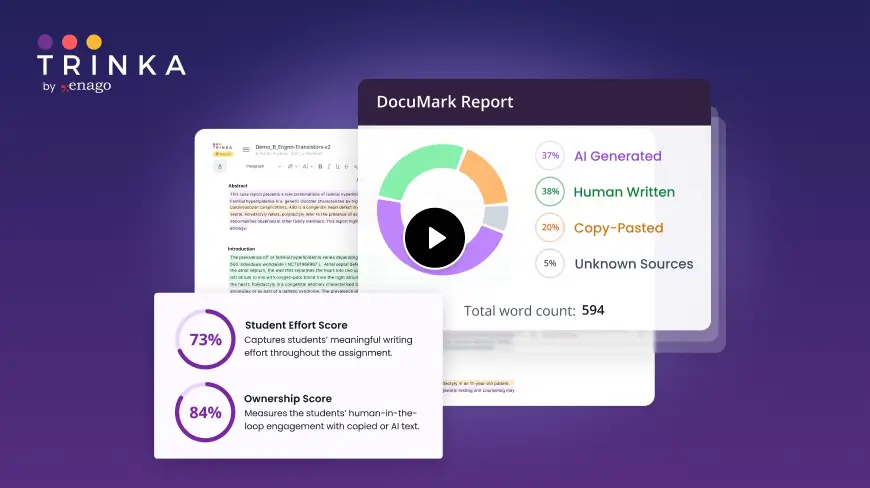
DocuMark: Responsible AI Use for Academic Integrity
Knowing your institution's AI policy is step one. DocuMark helps enforce it fairly by empowering universities to manage AI-generated content, prevent cheating, and support student writing through responsible AI use.
Common Questions About CUNY Queens College's AI Policies
CUNY Queens College has defined AI policies in 8 of 12 categories, with an overall coverage score of 67%.
When AI use is permitted, students must properly cite AI-generated or AI-altered content and may not present it as solely their own work. The governing assignment-specific AI rules are set through the syllabus or instructor communications.
Academic dishonesty involving AI is enforceable through the university’s academic integrity process, with penalties that can include failing grades, suspension, or expulsion. CUNY requires colleges to subscribe to an electronic plagiarism detection service and notify students that faculty may use it, and Queens College has an Academic Integrity Violation Form that documents referrals, departmental resolution, and Student Affairs judicial action.
No explicit data protection or approved AI platform policy is currently defined in the available policy sources.