Teaching & Learning
- Separate Dartmouth guidance provides that GenAI may be allowed for some coursework uses (e.g., drafting or editing) when the instructor permits it, and students are expected to follow stated boundaries
- If a student uses generative AI in a way that is not authorized by the instructor or is otherwise inconsistent with academic integrity expectations, it may constitute an academic honor principle/policy violation
- Dartmouth’s undergraduate Arts & Sciences policy treats generative AI use in coursework as governed by course-specific instructions; students must follow the instructor’s stated expectations for the course/assignment
The instructor is responsible for articulating in writing the permissible uses of generative artificial intelligence (GenAI) tools in the course.
Students are responsible for understanding and complying with the instructor’s stated expectations for the use of GenAI tools in the course.
Unless explicitly authorized by the instructor, submitting work generated in whole or in part by GenAI tools as one’s own work violates the Academic Honor Principle.
The Academic Honor Principle is the foundation for integrity and ethical conduct in all academic endeavors at Dartmouth.
Academic dishonesty includes, but is not limited to, plagiarism, cheating, and any other form of misrepresentation of one’s academic work.
- Institutional teaching guidance on exams and proctoring also frames unauthorized assistance/tools during examinations as inconsistent with academic integrity expectations, with course-level directions governing what is permitted
- Dartmouth’s guidance indicates that GenAI use during exams/assessments is controlled by the instructor’s explicit rules; absent explicit authorization, using GenAI in an exam context is treated as prohibited and may violate the Academic Honor Principle
The instructor is responsible for articulating in writing the permissible uses of generative artificial intelligence (GenAI) tools in the course.
Students are responsible for understanding and complying with the instructor’s stated expectations for the use of GenAI tools in the course.
Unless explicitly authorized by the instructor, submitting work generated in whole or in part by GenAI tools as one’s own work violates the Academic Honor Principle.
- Where GenAI is used for study support connected to coursework, students must comply with the instructor’s stated permissions and boundaries
- If GenAI-assisted work is submitted contrary to those boundaries, it is treated as an academic integrity concern under Dartmouth’s honor framework
- Dartmouth provides teaching and learning resources that discuss GenAI as a potential learning aid, but the binding policy position for students is that GenAI use is governed by instructor-defined expectations within a course
Students are responsible for understanding and complying with the instructor’s stated expectations for the use of GenAI tools in the course.
Unless explicitly authorized by the instructor, submitting work generated in whole or in part by GenAI tools as one’s own work violates the Academic Honor Principle.
- In addition to the university-wide guidelines, the Thayer School of Engineering has a specific AI policy for student work (including programming)
- It emphasizes that students remain responsible for all submitted content, must be transparent about AI use, and—if the instructor permits AI—must include a description of how AI tools were used
- Students must not represent AI-produced work as their own original work; unauthorized AI-generated code or assistance submitted as a student’s own work may be treated as an academic integrity violation
From Thayer School of Engineering AI Policy: "You are responsible for the content of all of your submitted work. This has always been the case, and the existence of powerful AI tools does not change this. ... Be transparent in your use of these tools. If your instructor permits the use of AI tools in your work, you must include a description of how you used them. ... Do not represent work produced by an AI tool as your own original work."
Research
- The policy also states that any use of generative AI tools in student academic work requires citation, with format guided by the instructor/advisor (and also considering applicable publisher/conference policies)
- The Guarini School of Graduate and Advanced Studies has a policy stating that using generative AI to produce content submitted as the student's own work for course credit or as part of a culminating academic experience (e.g., thesis, dissertation) is a violation of the Academic Honor Principle unless the student obtains prior written approval from the instructor or research advisor(s)
“The Guarini School of Graduate and Advanced Studies considers the use of generative A.I. to produce content that is submitted as the student's own work for course credit or as part of a culminating academic experience (e.g. thesis, dissertation) to be a violation of the principle of Academic Honor...”
“…students who wish to use generative A.I. in their academic work must obtain prior written approval from their instructor or from their research advisor(s)…”
“The Guarini school considers any use of generative A.I. tools in student academic work to require citation.”
- Generative AI models that are not Dartmouth-approved or contracted may only be used with Public data
- Dartmouth's Data Sensitivity Guide for Generative AI dictates what types of Dartmouth data may be used with generative AI tools
- This directly constrains how AI can be used for research data analysis and what research data can be entered into external/public AI systems
“Generative AI models that are not Dartmouth-approved or contracted may only be used with Public data. Dartmouth data classified as Internal, Confidential and Restricted may only be used with a Dartmouth-approved platform and following any specific use case guidance provided for that service. Never enter/upload Restricted data such as PII, PHI, student records (FERPA), social security numbers, credit card numbers, or driver's license numbers into a public/consumer generative AI service.”
- In the absence of an explicit research-specific AI integrity policy in the provided sources, this classification is not defined
- The provided sources do not define a Dartmouth-wide research integrity rule that specifically addresses AI use in IRB submissions, grant proposals, or formal research ethics declarations
- However, Dartmouth’s general honor/integrity framing and responsible-use materials emphasize ethical conduct and avoiding misrepresentation, and school/program policies may impose additional expectations
not defined
Academic Integrity
- Disclosure requirements are primarily defined by the course instructor under Dartmouth’s GenAI coursework guidelines
- In all cases, submitting GenAI-generated work as one’s own without explicit authorization violates the Academic Honor Principle
- However, some schools have more explicit requirements: the Guarini School states that any use of generative AI tools in student academic work requires citation (with format guided by the instructor/advisor), and the Thayer School of Engineering requires students to be transparent and, if AI use is permitted by the instructor, to include a description of how AI tools were used
Thayer School: “Be transparent in your use of these tools. If your instructor permits the use of AI tools in your work, you must include a description of how you used them.”
Guarini School: “The Guarini school considers any use of generative A.I. tools in student academic work to require citation. ... Students should consult with their instructor or advisor for the appropriate citation format.”
University Guidelines: “Unless explicitly authorized by the instructor, submitting work generated in whole or in part by GenAI tools as one’s own work violates the Academic Honor Principle.”
- Unauthorized use of GenAI in coursework is handled as an academic integrity violation under Dartmouth’s Academic Honor Principle
- While instructors may investigate suspected misuse, Dartmouth teaching guidance explicitly discourages using AI detection reports as “proof” of academic dishonesty because such tools are unreliable and can raise bias and privacy concerns
“These tools are unreliable and can produce false positives and false negatives. Tools have been shown to be biased against non-native English speakers. The companies that make these tools gather data on student work that is submitted for checking. There are also privacy concerns with their use. For this reason, we discourage the use of AI detection reports as 'proof' of academic dishonesty.”
Institutional & Administrative
- Data protection guidance may still constrain what faculty/staff may enter into AI tools
- Where instructors use GenAI in teaching activities, the guidance emphasizes instructor responsibility for communicating policies to students
- Dartmouth provides faculty-facing guidance encouraging instructors to set clear GenAI expectations and discusses GenAI in the classroom, but a single mandatory, institution-wide policy governing faculty/staff use of AI for grading, feedback, lesson planning, recommendation letters, or administrative communications is not defined in the provided sources
“The instructor is responsible for articulating in writing the permissible uses of generative artificial intelligence (GenAI) tools in the course.”
- Dartmouth also maintains a tools page listing Dartmouth-supported generative AI tools
- Dartmouth's Data Sensitivity Guide for Generative AI is a key institutional policy governing data protection when using AI tools
- This effectively forbids entering internal/confidential/restricted data (including categories like PII/PHI and student records) into public/consumer generative AI services
“Generative AI models that are not Dartmouth-approved or contracted may only be used with Public data. Dartmouth data classified as Internal, Confidential and Restricted may only be used with a Dartmouth-approved platform... Never enter/upload Restricted data such as PII, PHI, student records (FERPA), social security numbers, credit card numbers, or driver's license numbers into a public/consumer generative AI service.”
- The initiative is comprised of working groups charged with developing recommendations regarding generative AI in key areas
- The provided sources describe this initiative-based governance approach rather than a single consolidated, binding AI governance policy document
- Dartmouth's AI governance and strategy are driven by Dartmouth’s Generative AI Initiative, described as a collaborative campus-wide, multi-year exploration overseen by the Office of the Provost and supported by campus partners
“Dartmouth’s Generative AI Initiative is a collaborative campus-wide, multi-year exploration of the potential uses for and implications of generative AI across the university. The initiative is overseen by the Office of the Provost with the support of many campus partners and is comprised of a number of working groups. The working groups are charged with developing recommendations regarding generative AI in key areas of our academic enterprise.”
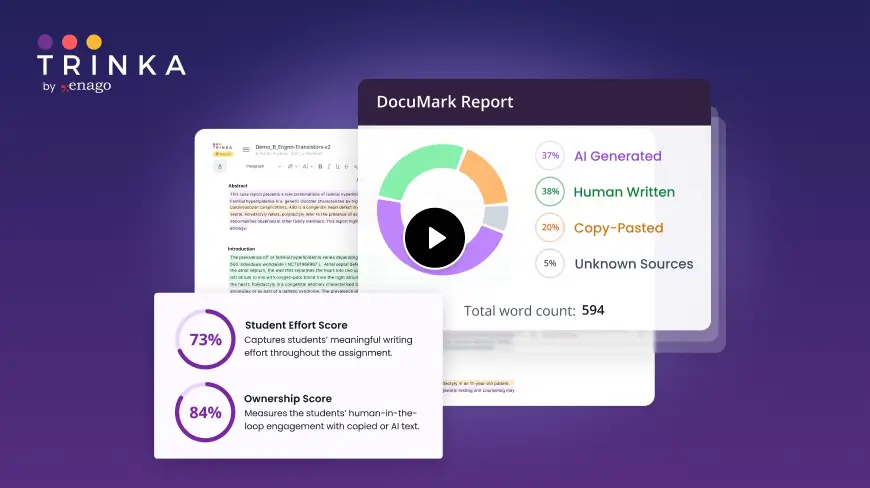
DocuMark: Responsible AI Use for Academic Integrity
Knowing your institution's AI policy is step one. DocuMark helps enforce it fairly by empowering universities to manage AI-generated content, prevent cheating, and support student writing through responsible AI use.
Common Questions About Dartmouth College's AI Policies
Dartmouth College has defined AI policies in 12 of 12 categories, with an overall coverage score of 100%.
Disclosure requirements are primarily defined by the course instructor under Dartmouth’s GenAI coursework guidelines. However, some schools have more explicit requirements: the Guarini School states that any use of generative AI tools in student academic work requires citation (with format guided by the instructor/advisor), and the Thayer School of Engineering requires students to be transparent and, if AI use is permitted by the instructor, to include a description of how AI tools were used. In all cases, submitting GenAI-generated work as one’s own without explicit authorization violates the Academic Honor Principle.
Unauthorized use of GenAI in coursework is handled as an academic integrity violation under Dartmouth’s Academic Honor Principle. While instructors may investigate suspected misuse, Dartmouth teaching guidance explicitly discourages using AI detection reports as “proof” of academic dishonesty because such tools are unreliable and can raise bias and privacy concerns.
Dartmouth's Data Sensitivity Guide for Generative AI is a key institutional policy governing data protection when using AI tools. It states that generative AI models that are not Dartmouth-approved or contracted may only be used with Public data, and that Internal, Confidential, and Restricted Dartmouth data may only be used with a Dartmouth-approved platform (following any specific use-case guidance). This effectively forbids entering internal/confidential/restricted data (including categories like PII/PHI and student records) into public/consumer generative AI services. Dartmouth also maintains a tools page listing Dartmouth-supported generative AI tools.