Teaching & Learning
- Use of AI for graded coursework is at instructor discretion
- Faculty set AI rules for each class, course, or assignment, and students must follow the syllabus and instructor guidance rather than assuming college-provided AI tools are automatically allowed
Faculty individually set the policy for acceptable use of AI in their classes, if any, on a course-by-course and/or assignment-by-assignment basis. Students should consult the course syllabus and the instructor for guidance on permissible uses of AI.
Davidson may provide AI tools accessible to all students to ensure equitable access to technology for all students. The availability of an AI tool from the college does not correspond to permission to use the capabilities of that tool in a particular course.
- Faculty set rules for each course or assignment, students must follow syllabus guidance, and violations may be referred to the Honor Council
- Davidson does not publish a separate examination-specific AI policy, but its general AI policy places academic assessment contexts under faculty discretion
Faculty individually set the policy for acceptable use of AI in their classes, if any, on a course-by-course and/or assignment-by-assignment basis. Students should consult the course syllabus and the instructor for guidance on permissible uses of AI.
Violations of this policy may be handled as with any matter of academic integrity, including but not limited to referral to the Honor Council.
- Davidson also provides institutionally available AI tools for students, but access does not itself grant permission to use them in a class
- The university states generally that AI may help with learning and routine work, but permitted student use in academic contexts still depends on faculty rules for the specific course or assignment
As with any tool, when used properly, generative AI may help you learn and accomplish routine work, including writing and summarizing documents, analyzing data, developing websites and presentations and writing code.
Faculty individually set the policy for acceptable use of AI in their classes, if any, on a course-by-course and/or assignment-by-assignment basis. Students should consult the course syllabus and the instructor for guidance on permissible uses of AI.
Davidson may provide AI tools accessible to all students to ensure equitable access to technology for all students. The availability of an AI tool from the college does not correspond to permission to use the capabilities of that tool in a particular course.
- Davidson acknowledges coding as a possible use of generative AI, but whether students may use AI for programming in coursework is left to faculty on a course-by-course or assignment-by-assignment basis
As with any tool, when used properly, generative AI may help you learn and accomplish routine work, including writing and summarizing documents, analyzing data, developing websites and presentations and writing code.
Faculty individually set the policy for acceptable use of AI in their classes, if any, on a course-by-course and/or assignment-by-assignment basis. Students should consult the course syllabus and the instructor for guidance on permissible uses of AI.
Research
- Davidson does not set a specific university-wide rule for using AI to draft or edit research manuscripts in the provided sources
- The AI policy states that faculty research use is governed by professional standards and guidelines issued by academic leadership, faculty governance, and professional societies
Faculty use of AI tools in their teaching, research and creative work is subject to professional standards and guidelines issued by the Vice President for Academic Affairs, faculty governance, and professional societies.
- Use of AI with research data is governed by Davidson's data-classification and approved-platform rules rather than a research-specific AI workflow rule
- Public data may be used in public or college-provided AI tools; Internal and Restricted data may only be used in college-provided or Davidson-approved AI tools while using Davidson credentials; Confidential data require explicit permission or review from T&I Information Security
Research data includes data relevant to funded or unfunded research activities where Davidson has an explicit or implicit requirement to ensure that data remain confidential and protected.
Public data may be uploaded to or analyzed in any publicly-available AI platform or any college provided AI platform.
Internal and Restricted data may only be uploaded to or analyzed in a college-provided AI platform, while logged into a Davidson account.
Confidential data may not be uploaded to or analyzed in any AI platform without review by Davidson’s Information Security Program Manager.
Only public data can be used in free AI tools. Davidson-owned data that are classified as Internal or Restricted may not be used in AI tools, unless that tool was approved and purchased by T&I, such as Gemini, Amplify, or a Davidson-paid ChatGPT/Claude license. Confidential data may not be used in any AI tool without explicit permission from T&I Information Security.
- The provided sources do not give AI-specific rules for grant proposals, IRB applications, or ethics declarations
- For research more broadly, Davidson applies its research misconduct policy to all research activities and states that faculty research use of AI is subject to professional standards and guidelines
Faculty use of AI tools in their teaching, research and creative work is subject to professional standards and guidelines issued by the Vice President for Academic Affairs, faculty governance, and professional societies.
This Policy applies to all Research activities proposed and conducted by academic, scientific, and professional staff, employees and faculty, emeritus faculty, and students of the College, whether or not they are externally funded and irrespective of the funding source, during their employment by or term of their contract with the College.
The College fosters a culture of research integrity and will:
1. Respond to Allegations of Research Misconduct promptly and fairly;
2. Protect the integrity of the Research Record;
Academic Integrity
- There is no university-wide student disclosure or citation requirement for AI use stated in the provided sources
- Instead, faculty are urged to include generative AI statements in syllabi, and students are directed to consult course-specific rules
Faculty individually set the policy for acceptable use of AI in their classes, if any, on a course-by-course and/or assignment-by-assignment basis. Students should consult the course syllabus and the instructor for guidance on permissible uses of AI.
Faculty are strongly urged to include a generative AI statement on their syllabi.
- Davidson states that violations of its AI academic-use policy may be treated as academic integrity matters and may be referred to the Honor Council
- The provided sources do not mention AI-detection tools or set a separate AI-specific enforcement process beyond existing academic integrity procedures
Violations of this policy may be handled as with any matter of academic integrity, including but not limited to referral to the Honor Council.
Institutional & Administrative
- Faculty use of AI in teaching, research, and creative work is governed by professional standards and guidelines, and faculty control AI rules in their own classes
- For staff and administrative uses, departments must review procurement of AI solutions with T&I, workplace uses that replace staff work must be reviewed with HR and IT leadership, and public-facing AI-generated content is governed by communications guidelines
Faculty use of AI tools in their teaching, research and creative work is subject to professional standards and guidelines issued by the Vice President for Academic Affairs, faculty governance, and professional societies.
Faculty individually set the policy for acceptable use of AI in their classes, if any, on a course-by-course and/or assignment-by-assignment basis.
As with all technology services and products, any college department or division wishing to procure a technology solution that provides or uses AI capabilities must review the request with T&I, and any technology agreements or contracts must be reviewed and approved by the Chief Information Officer and other college officials as required by the College Contract Policy.
Departments and divisions intending to use AI capabilities to perform work that would ordinarily be done by college staff should review their planned uses with the Chief Human Resources Officer (CHRO) and Chief Information Officer (CIO) for guidance before undertaking any such project.
For use cases where such AI technology would displace existing college staff, the CHRO and CIO will prepare a recommendation of the proposal for review by the President.
The use of AI to generate public-facing content such as websites, audio or video content, or other materials for public dissemination is governed by communications guidelines promulgated by College Communications and posted to the college’s Marketing Toolbox.
- Davidson has explicit data-protection rules for AI use based on data classification
- The college identifies approved or provided platforms including Amplify, Gemini, and Davidson-paid ChatGPT/Claude licenses, and employees and departments may not independently license AI tools without T&I approval
- Public data may be used in public or college-approved AI platforms; Internal and Restricted data may only be used in college-provided or Davidson-approved AI tools while logged into Davidson accounts; Confidential data may not be used without explicit approval or review from T&I Information Security
Davidson College data is organized into four data classifications by the Data Security Policy – Public, Internal, Restricted and Confidential.
Public data may be uploaded to or analyzed in any publicly-available AI platform or any college provided AI platform.
Internal and Restricted data may only be uploaded to or analyzed in a college-provided AI platform, while logged into a Davidson account.
Confidential data may not be uploaded to or analyzed in any AI platform without review by Davidson’s Information Security Program Manager.
At the time of this policy, the provided platforms are:
* Amplify (pro-level ChatGPT and Claude) - amplify.davidson.edu
* Google Gemini - gemini.google.com
* College-provided ChatGPT Pro and Claude Pro licenses
A college-provided license is one granted via centralized purchasing processes administered by T&I. A license procured in any other way, even if it is purchased with college funds, is not, for the purposes of this policy, college-provided. Individual employees and departments should not license their own AI tools without approval from T&I.
Only public data can be used in free AI tools. Davidson-owned data that are classified as Internal or Restricted may not be used in AI tools, unless that tool was approved and purchased by T&I, such as Gemini, Amplify, or a Davidson-paid ChatGPT/Claude license. Confidential data may not be used in any AI tool without explicit permission from T&I Information Security.
Amplify is built for higher-ed by higher-ed, and allows for access to Claude and ChatGPT models with the same appropriate data protections for most types of Davidson data. Public, internal, or restricted data may be used in Amplify.
Confidential data may not be used without explicit permission from T&I Information Security.
- Davidson states that faculty, staff, and students are working together to use AI responsibly across teaching, learning, research, and administration
- Governance responsibilities are assigned: the CIO reviews the AI policy every six months, the VPAA with faculty governance input is responsible for academic AI policy, and the senior leadership team concurs on administrative and community-wide AI policies
At Davidson, faculty, staff and students work together to make sure artificial intelligence is used responsibly in teaching, learning, research and administrative work.
The Chief Information Officer is responsible for ensuring that this policy is reviewed every six months. The Vice President of Academic Affairs (VPAA), with input from the governing bodies of the faculty, is responsible for college policies on academic uses of AI. The college senior leadership team (SLT) is responsible for concurring on policies governing administrative and community-wide uses of AI.
Due to the rapid evolution of AI, Davidson community members should consult their dean, vice president or division head for guidance over questions of acceptable uses of AI if this policy does not address them.
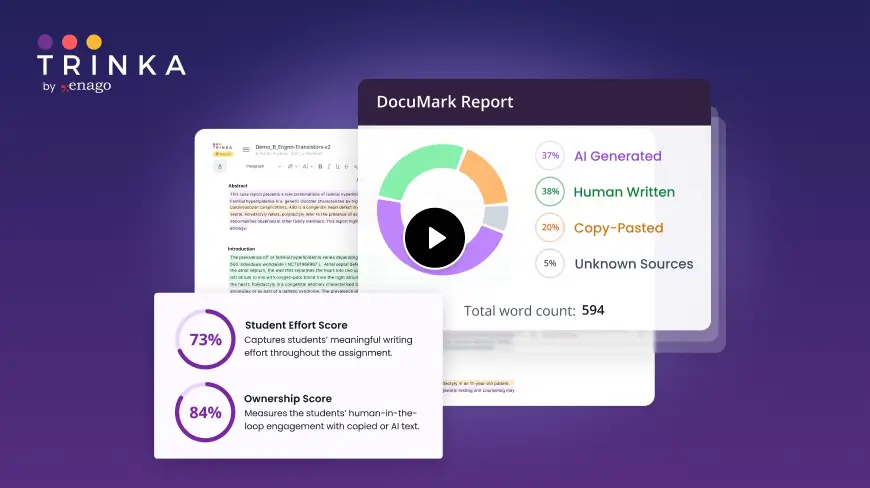
DocuMark: Responsible AI Use for Academic Integrity
Knowing your institution's AI policy is step one. DocuMark helps enforce it fairly by empowering universities to manage AI-generated content, prevent cheating, and support student writing through responsible AI use.
Common Questions About Davidson College's AI Policies
Davidson College has defined AI policies in 12 of 12 categories, with an overall coverage score of 100%.
There is no university-wide student disclosure or citation requirement for AI use stated in the provided sources. Instead, faculty are urged to include generative AI statements in syllabi, and students are directed to consult course-specific rules.
Davidson states that violations of its AI academic-use policy may be treated as academic integrity matters and may be referred to the Honor Council. The provided sources do not mention AI-detection tools or set a separate AI-specific enforcement process beyond existing academic integrity procedures.
Davidson has explicit data-protection rules for AI use based on data classification. Public data may be used in public or college-approved AI platforms; Internal and Restricted data may only be used in college-provided or Davidson-approved AI tools while logged into Davidson accounts; Confidential data may not be used without explicit approval or review from T&I Information Security. The college identifies approved or provided platforms including Amplify, Gemini, and Davidson-paid ChatGPT/Claude licenses, and employees and departments may not independently license AI tools without T&I approval.