Teaching & Learning
- Use of AI in academic work is governed by academic integrity rules rather than a single blanket permission or prohibition
- Students are directed to the Academic Handbook for guidance, and individual faculty are expected to state their course policies while students are expected to seek clarification
Adherence to policies on academic integrity is mandatory. Faculty and students should refer to the Academic Handbook , respectively, for guidelines on using AI tools in academic work and research.
Faculty should clearly communicate their policies on the use of AI tools, and students should seek clarification as needed.
- DePauw encourages AI literacy and supports responsible experimentation with AI tools
- The university presents AI resources for students, faculty, and staff to build understanding and technical skills, but it does not set a specific standalone rule for personal study assistance
DePauw University supports responsible experimentation with AI tools while recognizing important considerations around information security, data privacy, compliance, copyright, and academic integrity. These guidelines leverage and extend existing University policies to address the unique aspects of AI use across campus. Users are encouraged to stay informed and exercise responsible judgment when utilizing these tools.
The primary goal of these pages is to provide DePauw students, faculty and staff with resources related to improving their understanding and technical skills related to modern AI.
- Use in academic work remains subject to academic integrity requirements and to faculty course policies
- The university recognizes code as a type of AI-generated content, but it does not provide a separate programming-specific rule
This includes AI tools that create new content (text, images, music, videos, code) based on user prompts, as well as AI systems that analyze, organize, or assist with various tasks such as calendar scheduling, data analysis, research assistance, and decision support.
Adherence to policies on academic integrity is mandatory. Faculty and students should refer to the Academic Handbook , respectively, for guidelines on using AI tools in academic work and research.
Faculty should clearly communicate their policies on the use of AI tools, and students should seek clarification as needed.
Research
- AI use in research writing is governed through general research and academic integrity expectations rather than a manuscript-specific rule
- Users are responsible for reviewing and verifying AI-generated content, should clearly identify significant AI assistance, and should consult the Academic Handbook for guidance on AI in research
Users are responsible for any AI-generated content they produce or publish. This content can sometimes be inaccurate or contain copyrighted material. It's crucial to review and verify AI-generated content before its publication or use.
Clearly identify when content has been AI-generated or when AI significantly assisted your work.
Adherence to policies on academic integrity is mandatory. Faculty and students should refer to the Academic Handbook , respectively, for guidelines on using AI tools in academic work and research.
- AI may be used for tasks such as data analysis, but research data use is constrained by university data-classification rules
- Private or Restricted data, including research data covered by confidentiality agreements or IRB restrictions, must not be entered into AI tools unless the university has identified those tools as acceptable
This includes AI tools that create new content (text, images, music, videos, code) based on user prompts, as well as AI systems that analyze, organize, or assist with various tasks such as calendar scheduling, data analysis, research assistance, and decision support.
Institutional data usage is subject to the University’s Data Classification policy and any other applicable policies, regulations, or existing contractual agreements.
In line with DePauw’s Data Classification policy , any data classified as Private or Restricted should not be input into AI tools that have not been identified as acceptable for such use by the University. This includes, but is not limited to:
* Research data subject to confidentiality agreements or IRB restrictions
- Research-related AI use must still comply with data restrictions, including IRB-related confidentiality limits, and research is framed as requiring ethical conduct at all stages
- DePauw applies general academic integrity and responsible research expectations to AI use in research, but it does not provide a specific AI rule for grant proposals or IRB applications in the provided sources
Adherence to policies on academic integrity is mandatory. Faculty and students should refer to the Academic Handbook , respectively, for guidelines on using AI tools in academic work and research.
In line with DePauw’s Data Classification policy , any data classified as Private or Restricted should not be input into AI tools that have not been identified as acceptable for such use by the University. This includes, but is not limited to:
* Research data subject to confidentiality agreements or IRB restrictions
Ethical considerations take place at all stages of pursuing a scholarly project, from developing a question, to collecting and analyzing data, to sharing the final project. Regardless of the discipline or type of project, it is important to familiarize yourself with what it means to conduct research in a responsible and ethical manner.
Academic Integrity
- The university requires transparency about AI-generated or AI-assisted work
- DePauw states that users should clearly identify when content has been AI-generated or significantly assisted by AI, but the provided sources do not supply a detailed citation format for AI tools
Clearly identify when content has been AI-generated or when AI significantly assisted your work.
- The university instead directs faculty and students to existing academic integrity rules and course-level policies
- DePauw makes compliance with academic integrity policies mandatory, but the provided sources do not define AI-detection tools or AI-specific enforcement procedures
Adherence to policies on academic integrity is mandatory. Faculty and students should refer to the Academic Handbook , respectively, for guidelines on using AI tools in academic work and research.
Faculty should clearly communicate their policies on the use of AI tools, and students should seek clarification as needed.
Institutional & Administrative
- Faculty and staff are included in the university's AI resources and may experiment with AI responsibly, subject to existing university policies
- Faculty are specifically expected to communicate their AI-use policies to students, and faculty/staff use must comply with data protection, academic integrity, and procurement guidance
DePauw University supports responsible experimentation with AI tools while recognizing important considerations around information security, data privacy, compliance, copyright, and academic integrity.
Faculty should clearly communicate their policies on the use of AI tools, and students should seek clarification as needed.
The primary goal of these pages is to provide DePauw students, faculty and staff with resources related to improving their understanding and technical skills related to modern AI.
Faculty and staff are encouraged to peruse the site for use cases, learning activities, inspiration and/or to find potential collaborators.
- DePauw applies its data-classification policy to AI use and prohibits entry of Private or Restricted data into AI tools unless the university has identified the tool as acceptable for that use
- The policy specifically names student records, employee records, financial data, confidential or IRB-restricted research data, health information, legal documents, and donor information, and it instructs users to verify what embedded AI features can access in university-connected systems
Institutional data usage is subject to the University’s Data Classification policy and any other applicable policies, regulations, or existing contractual agreements.
In line with DePauw’s Data Classification policy , any data classified as Private or Restricted should not be input into AI tools that have not been identified as acceptable for such use by the University. This includes, but is not limited to:
* Student records (FERPA) and personally identifiable information (PII)
* Employee personal information (PII) and HR records, including faculty review files
* Financial data and payment information
* Research data subject to confidentiality agreements or IRB restrictions
* Medical or health information (HIPAA)
* Legal documents, contracts, and privileged communications
* Donor information and advancement records
Many AI tools operate within systems that already have access to University data (such as calendars, email, or learning management systems). When using AI features in these platforms, verify what data the AI component can access and how it processes that information and ensure the AI functionality complies with existing data use agreements.
Consult with Information Services if you have questions about or are considering procurement of a new AI tool. They aim to help you accomplish your goals while keeping DePauw’s data safe.
- DePauw has an institution-wide AI vision centered on human-centered, responsible, and transparent adoption aligned with its liberal arts mission
- The university states that it will regularly assess AI across curriculum and operations, and its AI resources are curated by the Tenzer Technology Center with contributions from other campus offices
DePauw University is fully committed to thoughtfully incorporating human-centered use of artificial intelligence (AI) as an emerging and evolving part of how we educate, operate and lead in service to our liberal arts mission, creating more space for personal connection. Our graduates will leave DePauw as critical, creative and capable individuals, fully equipped with AI literacy and supported in pursuing AI fluency.
We will employ AI responsibly and transparently across the institution, attending to its financial, social and environmental costs. We also commit to regularly assessing AI, as we do with other elements of our curriculum and operations.
This working vision will evolve as technologies change and as debates around the technology's utility continue to develop.
These AI resources are curated by the Tenzer Technology Center at DePauw University with important contributions from other campus offices as well as DePauw alumni.
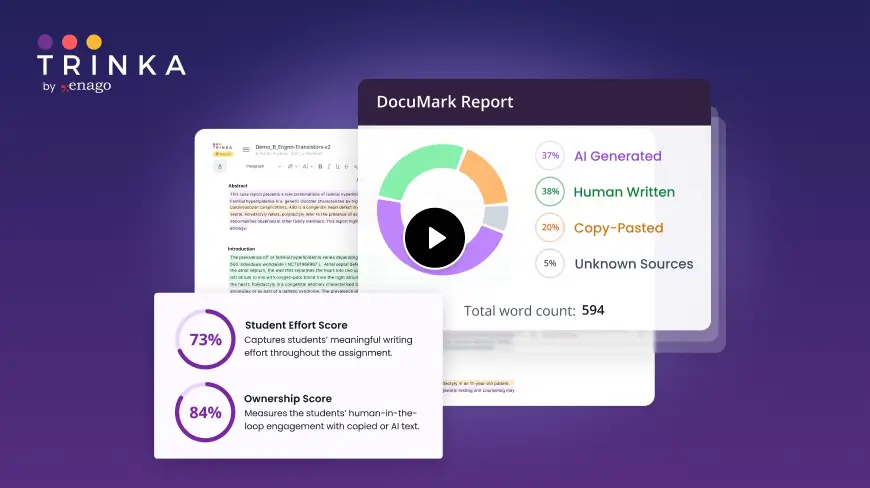
DocuMark: Responsible AI Use for Academic Integrity
Knowing your institution's AI policy is step one. DocuMark helps enforce it fairly by empowering universities to manage AI-generated content, prevent cheating, and support student writing through responsible AI use.
Common Questions About DePauw University's AI Policies
DePauw University has defined AI policies in 11 of 12 categories, with an overall coverage score of 92%.
The university requires transparency about AI-generated or AI-assisted work. DePauw states that users should clearly identify when content has been AI-generated or significantly assisted by AI, but the provided sources do not supply a detailed citation format for AI tools.
DePauw makes compliance with academic integrity policies mandatory, but the provided sources do not define AI-detection tools or AI-specific enforcement procedures. The university instead directs faculty and students to existing academic integrity rules and course-level policies.
DePauw applies its data-classification policy to AI use and prohibits entry of Private or Restricted data into AI tools unless the university has identified the tool as acceptable for that use. The policy specifically names student records, employee records, financial data, confidential or IRB-restricted research data, health information, legal documents, and donor information, and it instructs users to verify what embedded AI features can access in university-connected systems.