Teaching & Learning
- Dickinson states that faculty set course-level rules, and those rules can range from full incorporation to complete prohibition
- Use of generative AI for coursework and graded assignments is prohibited unless the professor explicitly permits it in the syllabus or other course documents
Unless it is expressly permitted by your professor, articulated through the syllabus or other course documents, it is unacceptable for students to use generative AI tools on assignments or exams. Without this explicit permission, use of these tools constitutes a violation of Dickinson’s academic misconduct policy.
Faculty and staff are empowered to decide for themselves which of their learning outcomes are furthered by the use of AI tools, and which are not – this is essential to academic freedom. They must also safeguard academic integrity by writing syllabus statements that are clear about what they consider to be appropriate use, and what constitutes misuse.
Wherever you fall on the continuum between wholehearted incorporation or complete prohibition of the use of GenerativeAI, it is incumbent upon faculty to make the parameters of appropriate use clear in their syllabi and assignments.
- Unapproved AI assistance on examinations and quizzes is treated as cheating under the academic misconduct policy
- Use of generative AI on exams, quizzes, and similar assessments is prohibited unless the professor expressly permits it
Unless it is expressly permitted by your professor, articulated through the syllabus or other course documents, it is unacceptable for students to use generative AI tools on assignments or exams. Without this explicit permission, use of these tools constitutes a violation of Dickinson’s academic misconduct policy.
• Cheating: assistance of GenAI on examinations and quizzes, and/or prohibitive use of GenAI on graded assignments.
Students are encouraged to discuss with their professors whether any use of translation or artificial intelligence tools is appropriate for a specific assignment or exam.
- This reflects staff guidance rather than a formal institutional policy
- Dickinson's Academic Technology staff guidance recognizes that some AI use may be appropriate as a learning aid outside graded work, such as tutoring, planning, and practice scenarios
- Faculty are encouraged to distinguish between prohibited assignment use and such productive support uses, and Academic Technology staff are available to assist students with these non-assignment uses
Some students may use GAI as a learning aid and in ways that are not dishonest or in violation of the academic integrity policy. For example, they might use GAI as a subject tutor or as an assistant for planning their day-to-day schedule. Many students with disabilities may find GAI is very useful to help them overcome the barriers to their living and learning.
Academic Technology staff are also prepared to assist your students with productive uses of GAI that you might not be aware of and are not directly related to course assignments or projects. Please let us know if you'd like us to teach these uses to your class or you could refer individuals to us. Examples include, but are not limited to:
* Plan a group project
* Make a daily calendar to assist with time management (allotting time to study, eat, socialize, etc.)
* Create custom learning scenarios like case studies or role-plays to help with concepts they're struggling with or would like to engage with more deeply.
- Dickinson does not set a uniform college-wide rule specifically for AI code generation in programming assignments
- Instead, faculty may decide course-level AI policies, and institutional guidance notes AI may be used for "code" in courses where instructors choose to integrate it
Because faculty have different opinions about the utility of GAIs, there is no single policy that works for every instructor of every course.
The Academic Technology Department is prepared to assist faculty who are interested in integrating AI into their assignments or courses. Examples may include AI for simulations, feedback, brainstorming, or explanations of text and code. Please contact your Academic Technology department liaison or James D’Annibale directly if you’d like help.
Faculty and staff are empowered to decide for themselves which of their learning outcomes are furthered by the use of AI tools, and which are not – this is essential to academic freedom.
Research
- The college has not yet issued a substantive faculty research-writing policy in these sources
- The provost states that the Faculty Personnel Committee should develop guidance on AI use in faculty scholarly and creative production during academic year 2025-26
The Faculty Personnel Committee is responsible for evaluating faculty at times of tenure, promotion, biennial and senior review. The committee should, through the course of academic year 25/26, work to develop a statement of guidance related to the uses of AI technologies in scholarly and creative production by faculty.
- Specific research ethics AI guidance remains to be developed
- Dickinson has not issued a dedicated policy on AI use in research ethics and integrity contexts
- However, the provost's statement notes that the Faculty Personnel Committee should develop guidance on AI use in scholarly and creative production during AY 2025-26, and the broader academic misconduct framework applies to integrity in all academic work
The Faculty Personnel Committee is responsible for evaluating faculty at times of tenure, promotion, biennial and senior review. The committee should, through the course of academic year 25/26, work to develop a statement of guidance related to the uses of AI technologies in scholarly and creative production by faculty.
There is not a one-size fits-all approach to these tools. But, any approach to generative artificial intelligence from academic affairs at the college must balance two imperatives: the protection of academic freedom and the protection of academic integrity.
Academic Integrity
- Disclosure of AI use is course-dependent but may be required when AI is allowed, and failure to disclose can constitute plagiarism
- Dickinson’s guidance for faculty also recommends building acknowledgements into syllabus policies and endorses a resource on citing AI sources
• Plagiarism: using the work created by GenAI, in part or in whole, and claiming it as your own, and/or failure to properly disclose use of GenAI.
When GenAI use is allowed, professors may require that students disclose the nature and extent of use.
* If allowing any GAI use, explain responsible use, acknowledgements, etc.
I wholeheartedly endorse the following documents, created by James D’Annibale in consultation with multiple campus partners, to assist you in making decisions about AI and your courses:
Citing AI sources
- No institutional AI detection software policy is defined in the available sources
- Undisclosed or impermissible AI use is enforceable as academic misconduct under Dickinson's Community Standards
- The policy categorizes impermissible AI use as its own form of academic misconduct that may incorporate cheating or plagiarism, with sanctions including a failing grade, course failure, or suspension
Without this explicit permission, use of these tools constitutes a violation of Dickinson's academic misconduct policy.
Impermissible use of GenAI is its own form of academic misconduct. Depending on the design of the assignment within the context of the course, it may incorporate one or more related violations:
In practical terms, this means that cheating and plagiarizing the work of others is prohibited and that anyone who is accused of such may be penalized with a failing grade for the assignment in question, an F for the course, suspension, or other consequences.
In addition to updating the practices and policies through which faculty might resolve academic integrity charges, the policy also now contains a section specific to the misuse of GenAI.
Institutional & Administrative
- The provost also recognizes legitimate AI use by Academic Affairs offices outside classrooms and scholarly work and calls for support and development around that use
- Faculty and staff are empowered to decide how AI fits their teaching and learning outcomes, but they must clearly communicate allowed and prohibited uses through syllabus statements
Faculty and staff are empowered to decide for themselves which of their learning outcomes are furthered by the use of AI tools, and which aren’t. This is essential to academic freedom. They must also safeguard academic integrity by writing syllabus statements that are clear about what they consider to be appropriate use, and what constitutes misuse.
The use of Generative AI technologies occurs throughout offices within Academic Affairs, apart from the classroom, and apart from scholarly and creative production. We must recognize the diversity of this legitimate use, seek to understand the impact of AI on those campus units, and offer development and opportunities for learning, related to that use.
Faculty may adopt one of these statements as-is, adapt parts of several, or use them as inspiration to craft their own. The intention is not to present “correct” policies, but to support clear, intentional, and transparent communication with students about AI use.
- No explicit institutional data protection or approved AI platforms policy has been confirmed in the reviewed sources
- However, Dickinson's Technology Services maintains a technology policies page that may contain relevant guidance and should be reviewed for any AI platform approval or data protection requirements
not defined
- The provost’s statement also points readers to reports from the Presidential Working Group on Artificial Intelligence and its subcommittees
- Dickinson has an institution-level AI governance and strategy posture centered on Academic Affairs: it emphasizes balancing academic freedom with academic integrity, preparing students to graduate as AI-fluent citizens, and directing departments to build structured curricular conversations about where AI learning belongs
I urge faculty and staff to consult, in addition to this statement and the links embedded within it, the several reports created by the Presidential Working Group on Artificial Intelligence, and the subcommittees of that body.
There is not a one-size fits-all approach to these tools. But, any approach to generative artificial intelligence from academic affairs at the college must balance two imperatives: the protection of academic freedom and the protection of academic integrity.
We cannot ignore the fact that our students will leave the college to enter careers and live lives that are impacted by these technologies. We must ensure that they leave Dickinson as AI-fluent global citizens, having engaged these technologies through a liberal arts curriculum.
Each academic department should, beginning in academic year 25/26, have ongoing and structured conversations about the curricula of the majors and minors provided by its faculty, and a collective conversation about where, in those curricula, AI learning should be incorporated.
DocuMark: Responsible AI Use for Academic Integrity
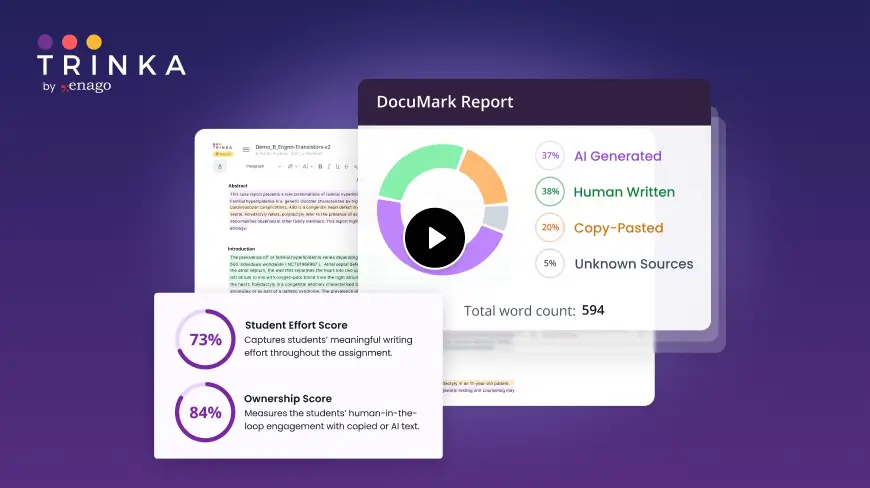
Knowing your institution's AI policy is step one. DocuMark helps enforce it fairly by empowering universities to manage AI-generated content, prevent cheating, and support student writing through responsible AI use.
Common Questions About Dickinson College's AI Policies
Dickinson College has defined AI policies in 11 of 12 categories, with an overall coverage score of 92%.
Disclosure of AI use is course-dependent but may be required when AI is allowed, and failure to disclose can constitute plagiarism. Dickinson’s guidance for faculty also recommends building acknowledgements into syllabus policies and endorses a resource on citing AI sources.
Undisclosed or impermissible AI use is enforceable as academic misconduct under Dickinson's Community Standards. The policy categorizes impermissible AI use as its own form of academic misconduct that may incorporate cheating or plagiarism, with sanctions including a failing grade, course failure, or suspension. No institutional AI detection software policy is defined in the available sources.
No explicit institutional data protection or approved AI platforms policy has been confirmed in the reviewed sources. However, Dickinson's Technology Services maintains a technology policies page that may contain relevant guidance and should be reviewed for any AI platform approval or data protection requirements.