Teaching & Learning
- Where AI is allowed, students are expected not to rely solely on AI-generated material and to take responsibility for any content they use
- In the Zimpleman College of Business, student use of AI for coursework and assignments is at instructor discretion and depends on faculty policies
- Students must consult faculty, and using AI without permission or outside course policies is treated as a violation of the college's academic integrity policy
• The use of AI tools for course work or assignments will depend on faculty policies.
• Faculty policies on the use of AI for course work, assignments, or exams will vary.
• Students should consult with faculty regarding the appropriate use of AI tools for course work.
• Students who use AI tools for course work without faculty permission or without following course policies will be in violation of the Zimpleman Academic Integrity Policy.
• For course work where AI tools are permitted, students should not solely rely on AI generated material.
• Students are responsible for any content they use that includes AI-generated material.
- Faculty are advised to communicate expectations, include AI rules in syllabi or assignments, and design assessment methods with AI in mind
- In the Zimpleman College of Business, AI use in exams is not governed by a single university-wide rule in the provided sources; faculty policies may differ by course
• Faculty policies on the use of AI for course work, assignments, or exams will vary.
• Faculty are encouraged to use class time to communicate their expectations regarding allowing, or not allowing the use of AI tools for coursework.
• Faculty should include AI policies or expectations in their syllabi and/or on individual course assignments.
• Faculty should not rely on single-type assessment methods for a course (i.e., consider a mix of assessment methods).
• Faculty should evaluate assessment methods to consider the impact of AI tools.
- In the Zimpleman College of Business example syllabus policy, generative AI may be used as a support tool to enhance understanding and comprehension, rather than as a substitute for thinking
- Students are encouraged to use AI to support learning, but merely repeating AI-generated content without understanding is discouraged, and instructor guidance may further limit use for particular assignments
This course is designed to encourage original critical thinking. Generative AI tools may be utilized as a support tool for academic work in this course, provided that the following guidelines are adhered to:
• Understanding and Learning: The primary goal of assignments is to foster understanding and learning. Therefore, students are encouraged to use generative AI tools as a support mechanism to enhance their comprehension of course material. Merely regurgitating AI-generated content without understanding the underlying concepts is discouraged.
• Instructor Guidance: Students are encouraged to consult with the instructor regarding the appropriate use of generative AI tools for specific assignments. The instructor may provide additional guidance or limitations on the use of AI tools based on the nature of the assignment and learning objectives.
- For coursework generally, AI use depends on faculty permission and course policies, so coding use is addressed only through that broader instructor-discretion framework
- The provided Zimpleman College of Business AI guidance acknowledges that generative AI tools can generate or debug code, but it does not set a distinct programming-specific rule
Generative AI tools can be used to brainstorm ideas, summarize research, produce stories or essays, generate or debug code, write emails or resumes, among other things.
• The use of AI tools for course work or assignments will depend on faculty policies.
• Students who use AI tools for course work without faculty permission or without following course policies will be in violation of the Zimpleman Academic Integrity Policy.
Research
Academic Integrity
- In the Zimpleman College of Business, when AI use is permitted, students are expected to use proper attribution and citation practices
- The example syllabus policy is stronger: AI-assisted work must be cited, and students must clearly disclose which portions were generated or assisted by AI
• For course work where AI tools are permitted, students should not solely rely on AI generated material. Students who use AI tools should use proper attribution and citation practices (e.g., APA ChatGPT citation instructions) and should carefully review any AI-generated material as AI-generated content can be inaccurate, misleading, entirely fabricated (e.g., deepfakes), or may contain copyrighted material.
• Proper Citation: All work generated or assisted by generative AI tools must be appropriately cited. Citations should include the name of the AI tool used, its version (if applicable), and any other relevant information necessary for others to identify and access the tool.
• Transparency: Students must be transparent about the use of generative AI tools in their academic work. This includes clearly indicating which portions of their work were generated or assisted by AI.
• Academic Integrity: Utilizing generative AI tools does not exempt students from adhering to academic integrity standards. Plagiarism, including the submission of AI-generated content without proper citation, will not be tolerated and may result in disciplinary action.
- The guidance also says AI detection tools are not perfectly reliable and warns faculty to consider false positives
- Drake's academic complaints page states that academic integrity appeals are handled through the instructor's college or school
- In the Zimpleman College of Business, undisclosed or unauthorized AI use in coursework is treated as an academic integrity violation, and faculty are expected to plan for responding to suspected misuse and report assessment penalties immediately in writing to the Associate Dean of Student Affairs
• Students who use AI tools for course work without faculty permission or without following course policies will be in violation of the Zimpleman Academic Integrity Policy.
• Faculty should establish a step-by-step plan for how they will address suspected student misuse of AI tools per their course policies. For example, per the academic integrity policy, if an instructor assigns a penalty to an assessment related to academic integrity, the incident must be immediately reported in writing to the Associate Dean of Student Affairs. For more details see Zimpleman Academic Integrity Policy.
• Faculty should be aware that AI detection tools are not perfectly reliable for detecting academic integrity issues and need to consider the risk of false positives.
Appeals related to academic integrity violation (e.g., plagiarism) must be submitted through the instructor's college or school.
Institutional & Administrative
- The provided Zimpleman College of Business guidance gives faculty recommendations for course-related AI use rather than mandatory institution-wide rules
- Faculty are encouraged to communicate expectations, include AI policies in syllabi or assignments, promote critical thinking, review assessment methods for AI impact, avoid overreliance on detection tools, and revisit course policies as AI evolves
• Faculty are encouraged to use class time to communicate their expectations regarding allowing, or not allowing the use of AI tools for coursework.
• Faculty should include AI policies or expectations in their syllabi and/or on individual course assignments.
• Faculty should encourage critical thinking ensuring that students do not become overly reliant on AI tools for learning.
• Faculty should not rely on single-type assessment methods for a course (i.e., consider a mix of assessment methods).
• Faculty should evaluate assessment methods to consider the impact of AI tools. For example, faculty should enter assignment prompts into AI tools to see the results to validate that assessment method is sound.
• Faculty should be aware that AI detection tools are not perfectly reliable for detecting academic integrity issues and need to consider the risk of false positives.
• Faculty are encouraged to regularly review AI course policies as new developments emerge.
- The available AI-related material is limited to local guidance and an event listing was provided but not available as source text here
- The provided sources show a college-level AI guidance document in the Zimpleman College of Business, but they do not define a university-wide AI governance framework, committee, or strategy
Zimpleman Artificial Intelligence Guidelines
With this background in mind, the Zimpleman College of Business has developed the following considerations for students and faculty for the ethical use of AI tools.
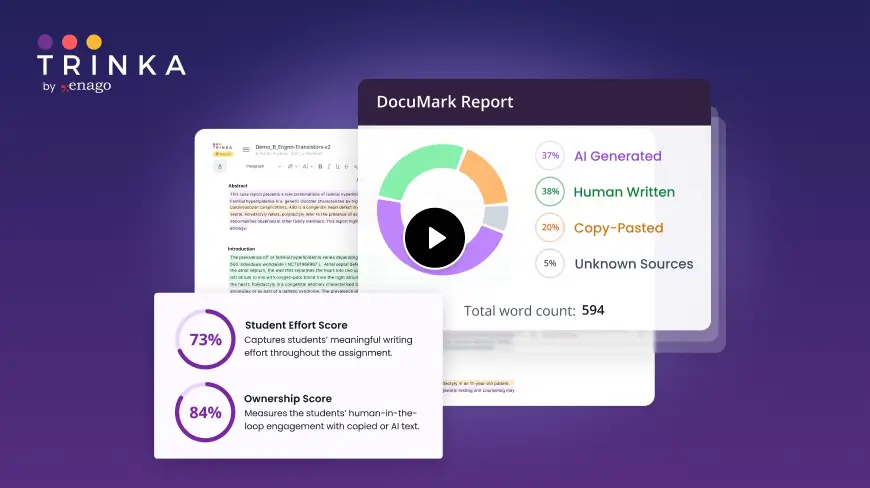
DocuMark: Responsible AI Use for Academic Integrity
Knowing your institution's AI policy is step one. DocuMark helps enforce it fairly by empowering universities to manage AI-generated content, prevent cheating, and support student writing through responsible AI use.
Common Questions About Drake University's AI Policies
Drake University has defined AI policies in 8 of 12 categories, with an overall coverage score of 67%.
In the Zimpleman College of Business, when AI use is permitted, students are expected to use proper attribution and citation practices. The example syllabus policy is stronger: AI-assisted work must be cited, and students must clearly disclose which portions were generated or assisted by AI.
In the Zimpleman College of Business, undisclosed or unauthorized AI use in coursework is treated as an academic integrity violation, and faculty are expected to plan for responding to suspected misuse and report assessment penalties immediately in writing to the Associate Dean of Student Affairs. The guidance also says AI detection tools are not perfectly reliable and warns faculty to consider false positives. Drake's academic complaints page states that academic integrity appeals are handled through the instructor's college or school.
No explicit data protection or approved AI platform policy is currently defined in the available policy sources.