Teaching & Learning
- AI use for graded coursework and assignments is governed by individual course/instructor rules
- Students are responsible for understanding what their instructor allows or prohibits for each assignment, and using AI in violation of course rules is treated as academic misconduct
Every course may have different rules about AI use.
If you're unsure, ask before using AI tools.
Drexel instructors are empowered to set their own GAI policies for every course.
If you are not sure about allowed/disallowed uses of GAI on a specific task, make sure to consult the syllabus and/or ask your instructor for clarification.
Using GAI in violation of course rules will count as academic misconduct.
- The Academic Integrity Policy treats use of unauthorized materials and unauthorized smart devices during examinations as academic misconduct
- The university does not define a uniform rule for AI use specifically during exams; instead, exam-related tool use depends on what is authorized
Using or processing specifically prepared materials during an examination such as (by example, not limitation) notes, formula lists, notes written on the students clothing, calculators, and/or smart devices that are not authorized.
- Students are also told to verify AI outputs and to follow course rules and disclosure requirements when applicable
- Drexel guidance encourages students to use AI to support learning (e.g., improving writing clarity, brainstorming, and organization) while emphasizing that AI should not replace student learning and that students remain responsible for what they submit
Use AI to support — not replace — your learning.
Improve Grammar, Spelling, and Clarity
Use AI tools to help polish your writing and improve readability. Review suggestions carefully and make the final edits yourself.
Brainstorm and Organize Ideas
AI can be especially helpful in the early stages of an assignment—generating ideas, outlining arguments, or organizing notes.
Review and Verify AI Output
Always check AI‑generated content for accuracy, bias, and relevance. Decide what to keep, revise, or discard.
Follow Course Rules and Disclose AI Use When Required
AI policies vary by course. Always follow your instructor’s guidance and disclose AI use if required.
- Drexel guidance warns students that AI-generated code may appear functional but can include bugs and vulnerabilities
- Drexel does not provide a single university-wide permission/prohibition rule specific to AI code generation in coursework; instead, AI use rules (including for programming tasks) are set at the course/instructor level
Drexel instructors are empowered to set their own GAI policies for every course.
AI-generated code might look functional but often contains bugs and security vulnerabilities.
Research
- Drexel guidance for staff indicates generative AI may be used to support data analysis only when the data is appropriate for use, and when working with institutional information, staff should use only de-identified data or Drexel-approved AI tools
Data Analysis (With Care)
Generative AI can support analysis when data is appropriate for use. When working with institutional information, use only de‑identified data or Drexel‑approved AI tools.
Academic Integrity
- If the instructor does not provide citation guidance, students should use the style typically used in the relevant discipline
- When AI tool usage is permitted by an instructor, students are obligated to follow the instructor’s instructions for how/if AI use must be attributed or cited
If usage of Artificial Intelligence Tools is permitted by the instructor, students are obligated to follow the instructor's guidance regarding if and how that usage is to be attributed/cited in the submitted work. If no attribution/citation guidance is given by the instructor, the students should adopt the style typically used in the discipline most closely aligned with the course.
- Drexel states that using generative AI in violation of course rules counts as academic misconduct
- The provided sources do not define any university position on AI detection tools (e.g., Turnitin AI detection) or describe specific AI-detection enforcement mechanisms
Using GAI in violation of course rules will count as academic misconduct.
Institutional & Administrative
- Drexel guidance for staff states that AI does not replace human judgment and that staff should always review and verify AI-generated content before sharing it
- The staff guidance also directs staff to avoid entering identifiable student/employee/confidential information into AI tools and to review and personalize AI-generated feedback before sharing
It's important to remember:
* AI does not replace human judgment
* Outputs may contain biases or inaccuracies
* Always review and verify before sharing AI-generated content
Remember: Avoid entering identifiable student, employee, or confidential information into AI tools. Always review and personalize AI‑generated feedback before sharing it.
- Drexel IT guidance states that university sensitive data must not be shared with consumer versions of GenAI services that have not been reviewed and approved for use
- Drexel also encourages use of university-licensed AI accounts for university-related work and states that protected health information should not be entered into ChatGPT Edu; staff/student guidance also warns against inputting private/sensitive data and PII unless explicitly permitted by policy
It is important for faculty and staff to be aware that any university sensitive data must not be shared with any of the consumer versions of these GenAI services that have not been reviewed and approved for use.
You are encouraged to use University-licensed AI accounts for University-related work so the protections in this enterprise agreement apply.
Please note that protected health information should not be entered into ChatGPT Edu.
Avoid submitting any private or sensitive data — such as credit card numbers, identification details, or addresses — to these platforms.
Do not input personally identifiable information (PII) into AI tools unless explicitly permitted by university policy.
- The AI site also states it was created to provide guidance on AI tools and policies and to define best practices for students, faculty, and professional staff
- Drexel identifies a Standing Committee on AI (SCAI) that provides recommendations related to AI, including exploring licensing agreements with trusted providers to provide secure and responsible AI access
To advance these efforts and more closely connect our community with this world-changing technology, the Standing Committee on AI (SCAI) provided recommendations and it was agreed we would explore licensing agreements with trusted providers.
The Artificial Intelligence site was created to provide guidance on Drexel University's AI tools and policies and to define best practices to assist students, faculty, and professional staff on their AI journey.
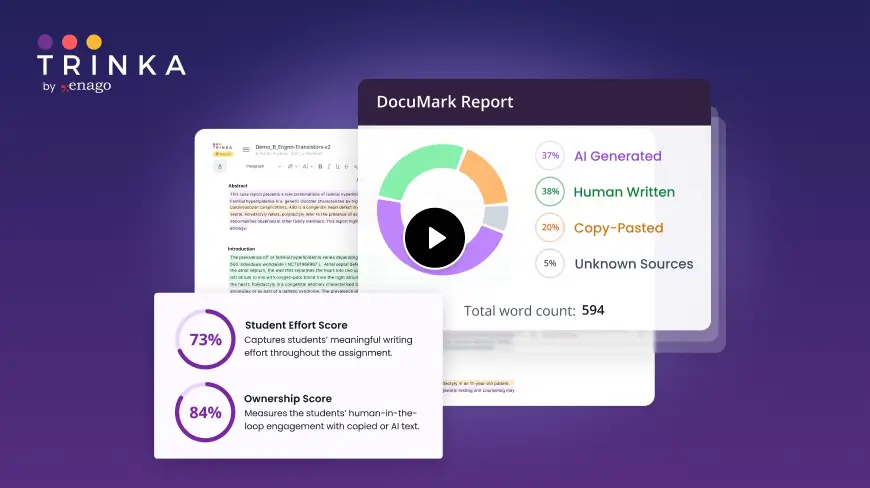
DocuMark: Responsible AI Use for Academic Integrity
Knowing your institution's AI policy is step one. DocuMark helps enforce it fairly by empowering universities to manage AI-generated content, prevent cheating, and support student writing through responsible AI use.
Common Questions About Drexel University's AI Policies
Drexel University has defined AI policies in 10 of 12 categories, with an overall coverage score of 83%.
When AI tool usage is permitted by an instructor, students are obligated to follow the instructor’s instructions for how/if AI use must be attributed or cited. If the instructor does not provide citation guidance, students should use the style typically used in the relevant discipline.
Drexel states that using generative AI in violation of course rules counts as academic misconduct. The provided sources do not define any university position on AI detection tools (e.g., Turnitin AI detection) or describe specific AI-detection enforcement mechanisms.
Drexel IT guidance states that university sensitive data must not be shared with consumer versions of GenAI services that have not been reviewed and approved for use. Drexel also encourages use of university-licensed AI accounts for university-related work and states that protected health information should not be entered into ChatGPT Edu; staff/student guidance also warns against inputting private/sensitive data and PII unless explicitly permitted by policy.