Teaching & Learning
- University-wide, Duke treats unauthorized use of generative AI as cheating under the Duke Community Standard, and instructors are given discretion to define when AI may be used in their courses
- At least one department (Classical Studies) prohibits generative AI use at any stage of conceiving, researching, or writing class assignments unless the instructor provides clear written and verbal permission; unauthorized use in that department is treated as plagiarism and a violation of the Community Standard
Under the Duke Community Standard, unauthorized use of generative AI is treated as cheating. This means you have the discretion to define how, if, and when generative AI may be used in your courses.
Because the indiscriminate use of generative AI conflicts with our goals of teaching and learning, the Department does not permit the use of generative AI for any stage of the conception, research, or writing of class assignments without the clear written and verbal permission of the instructor;
Unauthorized use of generative AI for such will be treated as plagiarism and a violation of Duke’s Community Standard. Each instructor’s class policies about AI use should be stated in the syllabus and clarified in class as needed.
- Duke’s Community Standard policy on academic dishonesty includes unauthorized use of AI software as an example of cheating
- The Classical Studies department also states generative AI is not permitted for assignments, examinations, or other assessed work without clear written and verbal instructor permission, and applies this to assessed work in its PhD and Bridge programs as well
using, consulting, and/or maintaining unauthorized shared resources including, but not limited to, test banks, solutions materials and/or unauthorized use of artificial intelligence (AI) software (spelling and grammar checkers are permissible unless stated otherwise by course instructor);
the Department also does not permit the use of generative AI to translate Greek or Latin texts for assignments, examinations, or other assessed work without the clear written and verbal permission of the instructor.
The same applies to all assessed work in the PhD and Bridge programs (e.g. class assignments, Qualifying and Preliminary Exams, Dissertation).
- Duke provides general guidance (via AI at Duke) encouraging students to engage creatively and think critically as AI evolves
- Duke’s teaching guidance notes that students can benefit from using AI as a tutoring aid, and frames AI use as something students should learn to use effectively (e.g., understanding how generative AI works and how to write effective prompts)
As the field of artificial intelligence evolves, Duke invites you to engage creatively, think critically, and shape the future of AI.
Students can benefit from using AI as a tutoring aid.
Students need to understand how generative AI works and the data behind it. They should also learn how to write effective prompts. The reality is it will be a part of their careers and everyday life so they should have the skills to use it correctly.
- Duke’s teaching guidance states AI can be used to debug code when used judiciously and emphasizes guiding students to use AI in ways that enhance learning rather than using AI-generated content as a shortcut
- The Classical Studies department policy also explicitly includes coding as an area where instructors may emphasize original work and prohibits generative AI use for class assignments without clear instructor permission (which would apply to any coding assignments in that department)
Used judiciously, AI can improve writing and debug code. The goal should be to guide students in using AI in ways that enhance their learning and writing, rather than relying on AI-generated content as a shortcut.
Instructors can emphasize why original writing (or coding or creativity) matters and what it means to develop your own voice and ideas.
Because the indiscriminate use of generative AI conflicts with our goals of teaching and learning, the Department does not permit the use of generative AI for any stage of the conception, research, or writing of class assignments without the clear written and verbal permission of the instructor;
Research
- Not defined
not defined
- Duke identifies “Research data” as an example under its Sensitive (High) data classification category
- Duke’s OIT guidance on AI assistants warns that sensitive information such as PHI and other research data discussed in meetings could be exposed and might be used to train AI systems, potentially leading to unintended data exposure
Sensitive (High)Sensitive data is the most restrictive data classification category and is reserved for data that Duke is either required by law to protect, or which Duke protects to mitigate institutional risk.
• Research data
Sensitive information, such as PHI and other research data, discussed in meetings could be exposed, and this data might be used to train AI systems, potentially leading to unintended data exposure.
- Duke’s AI at Duke initiative states that it aims to address ethical challenges posed by AI and provide information on using AI ethically and responsibly
- Duke’s teaching guidance also states that presenting AI-generated content as a student’s own work is inappropriate and that, when AI is allowed, AI content must be reviewed and verified before being incorporated into writing
Reflecting Duke University’s leadership in AI development, implementation, and research, the Provost has launched a collaborative strategic AI initiative designed to bring together Duke experts across all disciplines who are advancing AI research and applications, addressing the most pressing ethical challenges posed by AI, and shaping the future of AI in the classroom and our lives.
The AI at Duke website is a central hub for knowledge and resources in the rapidly evolving field of AI. It is designed to amplify AI initiatives and stories across Duke and provide information to the campus community on harnessing the power of AI in research, teaching and learning and using AI ethically and responsibly.
Students should be made aware of the ethical limitations of AI-generated content to help them understand why presenting it as their own work is inappropriate. If students are allowed to use AI, they need to understand how AI content must be reviewed and verified before incorporating it into their own writing.
Academic Integrity
- Separately, Duke’s Community Standard academic dishonesty policy states spelling and grammar checkers are permissible unless the course instructor states otherwise
- Duke’s teaching guidance includes sample syllabus language indicating that contributions from AI sources must be properly quoted and cited every time they are used, and encourages instructors to update syllabi with clear guidance on AI use
Sample syllabus language might be “Contributions from anyone or anything else in your writing—including AI sources—must be properly quoted and cited every time they are used.”
All instructors should update their syllabi to include clear guidance on the use of generative AI in their courses.
unauthorized use of artificial intelligence (AI) software (spelling and grammar checkers are permissible unless stated otherwise by course instructor);
- The Classical Studies department states unauthorized generative AI use will be treated as plagiarism and a violation of Duke’s Community Standard, and Duke’s Community Standard lists unauthorized AI use as a form of cheating
- Duke’s teaching guidance states it does not recommend using AI detection software; if instructors choose to use it, they should inform students in advance, and detection results should never be the sole evidence of academic dishonesty
Again, we do not recommend using detection software. However, if you choose to use these tools, you should inform students in advance. Detection results should never be the sole evidence of academic dishonesty.
Unauthorized use of generative AI for such will be treated as plagiarism and a violation of Duke’s Community Standard.
using, consulting, and/or maintaining unauthorized shared resources including, but not limited to, test banks, solutions materials and/or unauthorized use of artificial intelligence (AI) software (spelling and grammar checkers are permissible unless stated otherwise by course instructor);
Institutional & Administrative
- Duke’s CTL guidance recommends faculty clarify expectations for AI use and notes instructors have discretion in setting AI policies to fit their course and assignments
- Duke’s OIT AI assistant guidance recommends that meeting/class hosts notify attendees at the beginning of a meeting if an AI assistant will be used, and says it is crucial to review and edit AI-generated meeting summaries and recordings for accuracy, particularly when handling sensitive information
Informing Attendees: As a best practice, hosts should notify attendees at the beginning of a meeting if they plan to use an AI assistant, similar to how participants are informed when a meeting is being recorded.
It is crucial to review and edit AI-generated meeting summaries and recordings for accuracy, particularly when handling sensitive information.
We suggest that faculty clarify their expectations regarding the use of AI at the outset of their course. Instructors have discretion in setting specific AI policies to fit their course and individual assignments. There is no one-size-fits-all policy.
- Duke’s AI suite guidance also notes that neither ChatGPT nor DukeGPT is approved for sensitive data (e.g., PHI)
- Duke’s Data Classification Standard defines “Sensitive (High)” data as the most restrictive category and includes “Research data” as an example
- Duke provides institutionally supported AI platforms and differentiates between general-purpose and Duke-managed tools; DukeGPT is described as a secure, university-managed platform with maximum privacy and robust data protection, and it is explicitly not to be used with PHI
DukeGPT provides the Duke community with a secure, university-managed platform to explore and compare advanced AI models. Combining on-prem open-source options with cloud-based foundation models, it ensures maximum privacy and robust data protection, offering tailored resources and tools for learning, research, and productivity. Not to be used with PHI.
use ChatGPT for general, public tasks, and DukeGPT for anything tied to Duke or requiring extra privacy. Note neither tool is approved for sensitive data (e.g., PHI).
Sensitive (High)Sensitive data is the most restrictive data classification category and is reserved for data that Duke is either required by law to protect, or which Duke protects to mitigate institutional risk.
• Research data
- Duke also states it has an AI at Duke Steering Committee to identify Duke’s priorities around AI and develop infrastructure and communities of practice, and to develop recommendations guiding how Duke’s AI framework pillars are developed and applied across the university
- Duke states that the Provost launched a collaborative strategic AI initiative (“AI at Duke”) to bring together Duke experts across disciplines and address ethical challenges, shape AI in the classroom and beyond, and develop community, infrastructure, and strategic direction
Reflecting Duke University’s leadership in AI development, implementation, and research, the Provost has launched a collaborative strategic AI initiative designed to bring together Duke experts across all disciplines who are advancing AI research and applications, addressing the most pressing ethical challenges posed by AI, and shaping the future of AI in the classroom and our lives.
With the leadership of an interdisciplinary network of faculty and academic leaders, the growing initiative is developing community, infrastructure, and strategic direction for work with and on AI at Duke.
The AI at Duke steering committee is an interdisciplinary group of Duke faculty and experts working to identify Duke’s priorities around AI and develop critical infrastructure and communities of practice to drive Duke forward as a leader in the evolving field of artificial intelligence. Alongside pillar advisory and working groups, the steering committee will develop recommendations to guide and shape how AI at Duke’s four pillars are developed and applied across the university.
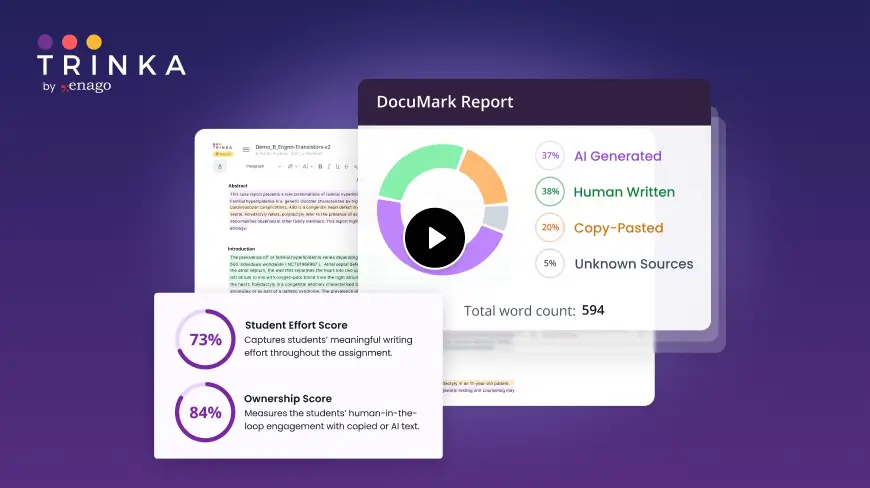
DocuMark: Responsible AI Use for Academic Integrity
Knowing your institution's AI policy is step one. DocuMark helps enforce it fairly by empowering universities to manage AI-generated content, prevent cheating, and support student writing through responsible AI use.
Common Questions About Duke University's AI Policies
Duke University has defined AI policies in 12 of 12 categories, with an overall coverage score of 100%.
Duke’s teaching guidance includes sample syllabus language indicating that contributions from AI sources must be properly quoted and cited every time they are used, and encourages instructors to update syllabi with clear guidance on AI use. Separately, Duke’s Community Standard academic dishonesty policy states spelling and grammar checkers are permissible unless the course instructor states otherwise.
Duke’s teaching guidance states it does not recommend using AI detection software; if instructors choose to use it, they should inform students in advance, and detection results should never be the sole evidence of academic dishonesty. The Classical Studies department states unauthorized generative AI use will be treated as plagiarism and a violation of Duke’s Community Standard, and Duke’s Community Standard lists unauthorized AI use as a form of cheating.
Duke provides institutionally supported AI platforms and differentiates between general-purpose and Duke-managed tools; DukeGPT is described as a secure, university-managed platform with maximum privacy and robust data protection, and it is explicitly not to be used with PHI. Duke’s AI suite guidance also notes that neither ChatGPT nor DukeGPT is approved for sensitive data (e.g., PHI). Duke’s Data Classification Standard defines “Sensitive (High)” data as the most restrictive category and includes “Research data” as an example.