Teaching & Learning
- Duquesne does not set a single university-wide rule for student AI use in coursework; faculty are strongly recommended to create course-level AI policies, and acceptable use may vary by school, department, course, and assignment
- The university’s teaching resources provide sample permissive, limited-use, and restrictive syllabus statements, and undisclosed AI use in coursework may be treated as an academic integrity violation when an instructor requires citation or prohibits such use
Faculty are strongly recommended to develop an AI policy that stipulates acceptable uses of AI within the context of their course, both for themselves and their students.
Course AI policies should be consistent with any existing school and departmental policies.
AI course policies should stipulate which types of tools are allowed in the course and in what capacity. For example, a course might allow editing and proofreading tools such as Grammarly but disallow ChatGPT and other text-generating tools.
The following are only recommendations, you are welcome to use them if you want but also encouraged to tailor them to your specific needs:
The use of generative AI tools is accepted in this class. Some assignments or in-class learning activities may even encourage or require it.
While I acknowledge that AI use is an important part of your education, the goals of this course emphasize other aspects of development and these AI tools create more barriers to these goals than they solve. That said, utilization of an AI service will be allowed in certain circumstances as designated per assignment or with my approval.
This course assumes that all work submitted by students will be generated by the students themselves, working individually or in groups. Students should not have another person/entity do the writing of any substantive portion of an assignment for them. This includes hiring a person or a company to write assignments as well as using artificial intelligence tools like Microsoft Co-pilot, ChatGPT, etc.
That said, utilization of an AI service to produce work without citing the use of that service may be treated as a violation of academic integrity.
Note that my approval still requires that you cite the use of AI tools, failure to do so will be treated as a violation of academic integrity.
- Instructor authorization is the deciding condition; the policy does not create a separate AI-specific exam rule beyond the broader ban on unauthorized assistance
- The university academic integrity policy prohibits AI or other computing tools during exams, quizzes, tests, or projects when they constitute unauthorized assistance or unauthorized material
Cheating on quizzes, tests, examinations, or projects may include giving, receiving, or using unauthorized assistance or material. Unauthorized material may include, but is not limited to, notes or other written documents as well as wireless communication or computing devices, calculators, formulas, computers, computer programs, software, data, or text.
- Duquesne’s teaching resources recommend AI as a possible support for non-graded learning activities such as study guides, outlining, tutoring, and interview practice
- At the same time, the university says faculty and student AI use should align with course learning objectives, so whether and how students may use AI for learning support can be shaped by course-level policies
Faculty and student AI use should align with the course’s stated learning objectives.
These are some general ideas to get you started on thinking about both how you can use AI in your teaching, and how students can use AI in their learning.
* Creating study guides/reading guides for students.
* Outlining for a project/paper/presentation.
* Function as an all-hours tutor.
* Role-play interviews.
* Require students to “teach” the AI about a subject.
- Duquesne does not define a separate university-wide rule for AI code generation in coursework
- Course-level policies may permit or restrict specific AI tools, and Duquesne’s AI guide identifies Copilot as a university AI tool that can assist with code completion, but no programming-assignment policy specific to students is stated
Faculty are strongly recommended to develop an AI policy that stipulates acceptable uses of AI within the context of their course, both for themselves and their students.
AI course policies should stipulate which types of tools are allowed in the course and in what capacity.
Copilot is a state-of-the-art AI assistant integrated into various applications to enhance productivity and efficiency. It provides intelligent suggestions, automates routine tasks, and assists in drafting documents or completing code, making it an invaluable tool for professionals and students alike.
* Intelligent Code Completion: Copilot can predict and suggest code snippets, helping developers write code faster and with fewer errors.
Research
- Sensitive or restricted data must not be used with unlicensed or uncontracted generative AI tools, and users are directed to avoid entering sensitive or confidential information into AI systems
- Duquesne provides data protection rules that apply when using AI with university data, including research-related data, but it does not define a separate policy on AI for research data analysis itself
Restricted Data may not be used in conjunction with any Generative AI tool that the University has not licensed and/or contracted for use. University approved generative AI tools will be listed at http://duq.edu/aiguide.
When utilizing AI tools, it's imperative to handle data responsibly. Avoid inputting sensitive or confidential information into these systems, as they may not guarantee complete data security.
- The undergraduate academic integrity policy also states that students must maintain integrity in research and writing projects
- Duquesne points users to university guidance on AI in research and gives general expectations around ethics, accuracy, privacy, and data protection, but it does not define specific rules for grant proposals, IRB applications, or research-ethics disclosures involving AI
For university guidance on using AI in teaching, learning, research, and administrative work, visit Artificial Intelligence at Duquesne.
Users of Generative AI must ensure that Computing Resources are safeguarded. In addition, users of Generative AI are responsible for the accuracy, privacy, regulatory compliance, and ethical use of content developed using Generative AI tools or services and used in campus communications and documentation including email.
Student responsibilities include maintaining academic integrity in all class assignments, examinations, research and/or writing projects, and any other academic endeavors related to their courses of study.
Academic Integrity
- Disclosure and citation requirements are primarily handled at the course level
- Faculty are strongly recommended to explain in course AI policies how to cite AI use and what counts as unacceptable use, and Duquesne’s sample syllabus statements require students to identify what AI generated, what tool was used, what prompt was used, and why AI was used; faculty who use AI in course materials, assignments, email correspondence, or assessment are also recommended or expected to disclose that use to students
Outline unacceptable uses of AI: This includes outlining how to cite AI use properly in the course and providing clear examples of policy violations.
If faculty intend to use AI to assist in developing course material or as a tool in course assignments or email correspondence, they should disclose this to students in their AI syllabus statement and go over the statement at the beginning of the course.
If AI is used to support student assessment in any capacity, faculty are strongly recommended to disclose its use to students verbally and include a statement in the course syllabus.
That said, utilization of an AI service to produce work without citing the use of that service may be treated as a violation of academic integrity.
If you utilize AI for any part of your assignments and/or in-class activities, you must specify:
* What specific content was generated by AI
* What AI tool was used
* What prompt was used to generate the AI content
* Both the prompt and original response from the AI tool must be provided (as a screenshot or PDF) in order for your use to be considered “cited” properly.
* Why the content was generated with AI
Note that my approval still requires that you cite the use of AI tools, failure to do so will be treated as a violation of academic integrity.
Do not hide the use of GenAI: if you are using a GenAI tool to take notes during a meeting, plan an event, write a memo, come up with case studies, develop learning activities, translate an article, assist in grading, etc., then it is unethical to not disclose this.
- Faculty are told to use AI detection tools cautiously because AI-generated work is difficult to identify and such tools may produce false positives or miss AI use
- Enforcement otherwise follows the university’s academic integrity process: faculty must investigate suspected violations and administer sanctions, and undisclosed or unauthorized AI use may be treated as a violation when it falls under unauthorized assistance or breaches an instructor’s AI policy
Faculty should exercise caution when using AI detection tools to review student assignments, as it is extremely difficult to identify AI-generated work. There may be instances where detection tools incorrectly attribute work to AI or fail to detect AI-generated work.
If faculty believe or suspect that academic integrity may have been violated, they must also play a central role in investigating and judging violations and administering sanctions.
Cheating on quizzes, tests, examinations, or projects may include giving, receiving, or using unauthorized assistance or material.
That said, utilization of an AI service to produce work without citing the use of that service may be treated as a violation of academic integrity.
Note that my approval still requires that you cite the use of AI tools, failure to do so will be treated as a violation of academic integrity.
Institutional & Administrative
- Duquesne provides preliminary faculty guidance rather than a single binding policy for all teaching uses
- Faculty are encouraged to disclose AI use in course materials and communications, remain responsible for the accuracy of AI-generated content, may not rely on AI as the sole means of student assessment, must retain holistic responsibility for evaluating students, and may use approved AI for administrative tasks such as email assistance while remaining fully responsible for the content and protecting confidential information
The Provost's Office, in collaboration with the faculty-based Artificial Intelligence Committee, created preliminary AI guidance for faculty on various topics related to their teaching duties. The guidance is intentionally broad, as AI may be used in vastly different ways across Duquesne's 10 schools and over 250 programs. Duquesne’s faculty are recommended to follow the guidelines below.
If faculty intend to use AI to assist in developing course material or as a tool in course assignments or email correspondence, they should disclose this to students in their AI syllabus statement and go over the statement at the beginning of the course.
Faculty should evaluate AI-generated content to verify it is factual, cited properly, and free of bias. In accordance with TAP 26, faculty maintain responsibility for ensuring the content they generate using AI tools is accurate.
AI tools should not be used as the only means of assessing students. If AI is used in student assessment, faculty remain fully responsible for holistically evaluating student performance.
Before using AI to assist in student assessment, faculty should consult with their department chair and abide by any existing school/department/program AI regulations and policies.
Faculty may use Duquesne-approved AI programs such as Microsoft Copilot to assist in email correspondence. While AI can assist in drafting email correspondences, TAP 26 stipulates that faculty maintain total responsibility for all content generated using AI tools.
Users of Generative AI must ensure that Computing Resources are safeguarded. In addition, users of Generative AI are responsible for the accuracy, privacy, regulatory compliance, and ethical use of content developed using Generative AI tools or services and used in campus communications and documentation including email.
- Duquesne requires the use of university-approved AI tools when confidential or restricted university data is involved
- Restricted data may not be used with generative AI tools unless the university has licensed or contracted for them, faculty are not permitted to use unapproved AI in student assessment, and unprotected third-party AI email tools are prohibited; Duquesne identifies Microsoft Copilot as an enterprise tool with data protections
While many AI tools are available, it is essential that faculty use Duquesne-approved tools when interacting with confidential or restricted data. Unlike other AI software, Duquesne-approved AI tools such as Microsoft Copilot have security protections for University data and intellectual property.
Restricted Data may not be used in conjunction with any Generative AI tool that the University has not licensed and/or contracted for use. University approved generative AI tools will be listed at http://duq.edu/aiguide.
Given the sensitivity and confidentiality of student assessment, faculty are not permitted to use AI programs in student assessment that have not been approved for use by the University.
Unprotected third-party AI software is prohibited from being used to read, respond or track emails on a Duquesne email account.
When utilizing AI tools, it's imperative to handle data responsibly. Avoid inputting sensitive or confidential information into these systems, as they may not guarantee complete data security.
Duquesne University also has an enterprised Generative AI software, Microsoft Copilot , which you can access with your multipass. Access to this enterprise solution means that data shared with Copilot through your Duquesne Account is protected and won't be utilized for training of the AI.
- Duquesne has an institution-level AI response framework tied to its strategic plan and developed through the Office of the Provost with a faculty-based Artificial Intelligence Committee and other campus groups
- The university describes AI integration as a gradual, collective effort, says the guidance will be updated regularly, and positions the Provost’s AI page as the central source for institutional principles, policies, and resources
In Duquesne University’s latest strategic plan, the University pledged to pursue the following imperative: “Duquesne will identify bold pathways to offer students the knowledge and skills they will need for productive and fulfilling lives and careers in the decades ahead.” To prepare students for the world beyond graduation, it is increasingly clear that Duquesne should explore ways to incorporate artificial intelligence in the teaching and learning process.
Over the past academic year, the Office of the Provost worked with Duquesne's faculty-based Artificial Intelligence Committee and other campus groups to develop the framework for the University’s response to artificial intelligence.
Integrating artificial intelligence tools at Duquesne will be a gradual and collective effort.
This page will be updated regularly to incorporate campus feedback and respond to new advancements in AI.
For university guidance on using AI in teaching, learning, research, and administrative work, visit Artificial Intelligence at Duquesne. The page outlines institutional principles and points you to relevant policies and campus resources maintained by the Provost’s Office.
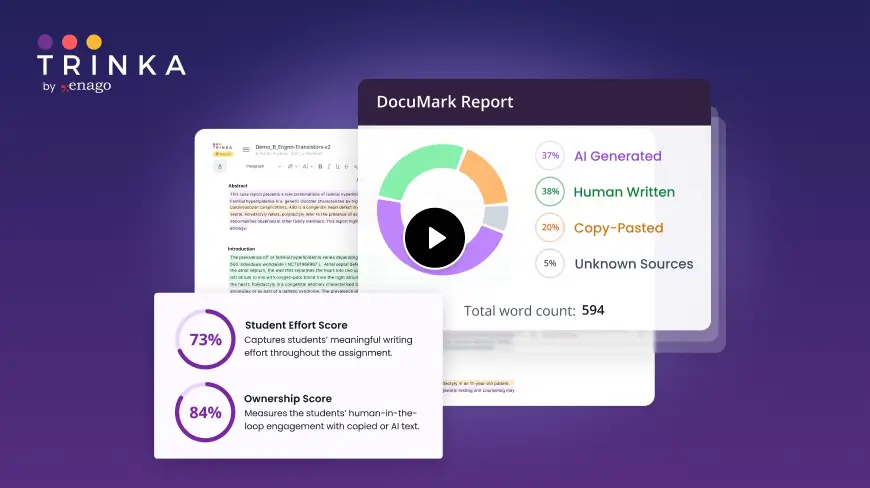
DocuMark: Responsible AI Use for Academic Integrity
Knowing your institution's AI policy is step one. DocuMark helps enforce it fairly by empowering universities to manage AI-generated content, prevent cheating, and support student writing through responsible AI use.
Common Questions About Duquesne University's AI Policies
Duquesne University has defined AI policies in 11 of 12 categories, with an overall coverage score of 92%.
Disclosure and citation requirements are primarily handled at the course level. Faculty are strongly recommended to explain in course AI policies how to cite AI use and what counts as unacceptable use, and Duquesne’s sample syllabus statements require students to identify what AI generated, what tool was used, what prompt was used, and why AI was used; faculty who use AI in course materials, assignments, email correspondence, or assessment are also recommended or expected to disclose that use to students.
Faculty are told to use AI detection tools cautiously because AI-generated work is difficult to identify and such tools may produce false positives or miss AI use. Enforcement otherwise follows the university’s academic integrity process: faculty must investigate suspected violations and administer sanctions, and undisclosed or unauthorized AI use may be treated as a violation when it falls under unauthorized assistance or breaches an instructor’s AI policy.
Duquesne requires the use of university-approved AI tools when confidential or restricted university data is involved. Restricted data may not be used with generative AI tools unless the university has licensed or contracted for them, faculty are not permitted to use unapproved AI in student assessment, and unprotected third-party AI email tools are prohibited; Duquesne identifies Microsoft Copilot as an enterprise tool with data protections.