Teaching & Learning
- Students may use generative AI in coursework only when it is explicitly permitted by the professor and only in accordance with the professor’s instructions
- Unauthorized use in assignments is treated as academic misconduct, and students remain responsible for verifying and critically assessing any AI-generated content they submit
The use of Generative AI by a student in assessed work can only be considered as a valid, if and only if the use is explicitly authorised by the professor in charge of the course.
Students must therefore strictly comply with the professor's instructions regarding the use of Generative AI in relation to the assessed work and for each assignment.
Unauthorised use of Generative AI is considered as a form of cheating in all assessed work.
The person using Generative AI is solely responsible for checking and validating the data generated before transmitting or integrating this data into a publication.
- Use of generative AI in assessed work, including formal assessments, is only allowed when the professor explicitly authorizes it
- Otherwise, using AI is considered cheating; for in-person exams, candidates are also barred from using unauthorized electronic devices or materials
The use of Generative AI by a student in assessed work can only be considered as a valid, if and only if the use is explicitly authorised by the professor in charge of the course.
Students must therefore strictly comply with the professor's instructions regarding the use of Generative AI in relation to the assessed work and for each assignment.
Unauthorised use of Generative AI is considered as a form of cheating in all assessed work.
The use of any material or means not specifically authorised by the invigilator is forbidden.
Candidates are prohibited from using electronic devices and carrying documents (except those required for the exam).
- The student guidance presents AI as a study aid for explanations, revision materials, summaries, brainstorming, and practice exercises, but warns students not to rely on it uncritically
- The school encourages students to use AI as a learning support tool for understanding concepts, practicing, and improving their work, while requiring them to remain critical and verify outputs
Approach AI as a “co-pilot,” not an “autopilot.” You are in charge. Use it to guide and support your work, but always think critically and make your own decisions.
Use AI to improve understanding, not replace thinking. Ask AI to explain concepts, give examples, or quiz you — but always check that you really understand the material yourself.
Use AI to create study support materials. Ask it to generate flashcards, summaries, concept maps, practice questions, or revision plans to help you review more effectively.
In all cases, AI should support your learning, not replace your own thinking, effort, or responsibility.
The person using Generative AI is solely responsible for checking and validating the data generated before transmitting or integrating this data into a publication.
Research
- However, it does not provide a more specific research-writing policy for theses, dissertations, or manuscripts in the provided sources
- The school states that responsibility for any AI-generated material used in publications remains with the human user, who must check and validate it before inclusion
The person using Generative AI is solely responsible for checking and validating the data generated before transmitting or integrating this data into a publication.
- No explicit policy was found in the provided sources on AI use in grant proposals, IRB materials, or formal research ethics declarations
- The school assigns full responsibility to the human user for checking and validating AI-generated material before it is integrated into a publication
The person using Generative AI is solely responsible for checking and validating the data generated before transmitting or integrating this data into a publication.
Academic Integrity
- When AI use is authorized, students are required to follow the professor’s instructions for that assessment
- The student guidance also instructs students to be transparent about how they used AI and to cite it appropriately when required by the instructor or assignment rules
Students must therefore strictly comply with the professor's instructions regarding the use of Generative AI in relation to the assessed work and for each assignment.
Be transparent. If your lecturer or assignment instructions require it, clearly explain how you used AI and cite it appropriately.
Acknowledge AI use where needed. If your lecturer asks for it or if the assignment guidelines require it, state clearly what tool you used and how you used it.
- Undisclosed or unauthorized AI use in assessed work is treated as cheating and can trigger the school’s academic misconduct procedures
- The misconduct policy lists sanctions that can range from a warning to exclusion or degree revocation, but the provided sources do not define a specific AI-detection-tool policy
Unauthorised use of Generative AI is considered as a form of cheating in all assessed work.
Any form of academic misconduct can be penalised by:
- a warning;
- a mark of zero for the examination, continuous assessment or validated work concerned;
- invalidation of the module, semester or year of study;
- a temporary exclusion from ESCP Business School for one or more years, or even a permanent exclusion;
- for graduates only, the revocation of the degree or qualification awarded.
Institutional & Administrative
- The materials emphasize AI integration in teaching and faculty upskilling rather than operational rules for staff use
- The provided sources describe institution-wide AI transformation and faculty engagement with AI, but they do not set a specific policy governing faculty or staff use for grading, feedback, recommendation letters, or administrative communications
Leveraging this partnership to empower ESCP faculty, staff, students and alumni with the latest AI knowledge and skills, ESCP becomes the first higher education institution globally to adopt OpenAI’s ChatGPT Edu solution at scale and to integrate the latest innovations in generative AI into all facets of the institution.
The initiative aims to equip all of ESCP’s 10,000 students and 6,000 staff and faculty members across six European campuses with an AI literacy foundation, ensuring they acquire the expertise and knowledge needed to engage effectively with AI in all aspects of the institution and in their work.
- The student guidance specifically directs users to avoid sharing private data and to use only approved tools in line with school rules
- ESCP provides an institutionally approved AI environment through ChatGPT Edu and gives members access to Microsoft Copilot, while warning users not to input sensitive or personal information into AI tools
Use only approved AI tools. Some AI tools may not meet ESCP's privacy, security, or educational standards. Follow your lecturer's instructions and ESCP's rules on which tools you are allowed to use.
Protect personal and sensitive data. Never upload confidential, personal, or identifying information into AI tools unless your lecturer has explicitly approved it and the tool is known to be secure.
At ESCP, all students and employees can access Microsoft Copilot.
Leveraging this partnership to empower ESCP faculty, staff, students and alumni with the latest AI knowledge and skills, ESCP becomes the first higher education institution globally to adopt OpenAI’s ChatGPT Edu solution at scale and to integrate the latest innovations in generative AI into all facets of the institution.
- ESCP has a formal institution-wide AI strategy centered on broad adoption, AI literacy, and transformation of education and operations
- The school describes large-scale deployment of ChatGPT Edu, AI training for students and staff, the AI1000 Champions initiative, and a broader plan to integrate AI across teaching, research, and institutional functions
ESCP Business School has launched an ambitious strategy to integrate Artificial Intelligence (AI) technologies into all aspects of its educational and operational framework.
ESCP becomes the first higher education institution globally to adopt OpenAI’s ChatGPT Edu solution at scale and to integrate the latest innovations in generative AI into all facets of the institution.
The initiative aims to equip all of ESCP’s 10,000 students and 6,000 staff and faculty members across six European campuses with an AI literacy foundation, ensuring they acquire the expertise and knowledge needed to engage effectively with AI in all aspects of the institution and in their work.
ESCP Business School has launched AI1000 Champions, a pioneering school-wide initiative designed to accelerate the integration of artificial intelligence across all aspects of the institution.
At the heart of this transformation is a comprehensive AI strategy focused on leveraging AI to drive academic excellence, foster innovation, and elevate the learning experience for students and staff alike.
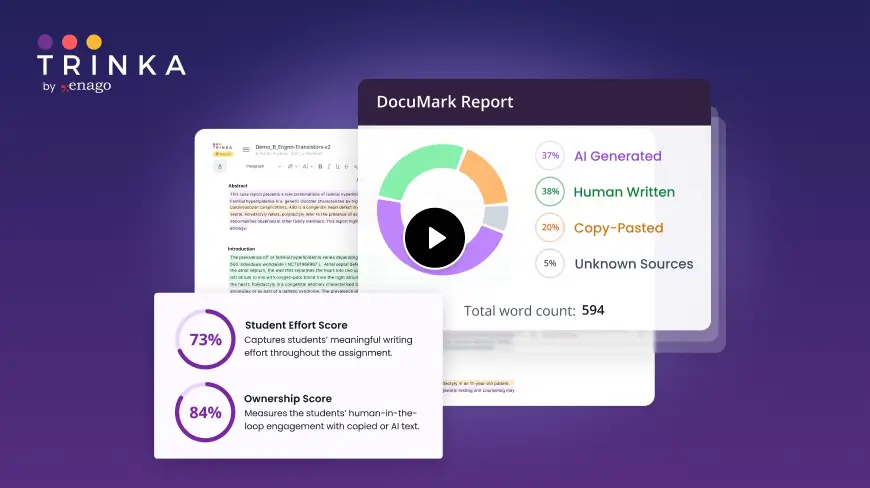
DocuMark: Responsible AI Use for Academic Integrity
Knowing your institution's AI policy is step one. DocuMark helps enforce it fairly by empowering universities to manage AI-generated content, prevent cheating, and support student writing through responsible AI use.
Common Questions About ESCP Business School (Berlin/Paris)'s AI Policies
ESCP Business School (Berlin/Paris) has defined AI policies in 10 of 12 categories, with an overall coverage score of 83%.
When AI use is authorized, students are required to follow the professor’s instructions for that assessment. The student guidance also instructs students to be transparent about how they used AI and to cite it appropriately when required by the instructor or assignment rules.
Undisclosed or unauthorized AI use in assessed work is treated as cheating and can trigger the school’s academic misconduct procedures. The misconduct policy lists sanctions that can range from a warning to exclusion or degree revocation, but the provided sources do not define a specific AI-detection-tool policy.
ESCP provides an institutionally approved AI environment through ChatGPT Edu and gives members access to Microsoft Copilot, while warning users not to input sensitive or personal information into AI tools. The student guidance specifically directs users to avoid sharing private data and to use only approved tools in line with school rules.