Teaching & Learning
- AI use in coursework is primarily at instructor discretion, with faculty expected to determine when AI may or may not be used and to clearly communicate the decision in the syllabus and assignment instructions
- The university provides example syllabus “traffic light” approaches: some courses may prohibit AI entirely, while others may allow AI use generally or for specific assignments with citation and validation requirements, and students are advised to consult their instructor when unsure
Determine when AI tools may or may not be used in your courses and clearly communicate your decision to students.
Your professor determines if and how AI technologies may be used in coursework.
Be sure to read the course syllabus carefully for guidance on the use of AI technologies and, if you need clarification, reach out to your professor before you use AI in your class assignments.
Students are encouraged to use AI tools, such as Google Gemini or Microsoft Copilot, to explore ideas and collaborate with others. All AI-generated content must be cited, and its accuracy should be carefully evaluated.
AI tools may be used with caution. For specific assignments, AI-generated content may be incorporated, but it must be clearly cited and validated. Students are advised to consult with the instructor if unsure about the appropriateness of AI for a particular task.
AI tools are not permitted in this course. All work must be completed independently, without the assistance of AI tools.
- Use of AI during exams is treated as academic misconduct when not specifically authorized by the instructor
- FSU’s AI academic integrity guidance provides an explicit example that unauthorized AI tool use during an exam constitutes cheating with AI
Cheating is the improper access to or use of any information or material that is not specifically condoned by the instructor for use in the academic exercise.
Use of unauthorized AI tools during an exam is an example of cheating with AI.
- The policy framing emphasizes that the instructor determines allowed AI use and students should review the syllabus and consult their instructor if unsure
- FSU’s guidance includes course-level examples where students are encouraged to use AI tools to explore ideas and collaborate with others, alongside requirements to cite AI-generated content and evaluate accuracy
Students are encouraged to use AI tools, such as Google Gemini or Microsoft Copilot, to explore ideas and collaborate with others. All AI-generated content must be cited, and its accuracy should be carefully evaluated.
Your professor determines if and how AI technologies may be used in coursework.
Be sure to read the course syllabus carefully for guidance on the use of AI technologies and, if you need clarification, reach out to your professor before you use AI in your class assignments.
Research
- This is a general capability/availability statement and does not define research-specific constraints or approvals for research data analysis
- FSU ITS describes generative AI as a tool that can be used to analyze data and states that generative AI is provided securely to all FSU users through Microsoft Copilot for the web
Generative AI is a type of artificial intelligence that assists you in creating and editing content, analyzing data, or editing images.
Provided securely to all FSU users through Microsoft Copilot for the web, you have access to generative AI through any web browser using your FSU login information.
Take advantage of this tool to assist with text generation, image synthesis, data analysis, and more.
Academic Integrity
- The university also emphasizes that instructors should clearly define acceptable AI use in syllabi and materials to foster transparency and accountability
- FSU’s teaching and learning guidance includes an explicit requirement to cite AI-generated content in contexts where AI use is encouraged/allowed, and its academic integrity guidance ties unacknowledged use of others’ work to plagiarism
Students are encouraged to use university-approved AI tools, such as Google Gemini or Microsoft Copilot, to explore ideas and collaborate with others. All AI-generated content must be cited, and its accuracy should be carefully evaluated.
AI tools may be used with limitations. For specific assignments, AI-generated content may be incorporated, but it must be clearly cited and validated.
The Academic Honor Policy defines plagiarism as using work from print, web, or other sources without acknowledging the source.
Uphold academic integrity by setting expectations and clearly defining acceptable AI use in your course syllabus and materials to foster transparency and accountability.
- FSU directs instructors to follow the Academic Honor Policy process when alleged academic misconduct involving AI occurs and provides examples of how AI use can fall under cheating, plagiarism, and falsification
- The Academic Honor Policy outlines procedures and sanctions, including reduced grades (including “0” or “F”) for assignments and additional academic work, and describes formal resolution and hearing processes using a preponderance of the evidence standard
Be sure to follow the FSU Academic Honor Policy process when alleged academic misconduct occurs.
When you suspect academic misconduct involving the use of AI, follow the FSU Academic Honor Policy.
Use of unauthorized AI tools during an exam is an example of cheating with AI.
Presenting AI-generated content as though it is original work is an example of plagiarism.
Examples of falsification include use of AI to generate false citations, documents, or signatures.
The following sanctions are available in the Student & Instructor Resolution and Administrative Case Resolution procedures and may be imposed singly or in combination.
2. A reduced grade (including “0” or “F”) for the assignment
Institutional & Administrative
- FSU instructs faculty to set expectations and define acceptable AI use in course syllabi and materials, and to follow the Academic Honor Policy when academic misconduct is suspected
- FSU also provides guidance that tools used for instruction must include safeguards to protect student information and institutional content, and indicates the ITS software/service checklist is required for the purchase of software (including AI tools)
Uphold academic integrity by setting expectations and clearly defining acceptable AI use in your course syllabus and materials to foster transparency and accountability.
Tools used for instruction must have safeguards in place to protect student information and institutional content.
FSU’s ITS Software/Service Checklist is required for the purchase of software, including AI tools and applications, and ensures software is appropriately vetted for the security of protected data.
- FSU also warns that sharing information with AI tools not licensed by the university can lead to unintended violations of data privacy laws such as FERPA, GDPR, and HIPAA
- FSU requires AI use to comply with data privacy laws and institutional policies and emphasizes information security risks, especially for AI tools without FSU data agreements
- The university states that its Acceptable Use of Technology Policy prohibits use of third-party tools not approved through specified university offices, and separately states that only reviewed and approved technologies and applications may be used
Ensure your use of AI complies with data privacy laws and institutional policies, safeguarding personal, academic, and research data.
It is important to understand the information security risks associated with their use, especially AI tools that do not have FSU data agreements in place.
FSU’s Acceptable Use of Technology Policy prohibits use of third-party tools not approved by Procurement Services, Office of the General Counsel, and the Information Security and Privacy Office.
Only technologies and applications reviewed and approved for use by Procurement Services, Office of the General Counsel, and the Information Security & Privacy Office may be used.
Sharing information with AI tools not licensed by the university (or approved through the appropriate university channels) can lead to unintended violations of data privacy laws such as FERPA, GDPR, and HIPAA.
- Separately, FSU’s students page states the university has been evaluating AI’s impact on teaching practices and developing policies for consideration by the Faculty Senate and the Office of the Provost
- FSU states that it established the Artificial Intelligence in Education Advisory Committee (AIEAC) in 2024 to evaluate AI’s impact on teaching and learning and to develop policies and practices, with recommendations to be presented to the Faculty Senate and the Office of the Provost in Spring 2025
In 2024, FSU established the Artificial Intelligence in Education Advisory Committee (AIEAC) to evaluate the impact of artificial intelligence (AI) on teaching and learning, as well as develop policies and practices that support effective use of the technology.
The committee’s recommendations will be presented to the Faculty Senate and the Office of the Provost in the Spring 2025 term.
The university has been evaluating the impact of artificial intelligence on practices in teaching, assessing its effect on learning and student engagement, and developing policies for consideration by the Faculty Senate and Office of the Provost.
DocuMark: Responsible AI Use for Academic Integrity
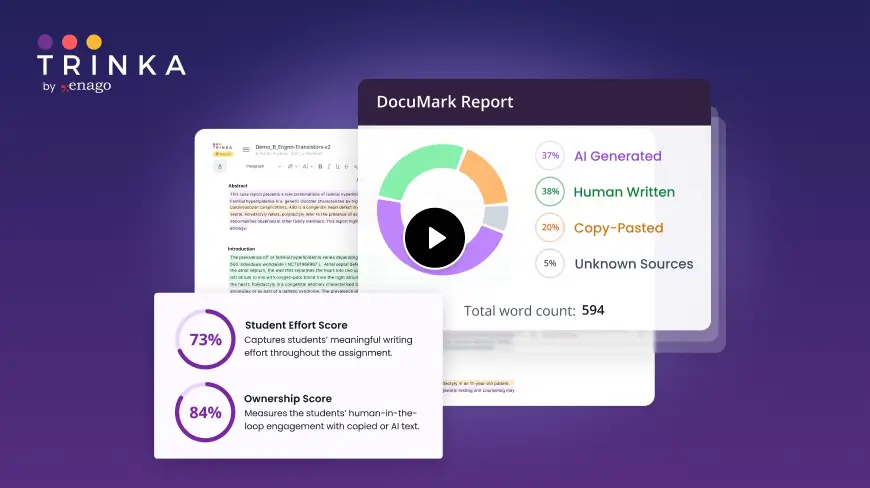
Knowing your institution's AI policy is step one. DocuMark helps enforce it fairly by empowering universities to manage AI-generated content, prevent cheating, and support student writing through responsible AI use.
Common Questions About Florida State University's AI Policies
Florida State University has defined AI policies in 9 of 12 categories, with an overall coverage score of 75%.
FSU’s teaching and learning guidance includes an explicit requirement to cite AI-generated content in contexts where AI use is encouraged/allowed, and its academic integrity guidance ties unacknowledged use of others’ work to plagiarism. The university also emphasizes that instructors should clearly define acceptable AI use in syllabi and materials to foster transparency and accountability.
FSU directs instructors to follow the Academic Honor Policy process when alleged academic misconduct involving AI occurs and provides examples of how AI use can fall under cheating, plagiarism, and falsification. The Academic Honor Policy outlines procedures and sanctions, including reduced grades (including “0” or “F”) for assignments and additional academic work, and describes formal resolution and hearing processes using a preponderance of the evidence standard.
FSU requires AI use to comply with data privacy laws and institutional policies and emphasizes information security risks, especially for AI tools without FSU data agreements. The university states that its Acceptable Use of Technology Policy prohibits use of third-party tools not approved through specified university offices, and separately states that only reviewed and approved technologies and applications may be used. FSU also warns that sharing information with AI tools not licensed by the university can lead to unintended violations of data privacy laws such as FERPA, GDPR, and HIPAA.