Teaching & Learning
- AI use in coursework is generally governed by instructor discretion
- Writing support materials repeat that students should not assume AI is allowed and should consult the professor first
- Furman treats using sources, including generative AI, on academic work as misconduct unless the instructor or assignment guidelines explicitly permit it, and students are told to ask their instructor if they are unsure
Furman’s academic integrity policy is in effect even if not explicitly stated. Below are general explanations and examples to help educate students on forms of academic misconduct. These examples should not be considered an exhaustive list. Individual instructor or course policies supersede any definition provided here. Remember to ask your course instructor to clarify what is permissible. Don’t assume that what applies in one course automatically extends to another.
Note: When “sources” are referred to in this document, it is assumed that this includes all sources of information, including generative AI.
Using information, devices, or sources in completing academic activities (e.g., writing papers, preparing reports, solving problems, summarizing or synthesizing readings) unless explicitly permitted by the instructor or guidelines. Please note that this could include the use of products that check spelling, grammar, and writing style and structure.
That depends! What does your professor say about AI?
Check your assignment sheet or syllabus for your professors’ AI statements. It’s possible that every professor will have a different approach, so you can’t assume that if one professor allows it that others will!
Ask your professor! If you can’t find an AI statement in your syllabus, or if you professor hasn’t provided one, then it’s super important to ask your professor BEFORE you use AI in any way for your coursework!
- Penalties for violations on tests are handled through the academic integrity process, with course penalties set by the instructor and additional review by the Academic Discipline Committee
- The university does not set a separate AI-specific exam rule; instead, exam use falls under the general academic integrity rule that unauthorized sources or devices are misconduct unless explicitly permitted by the instructor or guidelines
Using information, devices, or sources in completing academic activities (e.g., writing papers, preparing reports, solving problems, summarizing or synthesizing readings) unless explicitly permitted by the instructor or guidelines. Please note that this could include the use of products that check spelling, grammar, and writing style and structure.
Note: When “sources” are referred to in this document, it is assumed that this includes all sources of information, including generative AI.
Typically such penalties for academic misconduct include an F on the paper, test, or assignment, an adjusted semester grade in the course, or a failing grade in the course.
- AI use for learning support is not uniformly permitted or prohibited; it depends on the professor’s rules for the class
- Furman’s Writing & Media Lab says consultants may use or help students use generative AI only if the professor allows it, and students are directed to check the syllabus or ask the professor before using AI for coursework
That depends! What does your professor say about AI?
Check your assignment sheet or syllabus for your professors’ AI statements. It’s possible that every professor will have a different approach, so you can’t assume that if one professor allows it that others will!
If your professor allows you to use AI, then the WML Consultants can help you. Depending on your professor’s guidelines, we might use generative AI as part of the consulting process or help you learn how to use it as part of your assignment. But it all depends on your professor!
Ask your professor! If you can’t find an AI statement in your syllabus, or if you professor hasn’t provided one, then it’s super important to ask your professor BEFORE you use AI in any way for your coursework!
- The university-wide AI use policy also applies to all users including those using AI for technical tasks
- Furman has no dedicated code-generation or programming-specific AI policy, but the general academic integrity framework applies: using AI tools to solve problems or complete programming assignments is academic misconduct unless the instructor explicitly permits it
Using information, devices, or sources in completing academic activities (e.g., writing papers, preparing reports, solving problems, summarizing or synthesizing readings) unless explicitly permitted by the instructor or guidelines.
Note: When 'sources' are referred to in this document, it is assumed that this includes all sources of information, including generative AI.
Individual instructor or course policies supersede any definition provided here. Remember to ask your course instructor to clarify what is permissible.
Research
- The policy also says AI use for research and content production must follow established practices for rigor, data quality, and accurate communication
- Furman’s AI use policy allows AI-assisted content for formal submission or publication only when qualified humans supervise and review it before completion
The use of AI for research, analysis, content production, and other purposes shall adhere to common established practices for data safety, data quality, communication, and rigor to ensure that both inputs and outcomes are as accurate as possible.
AI-assisted content produced for formal representation, submission, publication, distribution, and/or transmission of University works shall at minimum and prior to completion, be governed, supervised and reviewed by qualified humans (Ex, the author) for accuracy, safety, bias, regulatory compliance and consistency with all policies, values, standards and rigor required for content production or publication at Furman University.
- The university requires AI use in research and analysis to follow established standards for data safety, data quality, communication, and rigor
- Research-related data entered into AI systems must also comply with Furman’s data classification and approved storage requirements, and faculty guidance warns users not to share confidential institutional data such as research data in generative AI tools
The use of AI for research, analysis, content production, and other purposes shall adhere to common established practices for data safety, data quality, communication, and rigor to ensure that both inputs and outcomes are as accurate as possible.
University data stored or shared with AI systems shall follow Furman’s Organizational Security and Data Classification policy and Data Storage Guidelines and shall be stored on approved data storage locations appropriate to its data class. Exceptions may be considered with proper consultation with Information Technology Services.
It is important to avoid sharing sensitive data such as the following:
Confidential institutional data: Proprietary information, research data, financial records, intellectual property, etc.
- The policy also requires human supervision and review of AI-assisted university content and says review should increase when the potential impact or risk is higher
- Furman requires AI use in research to align with integrity and ethical standards, and people directly involved in AI research or development may face additional review or oversight
The University requires all constituents to uphold the highest standards of integrity and ethics. These values extend to the use of AI. Users should comply with all University policies, codes of conduct and guidelines.
Users involved in direct research or development of AI technologies at Furman shall conform to the highest ethical standards and may be subject to additional review or oversight.
AI-assisted content produced for formal representation, submission, publication, distribution, and/or transmission of University works shall at minimum and prior to completion, be governed, supervised and reviewed by qualified humans (Ex, the author) for accuracy, safety, bias, regulatory compliance and consistency with all policies, values, standards and rigor required for content production or publication at Furman University.
Efforts for qualified human supervision shall be increased appropriately to account for cases where the potential, scope and scale of impact of the use of an AI technology likely exceeds what existing standards and policies may account for.
Academic Integrity
- When students use generative AI with instructor permission, Furman requires them to acknowledge that use in the submitted work
- The academic integrity materials also state that AI-derived material must be properly acknowledged or cited, and students should consult the instructor for the proper citation format
Presenting as your own any ideas, words, expressions, statements, pictures, graphs, or other material from another source, with or without consent of the original author or source, by incorporating it into your work without proper acknowledgement or citation. Please note that this applies to material drawn from any source, human and technological, including generative AI. You should consult with your instructor about the proper citation format for all sources.
Using generative AI to generate ideas, outlines, illustrations, or summaries for academic work turned in as your own without explicit permission from the instructor. Note, even if permission is granted by the instructor, you are responsible for acknowledging and/or the use of AI in the work you turn in.
- The provided sources do not define a university stance on AI-detection software specifically
- Instructors must report all infractions, course penalties are at instructor discretion, and repeat violations can lead to suspension or expulsion
- Furman states that academic misconduct violations have severe consequences and handles suspected violations through instructor investigation and the Academic Discipline Committee
Violations of the ethical standards of the institution will have severe consequences.
Professors who suspect that academic misconduct has occurred are required to investigate the matter. The student may either accept responsibility for the charge or dispute the charge by requesting a hearing with the Academic Discipline Committee. (Academic discipline panels include faculty and students.) All infractions, including those resolved between the faculty member and the student, must be reported to the Associate Academic Dean and reviewed by the Academic Discipline Committee.
All course-related penalties related to an academic integrity violation are at the discretion of the instructor. Typically such penalties for academic misconduct include an F on the paper, test, or assignment, an adjusted semester grade in the course, or a failing grade in the course. The Academic Discipline Committee routinely assesses additional penalties such as tutorials on ethics or plagiarism.
Academic Discipline Committee hearings are automatically convened in the case of second or multiple academic integrity violations. In such circumstances the committee considers such sanctions as suspension, expulsion from the university, and/or other, more severe, recourses.
Institutional & Administrative
- For university works, AI-assisted content must be supervised and reviewed by qualified humans before completion
- The faculty privacy guidance addresses using generative AI for teaching and scholarship and recommends reviewing privacy policies first
- Faculty and staff use of AI is allowed subject to university policies, with employee use governed by employee, faculty, staff, technology, security, purchasing, and approved AI policies
Applicable: Furman University (Students, Faculty, Staff, Affiliates, Service Providers, and Products)
Employee use of AI shall be governed by and in accordance with relevant Furman employee policies including but not limited to relevant Faculty and Staff policies, Technology policies, Information Security Policies, Purchasing guidelines, and any approved AI policies.
As many of you explore the use of generative artificial intelligence (GAI) for your teaching, scholarship, and personal lives, please note that while GAI is a powerful tool, it’s essential to be mindful of data security and privacy.
Before you use any GAI tool you should take time to review its relevant privacy policies.
AI-assisted content produced for formal representation, submission, publication, distribution, and/or transmission of University works shall at minimum and prior to completion, be governed, supervised and reviewed by qualified humans (Ex, the author) for accuracy, safety, bias, regulatory compliance and consistency with all policies, values, standards and rigor required for content production or publication at Furman University.
- The guidance identifies Microsoft Copilot used with a furman.edu account as having commercial data protection not available in other free AI tools
- Faculty guidance says users should avoid entering sensitive data, including PII, student records, and confidential institutional data, into generative AI tools
- Furman requires AI use to protect privacy, security, and data governance, and university data shared with AI systems must follow its data-classification policy and approved storage rules
The use of AI technologies shall protect or preserve the privacy and security , data classification and governance of all data that are collected, processed, stored, or shared by or with AI systems.
University data stored or shared with AI systems shall follow Furman’s Organizational Security and Data Classification policy and Data Storage Guidelines and shall be stored on approved data storage locations appropriate to its data class. Exceptions may be considered with proper consultation with Information Technology Services.
It is important to avoid sharing sensitive data such as the following:
Personally identifiable information (PII): Student names, social security numbers, addresses, phone numbers, email addresses, etc.
Confidential institutional data: Proprietary information, research data, financial records, intellectual property, etc.
Sensitive student information: Grades, attendance records, disciplinary actions, medical information, etc.
Because of Furman’s enterprise site license with Microsoft, using Microsoft Copilot comes with security protections. Anyone who signs into Copilot with their @furman.edu account (via free and paid accounts) gets commercial data protection while using the tool, which is not the case with any other free GAI tool.
This means that, even in the free version, prompts and responses you input into Copilot are not saved or used to train AI models and chat prompt traffic is encrypted.
- The policy establishes an AI Strategic Task Force to review, recommend, and oversee AI initiatives over time
- Furman has an institution-wide AI use policy aimed at responsible and ethical use of AI and states that the university seeks to optimize AI use while minimizing risks
- It also reserves the university’s right to monitor AI technologies in use or development and requires task-force review and approval for AI that cannot be feasibly managed by humans to meet university standards
To this end, the University aspires to optimize its use of AI technology to responsibly harness its benefits while minimizing its risks.
While we recognize the foregoing, this policy outlines guidelines for fostering responsible and ethical use of AI technologies including the principles of safety, security, accountability, integrity, fairness, and social responsibility with deference and fidelity to Furman University’s institutional values and positive societal stewardship.
AI technologies are rapidly growing in scope and pace of innovation, significantly accelerating technological achievements. As such, a qualified representative group of individuals responsible for evaluating AI (AI Strategic Task Force) shall review, recommend, and oversee alignment of AI initiatives with the University’s interests over time.
Any AI technology that advances beyond its ability to be feasibly managed by humans to behave according to the standards and expectations of Furman University and the protections of this policy or other relevant University policies, shall be submitted for review and approval by to the University’s AI Strategic Task Force prior to its initial release, use or continued use as may be the case.
Furman University reserves the right to monitor and review AI technologies or products in use or development at Furman to monitor the state of technology, usage and products to support responsible use of AI.
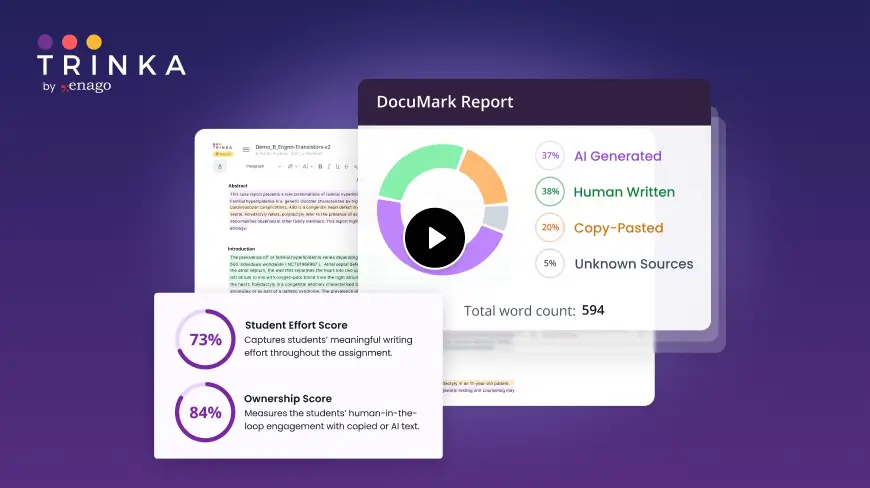
DocuMark: Responsible AI Use for Academic Integrity
Knowing your institution's AI policy is step one. DocuMark helps enforce it fairly by empowering universities to manage AI-generated content, prevent cheating, and support student writing through responsible AI use.
Common Questions About Furman University's AI Policies
Furman University has defined AI policies in 12 of 12 categories, with an overall coverage score of 100%.
When students use generative AI with instructor permission, Furman requires them to acknowledge that use in the submitted work. The academic integrity materials also state that AI-derived material must be properly acknowledged or cited, and students should consult the instructor for the proper citation format.
Furman states that academic misconduct violations have severe consequences and handles suspected violations through instructor investigation and the Academic Discipline Committee. Instructors must report all infractions, course penalties are at instructor discretion, and repeat violations can lead to suspension or expulsion. The provided sources do not define a university stance on AI-detection software specifically.
Furman requires AI use to protect privacy, security, and data governance, and university data shared with AI systems must follow its data-classification policy and approved storage rules. Faculty guidance says users should avoid entering sensitive data, including PII, student records, and confidential institutional data, into generative AI tools. The guidance identifies Microsoft Copilot used with a furman.edu account as having commercial data protection not available in other free AI tools.