Teaching & Learning
- Georgia State University does not set a single university-wide rule allowing or banning AI for graded coursework
- Instead, use in assignments is generally at instructor discretion, and students are responsible for following course-specific rules; unauthorized AI use can be treated as academic dishonesty
“Any use of AI by a student should be reasonable and responsible and should be approved by the instructor of the course. Students should not use AI to complete assignments unless specifically permitted by the instructor to do so. Failure to follow instructor policies governing the use of AI may constitute academic dishonesty.”
“In situations where the instructor has not stated a policy specifically addressing the use of AI, students should ask the instructor what is permitted. If students cannot ask the instructor for clarification before submitting the assignment, students should either cite their use of AI or not use AI.”
“Students are expected to complete all academic work with honesty and integrity. This means that any work you submit under your own name is expected to represent your own ideas, research, and writing. If your instructor permits the use of artificial intelligence (AI) tools, such use should be acknowledged and documented appropriately. Presenting AI-generated content as your own original work without permission or proper attribution can be considered a form of plagiarism or unauthorized assistance, and may be referred as a possible Academic Integrity Violation.”
- Use of AI during exams and similar assessments is prohibited unless an instructor explicitly allows it
- Georgia State identifies unapproved AI use during tests, quizzes, or other graded activities as unauthorized assistance and a potential academic integrity violation
“Using unauthorized materials, technology, devices, or assistance during an examination, quiz, or graded activity”
“Using artificial intelligence (AI) to complete tests, exams, or other assignments without permission”
“Any use of AI by a student should be reasonable and responsible and should be approved by the instructor of the course. Students should not use AI to complete assignments unless specifically permitted by the instructor to do so. Failure to follow instructor policies governing the use of AI may constitute academic dishonesty.”
- Georgia State permits and encourages AI for learning support such as tutoring, brainstorming, study help, and practice when used responsibly
- The university warns students to verify outputs, avoid overreliance, and check course expectations before using AI in ways connected to coursework
“AI can support student learning when used thoughtfully. It may be useful for:
• Brainstorming ideas
• Explaining difficult concepts
• Practicing skills or generating sample questions
• Organizing notes or reviewing material”
“AI should be used as a support—not a substitute—for your own thinking, writing, and problem-solving.”
“Always verify AI-generated content. It can be inaccurate, incomplete, or misleading.”
“Know your instructor’s expectations before using AI in coursework.”
Research
- Georgia State allows AI use in research writing only within external sponsor and publisher rules, and researchers remain fully responsible for the final work
- For theses and dissertations, students must obtain advisor approval, document how AI was used, verify accuracy, protect confidential material, and cannot list AI as an author
“Faculty, students, and staff may use GenAI tools in scholarly writing when appropriate and permissible under publisher, disciplinary, or sponsor guidelines, but must remain responsible for the accuracy, originality, and integrity of the final work.”
“Researchers should not list generative AI tools as authors or co-authors on manuscripts, abstracts, posters, reports, or presentations.”
“Use of AI tools in theses and dissertations should be discussed with and approved by the faculty advisor or dissertation chair in advance.”
“Students are responsible for the originality, accuracy, and integrity of all submitted work, including content generated with AI assistance.”
“Any use of AI in developing a thesis or dissertation should be transparently documented in a manner appropriate to the discipline or program.”
“Students should verify all AI-generated content and ensure that such use does not compromise academic integrity, confidentiality, or intellectual property.”
- Georgia State permits AI in research data and analysis only when researchers comply with legal, sponsor, IRB, and university data rules
- Researchers must not upload confidential, restricted, export-controlled, or regulated data into public AI systems unless an approved contract explicitly allows it, and they remain responsible for validating outputs
“Researchers may use GenAI tools for data-related tasks (e.g., cleaning data, coding text, generating code, identifying patterns, summarizing literature, or exploratory analysis) only when such use is consistent with data governance requirements, IRB/consent restrictions, sponsor terms, and applicable law.”
“Researchers must not input or upload into public or unapproved GenAI systems any:
• confidential, sensitive, or restricted university data;
• protected health information (PHI);
• personally identifiable information (PII);
• student education records (FERPA);
• export-controlled information;
• proprietary third-party data or data subject to a non-disclosure agreement;
• unpublished research data if disclosure would compromise intellectual property, publication rights, or contractual obligations.”
“Where a university-approved GenAI platform is covered by an institutional contract and appropriate privacy/security review, researchers must still comply with IRB protocols, consent language, sponsor restrictions, and any applicable data use agreements before entering data.”
“Researchers are responsible for validating the accuracy, bias, provenance, and appropriateness of AI-generated analyses, code, or outputs before using them in research decisions or publications.”
- Georgia State requires AI use in research to comply with research integrity, human-subjects protections, sponsor rules, and disclosure expectations
- Researchers must disclose AI use when required by journals, conferences, sponsors, or the nature of the work, and human responsibility for the research cannot be delegated to AI
“Use of GenAI in research must comply with existing university policies on research integrity, human subjects protections, data security, intellectual property, and conflicts of interest, as well as sponsor and publisher requirements.”
“Researchers must disclose the use of GenAI in proposals, manuscripts, presentations, IRB submissions, or other research outputs when required by the sponsor, publisher, conference, journal, regulatory body, or the nature of the work itself.”
“Researchers remain fully responsible for the content of submissions and may not delegate judgment, interpretation, or accountability to an AI tool.”
“If AI is used in activities involving human participants or identifiable private information, researchers must ensure that such use is described in IRB materials when relevant and approved when required.”
Academic Integrity
- For research and graduate work, AI use must be transparently documented in ways appropriate to the discipline or required by sponsors, publishers, or other authorities
- Georgia State requires acknowledgment and documentation of AI use when instructors permit it, and advises students to cite or disclose AI use if course rules are unclear
“If your instructor permits the use of artificial intelligence (AI) tools, such use should be acknowledged and documented appropriately.”
“If students cannot ask the instructor for clarification before submitting the assignment, students should either cite their use of AI or not use AI.”
“Any use of AI in developing a thesis or dissertation should be transparently documented in a manner appropriate to the discipline or program.”
“Researchers must disclose the use of GenAI in proposals, manuscripts, presentations, IRB submissions, or other research outputs when required by the sponsor, publisher, conference, journal, regulatory body, or the nature of the work itself.”
- Georgia State treats unauthorized AI use as a possible academic integrity violation and routes cases through existing misconduct procedures
- The university also cautions instructors against relying solely on AI detectors, stating that detection tools are not sufficiently reliable to serve as the only evidence in misconduct findings
“Presenting AI-generated content as your own original work without permission or proper attribution can be considered a form of plagiarism or unauthorized assistance, and may be referred as a possible Academic Integrity Violation.”
“Failure to follow instructor policies governing the use of AI may constitute academic dishonesty.”
“Reports of Possible Academic Integrity Policy Violations will be addressed through the University’s established academic misconduct process. Depending on the severity and nature of the violation, consequences may include educational outcomes, grade penalties, formal disciplinary action, or referral for further review under applicable university policies.”
“AI detection tools are not reliable enough to be used as the sole basis for academic misconduct allegations.”
“Instructors should avoid making decisions based solely on detector scores and should instead consider the full context of student work, including discrepancies in writing style, process documentation, and direct communication with the student.”
Institutional & Administrative
- Georgia State allows faculty and staff to use AI for teaching and administrative support, but requires human oversight and adherence to privacy and data rules
- Faculty are advised to review and edit AI-generated materials, avoid entering sensitive information into unapproved tools, and communicate course-specific AI expectations to students
“Faculty may choose to allow, limit, or prohibit AI use in their courses, depending on the learning objectives and assessment design.”
“Instructors should clearly communicate expectations about AI use in the syllabus, assignment instructions, or class discussions.”
“Faculty can use AI to support teaching tasks such as brainstorming activities, generating examples, drafting rubrics, or revising course materials. However, all outputs should be reviewed carefully for accuracy, bias, tone, and alignment with course goals.”
“Employees should not enter sensitive, confidential, or regulated university information into public AI tools unless the tool has been approved for such use.”
- Georgia State restricts what university data may be entered into AI systems and directs users toward institutionally approved tools
- The university bars entry of sensitive, confidential, regulated, or unpublished research data into public or unapproved AI platforms, while identifying approved enterprise options such as Microsoft Copilot and Google Gemini/NotebookLM under university-managed terms
“Employees should not enter sensitive, confidential, or regulated university information into public AI tools unless the tool has been approved for such use.”
“Researchers must not input or upload into public or unapproved GenAI systems any:
• confidential, sensitive, or restricted university data;
• protected health information (PHI);
• personally identifiable information (PII);
• student education records (FERPA);
• export-controlled information;
• proprietary third-party data or data subject to a non-disclosure agreement;
• unpublished research data if disclosure would compromise intellectual property, publication rights, or contractual obligations.”
“Where a university-approved GenAI platform is covered by an institutional contract and appropriate privacy/security review, researchers must still comply with IRB protocols, consent language, sponsor restrictions, and any applicable data use agreements before entering data.”
“Microsoft Copilot with enterprise data protection is available to eligible GSU users.”
“Google Gemini and NotebookLM are available to eligible Georgia State University users through the university’s Google Workspace environment.”
- Georgia State has an institutional AI governance structure and university-wide guidance framework for adopting AI
- The university maintains an AI Committee and presents AI guidance, principles, and centrally managed resources to support responsible use across teaching, research, and administration
“The AI Committee provides leadership and guidance for the responsible, ethical, and effective use of artificial intelligence at Georgia State University.”
“The committee brings together faculty, staff, and university leaders to evaluate emerging AI technologies, recommend institutional guidance, and support implementation across teaching, research, and operations.”
“Georgia State University is committed to supporting the responsible use of artificial intelligence technologies in ways that enhance teaching, learning, research, creativity, and operational effectiveness.”
“This site provides university guidance, tools, and resources to help the Georgia State community understand and use AI responsibly.”
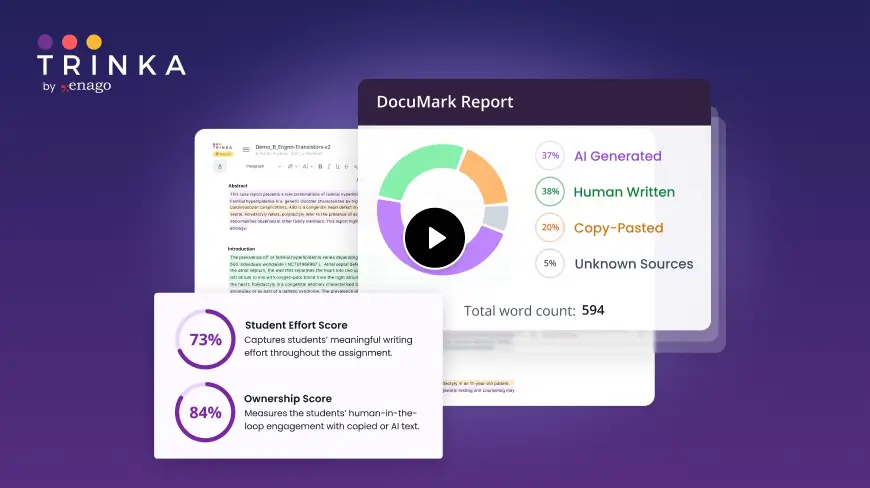
DocuMark: Responsible AI Use for Academic Integrity
Knowing your institution's AI policy is step one. DocuMark helps enforce it fairly by empowering universities to manage AI-generated content, prevent cheating, and support student writing through responsible AI use.
Common Questions About Georgia State University's AI Policies
Georgia State University has defined AI policies in 11 of 12 categories, with an overall coverage score of 92%.
Georgia State requires acknowledgment and documentation of AI use when instructors permit it, and advises students to cite or disclose AI use if course rules are unclear. For research and graduate work, AI use must be transparently documented in ways appropriate to the discipline or required by sponsors, publishers, or other authorities.
Georgia State treats unauthorized AI use as a possible academic integrity violation and routes cases through existing misconduct procedures. The university also cautions instructors against relying solely on AI detectors, stating that detection tools are not sufficiently reliable to serve as the only evidence in misconduct findings.
Georgia State restricts what university data may be entered into AI systems and directs users toward institutionally approved tools. The university bars entry of sensitive, confidential, regulated, or unpublished research data into public or unapproved AI platforms, while identifying approved enterprise options such as Microsoft Copilot and Google Gemini/NotebookLM under university-managed terms.