Teaching & Learning
- Separately, the Eisenhower Institute has a stricter unit-level policy: AI may be used only in limited, disclosed ways, and may not produce or rewrite substantial parts of student deliverables
- Gettysburg College does not state a single college-wide rule for classroom assignments on the JCCTL guidance page; instead, AI use in coursework is at instructor discretion, with faculty encouraged to choose and communicate a course stance in writing
Is it possible for students to work on my assignments using genAI tools?
* No
* Yes
* Is that okay with me? See stances below.
#### Stances
* Closed: No; it's too damaging to my learning goals.
* Restricted: Maybe, but only in specific ways and when I explicitly tell them to.
* Conditional: Yes, as long as they don't do certain things I don't want them to do.
* Open: Yes, they're welcome to use the tools as they see fit.
No matter your stance, students should be clear on how you define cheating and what they are and are not permitted to do— be sure guidelines appear in writing
Generative AI may only be used for Eisenhower Institute programs in specific, disclosed ways. Acceptable uses include light brainstorming, clarifying language, or exploring alternative ways to frame an argument. Your experiences, ideas, analysis, and writing must be your own.
Generative AI may NOT be used to:
* Produce or rewrite substantial sections of your deliverable.
* Conduct your analysis or research.
* Generate ideas, arguments, charts, or images that are presented as your own.
- Gettysburg College does not provide a university-wide AI exam rule
- The JCCTL guidance leaves exam and assessment design to instructor discretion; under a 'Closed' stance, faculty are specifically advised to adjust assessments to be more resistant to genAI use and to make syllabi as specific as possible about prohibited tools and usages, including tools like Grammarly
#### Stances
* Closed: No; it's too damaging to my learning goals.
* Restricted: Maybe, but only in specific ways and when I explicitly tell them to.
* Conditional: Yes, as long as they don't do certain things I don't want them to do.
* Open: Yes, they're welcome to use the tools as they see fit.
##### Closed
* Make your syllabus as specific as possible about which tools and usages are unwelcome — are you also asking them not to use Grammarly?
* Adjust assessments to be more resistant to use of genAI (see below)
No matter your stance, students should be clear on how you define cheating and what they are and are not permitted to do— be sure guidelines appear in writing
- Gettysburg College does not set a universal student study-aid rule
- The Gettysburg Library also maintains a generative AI citation guide that likely addresses AI use in research and study contexts
- The Eisenhower Institute permits limited AI use for light brainstorming, clarifying language, or exploring alternative framing, while the JCCTL faculty guidance recognizes instructors may adopt open, conditional, restricted, or closed approaches
Generative AI may only be used for Eisenhower Institute programs in specific, disclosed ways. Acceptable uses include light brainstorming, clarifying language, or exploring alternative ways to frame an argument. Your experiences, ideas, analysis, and writing must be your own.
#### Stances
* Closed: No; it's too damaging to my learning goals.
* Restricted: Maybe, but only in specific ways and when I explicitly tell them to.
* Conditional: Yes, as long as they don't do certain things I don't want them to do.
* Open: Yes, they're welcome to use the tools as they see fit.
[Note: The Gettysburg Library citation guide for generative AI (https://libguides.gettysburg.edu/citation/gen-ai) should also be reviewed for additional student guidance on AI use in study and research contexts.]
Research
- The provided sources do not define a college-wide policy for using AI to draft or edit research papers or manuscripts
- The Gettysburg Library maintains a generative AI citation guide that should be reviewed for guidance on citing AI in research writing
- The JCCTL genAI page notes its resources are for incorporating genAI into teaching and research but does not set rules for manuscript preparation
Are you looking to incorporate generative artificial intelligence (genAI) into your teaching and research?
This website is designed to provide you with an introduction to genAI and to how tie genAI use into your classes' learning goals and outcome.
[Note: The Gettysburg Library citation guide for generative AI (https://libguides.gettysburg.edu/citation/gen-ai) should also be reviewed as it likely provides guidance on citing AI tools in research and manuscript contexts.]
- No broader college-wide policy on AI for research data collection, data analysis, or statistical processing is defined in the provided materials
- The only explicit AI rule in the supplied sources for research analysis appears in the Eisenhower Institute policy, which prohibits AI from conducting a student's analysis or research for Institute work
Generative AI may NOT be used to:
* Produce or rewrite substantial sections of your deliverable.
* Conduct your analysis or research.
* Generate ideas, arguments, charts, or images that are presented as your own.
- The provided sources do not contain an AI-specific rule for grant proposals or research ethics declarations
- The IRB office page should be reviewed to determine whether AI-specific guidance exists for research involving human subjects
- Gettysburg's research misconduct policy defines a general standard requiring that misconduct be a significant departure from accepted practices, be committed intentionally or recklessly, and be proven by a preponderance of evidence, with the Provost responsible for fostering research integrity
A finding of research misconduct requires that: (a) the misconduct is a significant departure from accepted practices of the relevant research community; (b) the misconduct be committed intentionally, knowingly, or recklessly; and, (c) the allegation be proven by a preponderance of the evidence.
The President delegates to the Provost responsibility for:
* Coordination of all procedures related to allegations of research misconduct by anyone performing research under the College's aegis.
* Fostering a research environment that discourages misconduct in all research and promotes research integrity.
* Dissemination of policy and maintenance of records related to misconduct in research.
[Note: The Gettysburg IRB office page (https://www.gettysburg.edu/offices/provost/irb/) was not fully reviewed and may contain AI-specific guidance for human subjects research.]
Academic Integrity
- The Gettysburg Library generative AI citation guide likely provides additional attribution guidance and should be incorporated
- The JCCTL guidance advises faculty to put permitted and prohibited uses in writing, but no college-wide student disclosure format is defined in the provided sources
- The Eisenhower Institute requires disclosure whenever AI is used on any project, application, or written material, including naming the tool and precisely explaining its contribution before submission
If you choose to use AI for any project, application, or written material, you must:
* Disclose its use before submitting your work.
* Name the tool and explain precisely how it contributed to your work.
No matter your stance, students should be clear on how you define cheating and what they are and are not permitted to do— be sure guidelines appear in writing
[Note: The Gettysburg Library citation guide for generative AI (https://libguides.gettysburg.edu/citation/gen-ai) should be reviewed for additional attribution and citation requirements.]
- A faculty letter from the Honor Commission also states that AI can constitute an Honor Code violation and calls for a universal AI policy
- The JCCTL guidance advises faculty not to rely on AI detectors because they are 'extremely unreliable,' and says instructors who use them should disclose that upfront
- Enforcement for misuse can proceed through existing academic integrity processes: the Eisenhower Institute states noncompliance may be referred to the Honor Commission, and the Honor Code provides penalties and hearing procedures for cheating, plagiarism, unauthorized aid, and related misconduct
We do not recommend using a genAI detector because they are extremely unreliable, but if you choose to do so, we highly recommend that you disclose that to students up front
Failure to comply with this policy is considered a violation of Eisenhower Institute standard s. Your work may be referred to the Gettysburg College Honor Commission for further review. Consequences may include the rejection of your deliverable, dismissal from the program, exclusion from future Eisenhower Institute programs, or other disciplinary measure s determined by the Institute or the College.
3.10 These processes will be used to resolve all accusations regarding breaches of the College’s principles of academic honesty and integrity, including, but not limited to, cheating, plagiarism, unauthorized collaboration, unauthorized aid, fabrication of data or documents, forgery on academic forms and documents, lying to gain academic advantage, failure to report actions which clearly indicate violations of the Honor Code, stealing or destroying library materials.
3.7 Penalties ranging in severity up to and including failure in the course may be assigned through the Preliminary Conference. The imposition of more severe penalties requires the determinations of a Hearing Board.
In this meeting, we discussed Artificial Intelligence, which can constitute an Honor Code Violation, and the possibility of adding a warning for minor violations, among other topics.
1. AI Policy: Given the advancement in technology since the last revision of the Honor Code, we need to address and create a universal artificial intelligence (AI) policy to ensure it aligns with our commitment to academic integrity.
Institutional & Administrative
- Gettysburg's supplied AI guidance for faculty centers on teaching practice rather than imposing mandatory institution-wide rules
- Faculty are encouraged to decide their course stance on AI, define cheating, communicate rules in writing, and consider whether and how to integrate AI into assignments and learning outcomes
This website is designed to provide you with an introduction to genAI and to how tie genAI use into your classes' learning goals and outcome.
This website is a one-stop resource for your genAI needs as a faculty member.
#### Stances
* Closed: No; it's too damaging to my learning goals.
* Restricted: Maybe, but only in specific ways and when I explicitly tell them to.
* Conditional: Yes, as long as they don't do certain things I don't want them to do.
* Open: Yes, they're welcome to use the tools as they see fit.
No matter your stance, students should be clear on how you define cheating and what they are and are not permitted to do— be sure guidelines appear in writing
##### Restricted
* Identify areas where genAI may ease labor without interfering with learning or enable students to learn more with the same labor
* Design assignments/approaches that integrate genAI into their process or content
* Consider adapting outcomes to reflect lifting done by AI
- Gettysburg College prohibits users from using personal AI accounts and other unauthorized third-party services to handle College Data or personally identifiable information
- All College Data must be stored, processed, and transmitted only through College-approved and College-contracted systems, and use of third-party services for legitimate College business requires prior approval from the Data Governance Council
Use of Non-College Systems: Users are prohibited from using personal accounts, consumer-grade applications, or unauthorized third-party services to collect, store, process, use, share, or disclose College Data or PII. This includes but is not limited to: storing Personally Identifiable Information about students, alumni, employees, or other members of the Gettysburg College community on the following services:
* Personal AI Accounts (ChatGPT, Claude AI, Microsoft CoPilot, etc.)
* Any software or service where personally identifying information is not protected by contractual terms that meet the College’s standards.
All College Data must be stored, processed, and transmitted using only College-approved and College-contracted systems and services. Users requiring access to third-party services for legitimate College business must obtain prior approval from the Data Governance Council by using the form below:
- Gettysburg College has announced a three-year institutional AI initiative launching in the current fall semester
- It will be guided by an AI Leadership Team comprised of students, faculty, and staff, implemented across three phases over three academic years
- The initiative is intended to position the campus to experiment, assess, and define a 'Gettysburg Approach' to AI, with the goal of ensuring every student is prepared to use AI ethically and effectively
In response to the profound change occurring in education and the workforce, we are launching a three-year AI initiative starting this fall. This initiative will position our campus to experiment, assess, and to understand what AI means for a Gettysburg education—and ultimately to define a Gettysburg Approach to AI moving forward.
Our goal is to ensure that every Gettysburgian is prepared to flourish in a world increasingly shaped by AI—equipped with the knowledge, skills, and discernment to use AI ethically and effectively in their own lives and careers.
Over the next three academic years, our AI work— guided by an AI Leadership Team comprised of students, faculty, and staff—will be implemented in three phases:
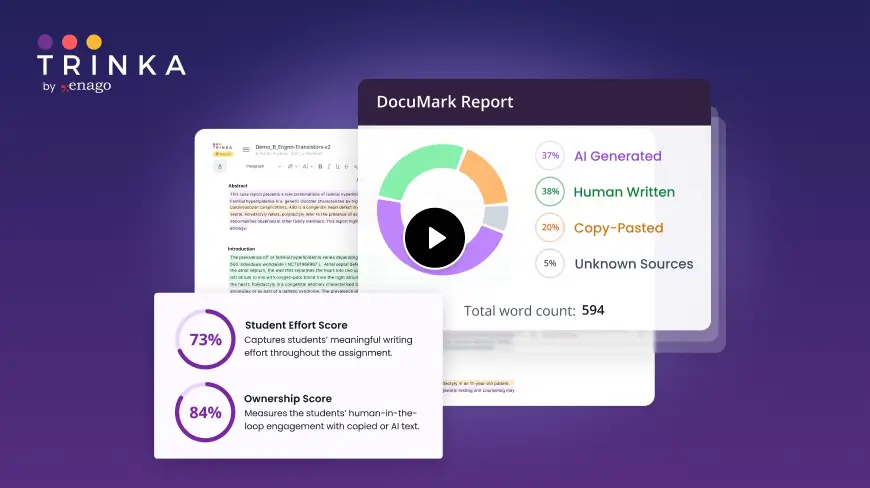
DocuMark: Responsible AI Use for Academic Integrity
Knowing your institution's AI policy is step one. DocuMark helps enforce it fairly by empowering universities to manage AI-generated content, prevent cheating, and support student writing through responsible AI use.
Common Questions About Gettysburg College's AI Policies
Gettysburg College has defined AI policies in 11 of 12 categories, with an overall coverage score of 92%.
The Eisenhower Institute requires disclosure whenever AI is used on any project, application, or written material, including naming the tool and precisely explaining its contribution before submission. The JCCTL guidance advises faculty to put permitted and prohibited uses in writing, but no college-wide student disclosure format is defined in the provided sources. The Gettysburg Library generative AI citation guide likely provides additional attribution guidance and should be incorporated.
The JCCTL guidance advises faculty not to rely on AI detectors because they are 'extremely unreliable,' and says instructors who use them should disclose that upfront. Enforcement for misuse can proceed through existing academic integrity processes: the Eisenhower Institute states noncompliance may be referred to the Honor Commission, and the Honor Code provides penalties and hearing procedures for cheating, plagiarism, unauthorized aid, and related misconduct. A faculty letter from the Honor Commission also states that AI can constitute an Honor Code violation and calls for a universal AI policy.
Gettysburg College prohibits users from using personal AI accounts and other unauthorized third-party services to handle College Data or personally identifiable information. All College Data must be stored, processed, and transmitted only through College-approved and College-contracted systems, and use of third-party services for legitimate College business requires prior approval from the Data Governance Council.