Teaching & Learning
- The university treats unacknowledged AI-generated content submitted as a student's own work as inappropriate and as a breach of the Code of Student Conduct
- Use of AI in assessed coursework is allowed only when the specific module handbook or assessment guidance states it is appropriate and the AI use is correctly acknowledged or referenced
In practice, the appropriate use of GenAI is highly contextual and will depend on what you are studying. This could vary from module to module, so it is important that you check each of your module handbooks and assessment outlines to see whether use of AI is allowed. The inclusion of AI generated content in your assessments is only allowed if both of the following conditions are met:
1. The use of GenAI is stated as appropriate for that specific assessment in the module handbook/assessment guidance.
2. Your use of GenAI is acknowledged or referenced correctly.
If this is not clear, please speak with the teaching team to confirm what use is considered appropriate. Inappropriate use of AI is a breach of the Code of Student Conduct.
Submitting AI generated content as own work.
9.8.1 As referred to in 9.6.1 above, the inappropriate inclusion of AI generated content within assessments is considered to be a breach of this Code.
- For assessments, AI use is only allowed where the assessment guidance specifically permits it and the use is properly acknowledged
- The student guidance also states that using AI to generate answers for submission in quizzes and exams is not appropriate, and the Code treats inappropriate AI-generated content in assessments as misconduct
The inclusion of AI generated content in your assessments is only allowed if both of the following conditions are met:
1. The use of GenAI is stated as appropriate for that specific assessment in the module handbook/assessment guidance.
2. Your use of GenAI is acknowledged or referenced correctly.
Quizzes and Exams
Generating practice questions for self-assessment.
Using AI to generate answers for submission.
9.8.1 As referred to in 9.6.1 above, the inappropriate inclusion of AI generated content within assessments is considered to be a breach of this Code.
- However, students are told not to rely solely or uncritically on AI, and they must maintain critical thinking and human decision making
- The university encourages students to experiment with AI for formative learning and self-directed study, including topic exploration, discussion of ideas, project planning, and reformatting materials for personal study
Students and staff are therefore encouraged to experiment with, and learn from, the use of these tools to support active and collaborative learning as identified in the Strategy for Learning. Students may wish to use AI for formative purposes, to enhance their understanding in conjunction with traditional learning practices.
Using AI as a formative tool to augment and develop understanding from lectures.
Using AI to assist in project planning and timings.
Using an AI tool to restructure or change the format of existing learning resources to aid personal study. This can be beneficial for accessibility.
The University believes that GenAI should be viewed as a tool to augment human capabilities and enhance efficiency, rather than a replacement for professional judgement, critical thinking, and human decision making. Maintaining critical thinking and human decision making are key components when considering if student use of GenAI is appropriate.
- Any use of AI in assessed work remains subject to module-level permission and acknowledgement requirements
- The university permits AI for technical assistance in learning contexts, such as instructions on how to use software, but does not provide a programming-specific university-wide rule for coding assignments
Problem-based learning
Providing technical assistance, such as instructions on how to use R, Excel, PowerPoint, etc.
The inclusion of AI generated content in your assessments is only allowed if both of the following conditions are met:
1. The use of GenAI is stated as appropriate for that specific assessment in the module handbook/assessment guidance.
2. Your use of GenAI is acknowledged or referenced correctly.
Research
- The university does not define a research-specific AI policy for drafting, editing, or preparing theses, dissertations, or manuscripts in the provided sources
- Research-degree misconduct materials address plagiarism, ghost writing, and other academic misconduct generally, but do not set explicit AI writing rules for research outputs
not defined
- The university does not provide a research-specific AI policy on data collection, data analysis, synthetic data, or interpretation of results in the provided sources
- The only explicit AI-related requirement is that any processing of personal data involving AI must follow a data protection by design approach, with a DPIA and recording in the Information Asset Register
21.2 The University will take a data protection by design approach at the outset of any processing of personal data involving AI. This can be demonstrated by undertaking a data protection impact assessment (DPIA) to ensure that any risks that arise from a specified use of Generative AI are identified and accounted for.
21.3 Uses of personal data in AI systems will be recorded in the Information Asset Register.
- The university does not set AI-specific rules for grant proposals, IRB applications, or ethics declarations in the provided research integrity sources
- Its stated research integrity position is general: research must meet the highest standards of honesty, rigour, and transparency, including in data gathering, analysis, interpretation, and acknowledging others' work
The University is committed to the highest standards of research integrity and good practice in all of its research activities and has committed to the UKRIO Concordat to Support Research Integrity and to adhere to the UKRIO Code of Practice for Research in the conduct of its research.
in all aspects of research, including in the presentation of research goals, intentions, and findings, in reporting on research methods and procedures, in gathering data, in using and acknowledging the work of other researchers, and in conveying valid interpretations and making justifiable claims based on research findings.
in declaring conflicts of interest, in the reporting or research data collection methods, in the analysis and interpretation of data, in making research findings widely available, which includes sharing negative results as appropriate, and in presenting the work to other researchers and the general public.
Academic Integrity
- Disclosure of AI use in assessments is required when AI-generated content is included
- The university requires students to acknowledge or reference AI use correctly, and its guidance also says staff should be transparent about when and how they have used GenAI in their work
The inclusion of AI generated content in your assessments is only allowed if both of the following conditions are met:
1. The use of GenAI is stated as appropriate for that specific assessment in the module handbook/assessment guidance.
2. Your use of GenAI is acknowledged or referenced correctly.
Including AI generated content without appropriate acknowledgement and contextualisation.
Not acknowledging the use of AI as a co-creator / collaborator.
Staff should be transparent about when and how they have used GenAI in their work.
- The university does not currently advocate using AI-detection checking tools
- Suspected AI misuse is handled under the Code of Student Conduct as academic misconduct, may involve a structured academic engagement to test the student's knowledge and understanding, and can be treated as either a minor or major breach depending on the extent of AI use
7.5. The University does not currently advocate the use of checking tools to detect students' use of AI and staff should follow the Code of Student Conduct where AI misuse is suspected.
9.8.2 Where there are concerns about the inappropriate use of AI, this should be investigated as academic misconduct (as opposed to via the plagiarism route) and the investigation may include a structured academic engagement (see 9.7.3 above) to test the student’s knowledge and understanding of the submitted work, and to establish the full extent of any academic misconduct.
9.8.3. On completion of the investigation:
i. If the usage of AI is considered to be minor, then this should be considered as a minor breach of the Code, and an appropriate penalty applied below (see Section 11.2 below) and form Appendix 7a should be completed and returned to the Department of Governance and Legal Services.
ii. If the usage of AI is considered to be major (i.e. the assessment is substantially generated by AI), and following consultation with the Department of Governance and Legal Services if appropriate, an allegation and supporting evidence should be forwarded by the Dean of the School, by completion of a major disciplinary breach referral form (Appendix 7b) to the Department of Governance and Legal Services for Consideration by the Senate Disciplinary Committee.
Institutional & Administrative
- The university has a staff-wide framework supporting GenAI use for business and academic purposes, while requiring responsible, ethical, and compliant use
- Staff are expected to verify outputs for accuracy, appropriateness, and bias, be transparent about use, and comply with university policies on privacy, intellectual property, and information security
1.1. This document serves as a framework for all University staff on the responsible, ethical, and compliant use of Generative Artificial Intelligence (GenAI).
1.2. The University supports the use of GenAI for business and academic purposes, embracing the opportunities, efficiencies, and innovations it brings.
2.1.3. Responsibility: Staff are responsible for their use of GenAI tools, and the outputs generated. The use of GenAI tools must comply with all relevant guidelines and policies and respect data privacy, intellectual property rights, and information security.
2.1.4. Confidence: Staff should be transparent about when and how they have used GenAI in their work. Staff should maintain a critical perspective on the outputs generated by GenAI tools, verifying their accuracy, appropriateness, and potential for bias before using them.
- The university recommends Microsoft 365 Copilot as its supported GenAI tool for staff and requires staff to log in with university credentials for stronger security
- Public GenAI tools may only be used with publicly available data, and staff must not input university data, personal data, sensitive/confidential data, university intellectual property, or copyrighted material without permission; staff also must seek advice before using a new AI system
1.5. The University recommends and supports the use of the GenAI tool Microsoft 365 Copilot. Staff must be logged into Microsoft 365 Copilot with their University credentials to enable enhanced data security and privacy assurances.
3.2. The University recommends and supports the use of Microsoft 365 Copilot as the GenAI tool for working with any personal or business data for tasks such as answering queries, enhancing productivity, creating content, or analysing information.
3.4. Microsoft 365 Copilot must not be used for working with highly confidential data, as defined by the University's Information Classification and Handling Policy.
4.2. Publicly available GenAI tools may only be used for working with publicly available data and staff must adhere to all University policies regarding data protection, intellectual property, and copyright.
5.3. Do not input University data, personal data, or sensitive/confidential data into publicly available GenAI tools.
6.1. Do not input University intellectual property into publicly available GenAI tools.
21.4 All Colleagues must seek advice from Procurement, Information Services and Data Protection prior to using a new AI system. Colleagues should not sign up to free trials without seeking advice.
- The staff guidance was approved by the Information Governance Committee and Senate, and the university says further guidance for learning, teaching, and research will be developed
- The university has an institutional framework for responsible GenAI use by staff and states that its position will be guided by core values including integrity, creativity, responsibility, and confidence
Approved By Information Governance Committee (06/05/2025)
Senate (04/06/2025)
1.1. This document serves as a framework for all University staff on the responsible, ethical, and compliant use of Generative Artificial Intelligence (GenAI).
1.4. The primary goal of this framework is to foster a positive and informed environment for engaging with this technology, ensuring that the adoption of GenAI aligns with the core values and legal obligations of GCU.
Recognising the opportunities and challenges that developments in GenAI present, GCU’s position on the use of GenAI will be guided by our core values:
2.1.1. Integrity:
2.1.2. Creativity:
2.1.3. Responsibility:
2.1.4. Confidence:
1.6. Further guidance supporting the practical use of GenAI in both learning and teaching, and research will be developed and made available in the coming months.
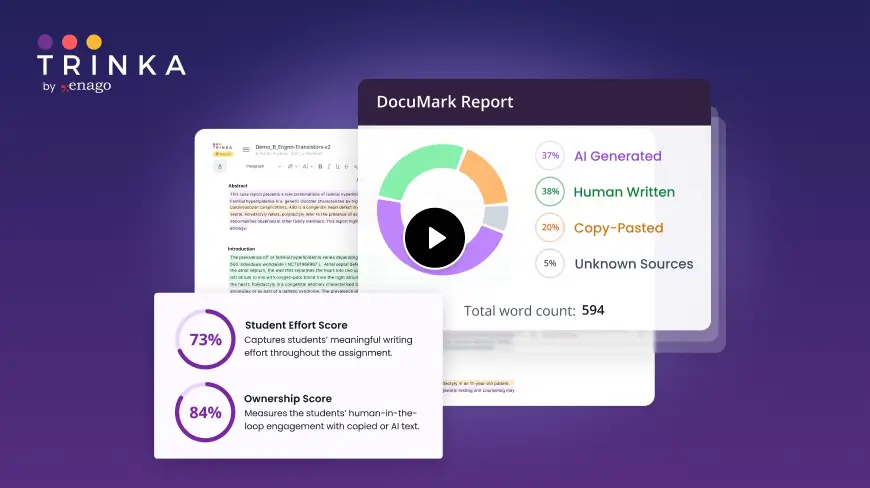
DocuMark: Responsible AI Use for Academic Integrity
Knowing your institution's AI policy is step one. DocuMark helps enforce it fairly by empowering universities to manage AI-generated content, prevent cheating, and support student writing through responsible AI use.
Common Questions About Glasgow Caledonian University's AI Policies
Glasgow Caledonian University has defined AI policies in 12 of 12 categories, with an overall coverage score of 100%.
Disclosure of AI use in assessments is required when AI-generated content is included. The university requires students to acknowledge or reference AI use correctly, and its guidance also says staff should be transparent about when and how they have used GenAI in their work.
The university does not currently advocate using AI-detection checking tools. Suspected AI misuse is handled under the Code of Student Conduct as academic misconduct, may involve a structured academic engagement to test the student's knowledge and understanding, and can be treated as either a minor or major breach depending on the extent of AI use.
The university recommends Microsoft 365 Copilot as its supported GenAI tool for staff and requires staff to log in with university credentials for stronger security. Public GenAI tools may only be used with publicly available data, and staff must not input university data, personal data, sensitive/confidential data, university intellectual property, or copyrighted material without permission; staff also must seek advice before using a new AI system.