Teaching & Learning
- Independent verification of AI output is emphasized
- For student coursework, the university says the permissibility of generative AI depends on the task and the instructor's rules
- Students are responsible for understanding course-specific requirements, and unauthorized AI use can be treated as an attempt to deceive if AI-generated passages are submitted as their own work
Ob der Einsatz von KI-Tools erlaubt ist, hängt von der Aufgabenstellung und den Vorgaben Ihrer Lehrenden ab.
Informieren Sie sich im Vorfeld, ob und wie generative KI in einer Lehrveranstaltung verwendet werden darf.
Falls die Nutzung von generativer KI nicht explizit erlaubt wird, sollten Sie vorsichtig sein.
Insgesamt dürfen Sie sich von generativer KI unterstützen lassen, müssen aber die Nutzung kritisch reflektieren und in der Regel kennzeichnen.
Lehrende sind dazu angehalten, transparent zu machen, ob und wie Studierende generative KI nutzen dürfen.
Liegen konkrete Anhaltspunkte vor, dass eine Studierende oder ein Studierender bei der Erbringung einer Prüfungsleistung ausschließlich oder in weiten Teilen KI-generierten Text als eigenen Text eingereicht haben könnte, kann dies den Verdacht einer Täuschungshandlung begründen.
Bitte beachten Sie, dass Sie die Verantwortung dafür tragen, dass durch KI-Unterstützung erzeugte Inhalte nicht ungeprüft übernommen werden.
- The university treats AI use in assessments as governed by the specific exam format and examiner instructions
- In oral exams or other assessments, examiners may ask whether AI was used and may require explanation of how it was used
- If there are concrete indications that a student submitted AI-generated text as their own in an assessed submission, this can justify suspicion of deception
Ob der Einsatz von KI-Tools erlaubt ist, hängt von der Aufgabenstellung und den Vorgaben Ihrer Lehrenden ab.
Bei mündlichen Prüfungsformaten können Prüfende die Verwendung von KI direkt abfragen und sich erläutern lassen.
Liegen konkrete Anhaltspunkte vor, dass eine Studierende oder ein Studierender bei der Erbringung einer Prüfungsleistung ausschließlich oder in weiten Teilen KI-generierten Text als eigenen Text eingereicht haben könnte, kann dies den Verdacht einer Täuschungshandlung begründen.
- Use is framed as supportive rather than a substitute for their own learning work
- Students are told to verify content independently because AI can produce false or biased outputs
- The university recommends generative AI as a study aid for brainstorming, revision, explanation, feedback, and language support, but only with critical checking
Generative KI kann Sie beim Lernen unterstützen – etwa beim Brainstorming, beim Strukturieren von Texten, bei Formulierungshilfen oder beim Verstehen komplexer Inhalte.
KI kann Ihnen auch helfen, Fragen zu formulieren, Texte zusammenzufassen, Rückmeldungen zu Ihrem Schreibstil zu geben oder fremdsprachige Inhalte zugänglicher zu machen.
Die Nutzung von generativer KI kann sinnvoll sein, wenn Sie diese als Unterstützung und nicht als Ersatz für eigenes Denken und Lernen einsetzen.
Bitte beachten Sie, dass Sie die Verantwortung dafür tragen, dass durch KI-Unterstützung erzeugte Inhalte nicht ungeprüft übernommen werden.
Achten Sie auf mögliche Fehler, Verzerrungen oder erfundene Quellenangaben.
Research
Academic Integrity
- It advises documenting AI assistance in a comprehensible way and being able to explain what parts were AI-supported
- However, the exact disclosure format is not presented as a single uniform university-wide rule in the provided sources
- The university generally expects students to indicate AI use and says teaching staff should make permitted uses transparent
Insgesamt dürfen Sie sich von generativer KI unterstützen lassen, müssen aber die Nutzung kritisch reflektieren und in der Regel kennzeichnen.
Lehrende sind dazu angehalten, transparent zu machen, ob und wie Studierende generative KI nutzen dürfen.
Dokumentieren Sie nachvollziehbar, wenn und wie Sie generative KI in einem Arbeitsprozess verwendet haben.
Machen Sie kenntlich, welche Teile Ihrer Arbeit eigenständig entstanden sind und wo KI eine Rolle gespielt hat.
- The university does not endorse AI detectors as standalone proof
- The university also operates Turnitin Similarity in a pilot context for text comparison and warns that AI-submitted work may trigger suspicion of deception
- Its checklist says suspicion must rest on concrete indications and a case-by-case overall assessment, while detection software results alone are insufficient
Eine Täuschung kann nicht allein mit dem Ergebnis eines KI-Detektors begründet werden.
Der Nachweis einer Täuschungshandlung muss vielmehr auf einer Gesamtwürdigung aller Umstände des Einzelfalls beruhen.
Liegen konkrete Anhaltspunkte vor, dass eine Studierende oder ein Studierender bei der Erbringung einer Prüfungsleistung ausschließlich oder in weiten Teilen KI-generierten Text als eigenen Text eingereicht haben könnte, kann dies den Verdacht einer Täuschungshandlung begründen.
Turnitin Similarity ist eine softwarebasierte Lösung zur Unterstützung bei der Identifikation von Textähnlichkeiten.
Die Nutzung von Turnitin Similarity erfolgt im Rahmen eines Pilotprojekts der Goethe-Universität Frankfurt.
Institutional & Administrative
- The provided sources do not set a detailed university-wide rule for grading or recommendation letters
- Faculty are advised to review AI outputs critically, protect sensitive data, and communicate transparently to students whether and how AI may be used in a course
- The university permits teaching staff to use generative AI as support in course preparation and teaching, but stresses that responsibility remains with the instructor
Generative KI kann Lehrende in vielen Bereichen der Lehre unterstützen – etwa bei der Planung von Lehrveranstaltungen, der Erstellung von Materialien, der Formulierung von Aufgaben oder bei der Strukturierung von Inhalten.
Die Verantwortung für Inhalte, Bewertungen und Entscheidungen verbleibt jedoch immer bei den Lehrenden.
Lehrende sind dazu angehalten, transparent zu machen, ob und wie Studierende generative KI nutzen dürfen.
Prüfen Sie KI-generierte Inhalte immer kritisch und überarbeiten Sie diese bei Bedarf.
Geben Sie keine sensiblen oder personenbezogenen Daten in öffentliche KI-Tools ein.
- The materials therefore indicate both approved institutional platforms and data-protection limits
- It warns users not to enter sensitive or personal data into public AI tools and states that use of the ToolLab is subject to the university privacy policy
- The university provides institutionally offered AI services through the AI ToolLab and an LLM API, and it ties their use to university credentials and project-related conditions
The AI ToolLab of Goethe University is an environment that bundles the currently offered AI tools and services and makes them available to members of the university.
Use of the AI ToolLab requires a valid Goethe University account.
This service provides selected Large Language Models (LLMs) via API for members of Goethe University Frankfurt.
Access to the LLM API is subject to availability and may be restricted to specific projects or user groups.
Geben Sie keine sensiblen oder personenbezogenen Daten in öffentliche KI-Tools ein.
The AI ToolLab is subject to Goethe University’s privacy policy.
- The sources show institutional coordination and service provision, but not a comprehensive university-wide AI governance code
- The university presents an organized institutional AI initiative centered on the Kompetenzzentrum für Künstliche Intelligenz and the AI ToolLab
- Its materials frame AI adoption around support, experimentation, and guidance for teaching and learning rather than a single binding AI statute
Das Kompetenzzentrum für Künstliche Intelligenz (KIZ) unterstützt Lehrende, Studierende und Mitarbeitende der Goethe-Universität beim reflektierten und verantwortungsvollen Einsatz von KI.
The AI ToolLab of Goethe University is an environment that bundles the currently offered AI tools and services and makes them available to members of the university.
Auf dieser Seite finden Sie allgemeine Empfehlungen zum Umgang mit generativer KI in Studium und Lehre an der Goethe-Universität.
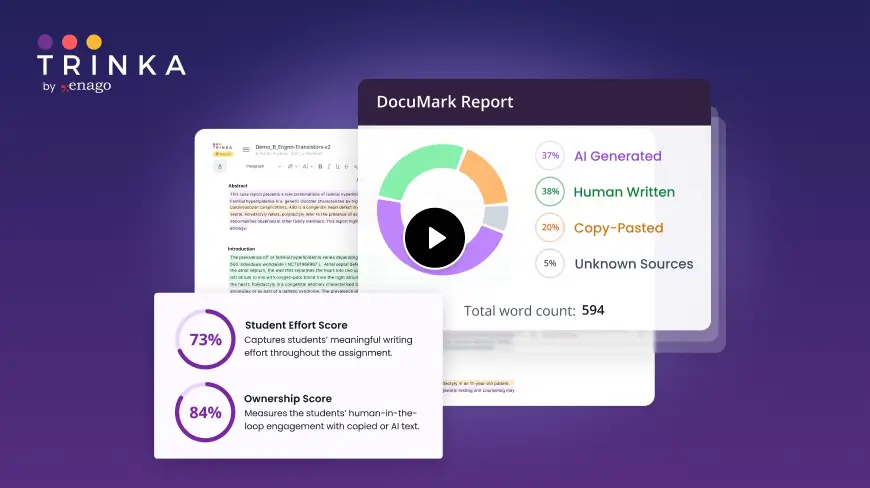
DocuMark: Responsible AI Use for Academic Integrity
Knowing your institution's AI policy is step one. DocuMark helps enforce it fairly by empowering universities to manage AI-generated content, prevent cheating, and support student writing through responsible AI use.
Common Questions About Goethe University Frankfurt's AI Policies
Goethe University Frankfurt has defined AI policies in 8 of 12 categories, with an overall coverage score of 67%.
The university generally expects students to indicate AI use and says teaching staff should make permitted uses transparent. It advises documenting AI assistance in a comprehensible way and being able to explain what parts were AI-supported. However, the exact disclosure format is not presented as a single uniform university-wide rule in the provided sources.
The university does not endorse AI detectors as standalone proof. Its checklist says suspicion must rest on concrete indications and a case-by-case overall assessment, while detection software results alone are insufficient. The university also operates Turnitin Similarity in a pilot context for text comparison and warns that AI-submitted work may trigger suspicion of deception.
The university provides institutionally offered AI services through the AI ToolLab and an LLM API, and it ties their use to university credentials and project-related conditions. It warns users not to enter sensitive or personal data into public AI tools and states that use of the ToolLab is subject to the university privacy policy. The materials therefore indicate both approved institutional platforms and data-protection limits.