Teaching & Learning
- Use of AI for coursework and assignments is at instructor discretion
- Gonzaga’s academic integrity policy also treats submitting assignment work obtained from the internet or another source without proper attribution as plagiarism
- The student guidance says faculty set their own expectations, students should not assume AI use is acceptable, and they should ask what kinds of AI use are allowed for particular assignments
Most importantly: Each faculty member sets their own expectations for AI use in their course. Some may permit it in limited ways; others may prohibit it entirely. Always ask if you’re unsure.
Don’t assume any AI use is acceptable. If AI use isn’t clearly addressed by the professor or course syllabus, have a conversation with your instructor. Consider asking the following questions:
* What kinds of AI use are allowed in this course, and for which assignments? Clarify expectations and note that some assignments may have different guidelines.
* Can I use AI for brainstorming, outlining, or revising my writing or other work? Writing is thinking. Work with faculty to understand when and how AI can support (but not replace) your voice.
Plagiarism is the representation of the words, ideas, or other works belong to another as one’s own.
It includes failure to cite references or improperly citing references with the intent to deceive, submitting a paper or any assignment written by another person, submitting a paper or any assignment obtained, wholly or in part, from the internet or from any other electronic or print source without proper attribution.
- Use of AI for exams and assessments is at instructor discretion for students, and the academic integrity policy prohibits unauthorized aids during exams
- Student guidance tells students to ask whether AI may be used to study or prepare for quizzes and exams, and warns that academic dishonesty standards can vary by course
Most importantly: Each faculty member sets their own expectations for AI use in their course. Some may permit it in limited ways; others may prohibit it entirely. Always ask if you’re unsure.
* Am I allowed to use AI tools to help me study or prepare for quizzes and exams? Don’t risk crossing the line. What counts as academic dishonesty can vary by course.
Cheating can take many forms, including but not limited to inappropriate collaboration when independent work is reasonably assumed by the nature of the assignment; giving or receiving unauthorized information and materials; unauthorized use of an aid or tool (to include online resources) during an exam;
- AI use for learning and study assistance is addressed as a permitted support only within instructor-set boundaries and with attention to learning rather than replacement
- Gonzaga also describes ZagAI as a learning assistant that supports assignments through Socratic questioning and reflection rather than replacing human insight and critical thinking
- The student guide encourages students to consider whether AI is enhancing or replacing their learning and to ask instructors whether AI tools may be used for studying or course work
Before using AI for anything, pause to consider the purpose of the task and the impact on your own learning.
* Am I using AI to enhance my learning, or to replace it?
* Does this use of AI reflect my own voice, ideas and values?
* Am I considering AI use on this assignment as an opportunity to grow, or using it to avoid the challenge presented?
* Am I allowed to use AI tools to help me study or prepare for quizzes and exams? Don’t risk crossing the line. What counts as academic dishonesty can vary by course.
Furthering its commitment to ethical and innovative uses of emerging technologies, the Institute for Informatics and Applied Technology, with faculty partners, is piloting ZagAI—a custom-built AI learning assistant for Gonzaga instructors and students.
Designed with a focus on data privacy, transparency, and research, ZagAI reflects the unique needs of Gonzaga’s academic community. ZagAI helps students tackle complex assignments through Socratic questioning, deepens reflection, supports faculty in enhancing instruction, and explores how AI can meaningfully support learning without replacing human insight and critical thinking.
- The academic integrity policy explicitly includes coding and programming within work expected to be original
- Programming-related AI use for student work is not given a separate uniform AI rule; course expectations govern student use
- For faculty and scholarly workflows, the faculty guide says AI may be used for coding support with clear attribution and methodological rigor
Most importantly: Each faculty member sets their own expectations for AI use in their course. Some may permit it in limited ways; others may prohibit it entirely. Always ask if you’re unsure.
It includes any work that is assigned to be original, including artist production, computer or other digital coding or programming, computational processes, and the like.
Using AI for coding support, data visualization, or exploratory analysis with clear attribution and methodological rigor as part of a broader scholarly workflow.
Research
- For scholarship and research, Gonzaga allows some AI assistance only when accompanied by acknowledgment, verification, and proper citation
- The faculty guide says relying on AI-generated summaries or translations without thorough verification or citing appropriately is disfavored, and using AI to write or rewrite scholarship without acknowledgment is not acceptable
Scholarship & Research
Using AI for coding support, data visualization, or exploratory analysis with clear attribution and methodological rigor as part of a broader scholarly workflow.
Relying on AI-generated summaries or translations without thorough verification of accuracy or citing appropriately.
Using AI to write or rewrite scholarship without acknowledgment, or in place of disciplinary engagement.
- The faculty guide allows AI for data visualization or exploratory analysis within a broader scholarly workflow
- Gonzaga permits AI use for research data and analysis only with methodological rigor, clear attribution, and approved data protections
- Separately, the university’s AI guidelines restrict Gonzaga data to approved sandboxed tools and prohibit uploading sensitive data to unapproved platforms
Using AI for coding support, data visualization, or exploratory analysis with clear attribution and methodological rigor as part of a broader scholarly workflow.
The use of the AI tools with Gonzaga data must be made with an AI tool that has been fully approved through Gonzaga’s vendor integration contract review process resulting in a business data sharing agreement with that vendor and that the tool is managed by ITS.
Data containing personally identifiable information (PII), protected health information (PHI), or other sensitive details should not be uploaded or processed on platforms not approved on the previous list.
- The faculty guide says scholarship and research uses should include clear attribution and methodological rigor, and it warns against unverified or unacknowledged AI use and against AI integration without ethical vetting
- Gonzaga addresses research ethics and integrity through expectations for attribution, methodological rigor, verification, and ethical vetting, but it does not provide a specific university-wide rule in these sources for grant proposals or IRB applications
Using AI for coding support, data visualization, or exploratory analysis with clear attribution and methodological rigor as part of a broader scholarly workflow.
Relying on AI-generated summaries or translations without thorough verification of accuracy or citing appropriately.
Using AI to write or rewrite scholarship without acknowledgment, or in place of disciplinary engagement.
Promoting AI integration without ethical vetting, community input, or reflection on human cost.
Academic Integrity
- Disclosure and attribution are required when AI use is permitted
- The faculty guide also requires acknowledgment and appropriate citation or verification in scholarship and research uses
- Student guidance instructs students to ask instructors how to disclose or cite AI use and says they should always be honest and clear about how AI was used
* How should I disclose or cite my use of AI, if it’s permitted?
* Different disciplines have different standards. As a baseline, always be honest and clear about how you’ve used AI in your work.
Using AI for coding support, data visualization, or exploratory analysis with clear attribution and methodological rigor as part of a broader scholarly workflow.
Relying on AI-generated summaries or translations without thorough verification of accuracy or citing appropriately.
Using AI to write or rewrite scholarship without acknowledgment, or in place of disciplinary engagement.
- The provided sources do not define a university stance on AI detection tools
- They do define enforcement for academic integrity violations generally: violations are not tolerated, and the minimum sanction for a violation is a zero on the test or assignment, with any make-up option left to faculty discretion
We acknowledge that in order to preserve and promote the academic integrity of Gonzaga University, violations of this policy will not be tolerated;
There is a minimum sanction (penalty) for violation of the AIP.
Whether a student admits to violating the AIP in the initial inquiry or is found to have done so via the result of an adjudication by the AIB, the minimum sanction will be applied for the test or assignment in question. The minimum sanction is no academic credit (a zero) for the entire test or assignment in question.
Although the minimum sanction is always zero for the assignment, the faculty member may allow a student to recoup points with a make-up assignment at her/his discretion, within the boundaries established in 5.5.2.
Institutional & Administrative
- Gonzaga gives faculty guidance that AI may support course design, formative feedback, communication, accessibility, mentoring, and professional learning, but human oversight, validation, personalization, and transparency are expected
- The faculty guide rejects fully delegating grading or assessment feedback to AI, warns against using AI for communication without thoughtful personalization, and says students should be informed how and when AI is used in instruction or evaluation
Using AI to scaffold formative feedback (e.g., grammar, organization, tone, etc.) ensuring all evaluations reflect human review and understanding of student work.
Using AI to draft feedback for assignments or discussions which is then edited by the instructor.
Fully delegating grading or assessment feedback to AI by allowing AI to provide grades or comments without instructor validation or customization.
Using AI for proofreading of messages or to model audience response.
Using AI to generate responses to student messages or as course announcements without thoughtful personalization.
Automating communication in ways that reduce empathy, accessibility, or student-faculty trust.
Using AI to create transcripts, summaries, alternate formats, or UDL supports with human oversight to verify accuracy.
E.g. employing AI in instruction or evaluation without informing students how and when it is used.
Using AI to assist with scheduling, note-taking, or identifying academic resources in support of personal mentoring relationships.
Using AI to send reminders or summarize meeting notes.
Delegating student mentoring or holistic advising to AI systems, weakening cura personalis and trust-building.
- Gonzaga has explicit institution-level AI data protection rules
- Sensitive data such as PII and PHI must not be uploaded to unapproved platforms
- Users are urged to use university-managed or approved sandboxed AI systems for Gonzaga data, and Gonzaga data may only be used with tools approved through vendor review and managed by ITS
In alignment with our commitment to responsible stewardship, it is imperative to prioritize the safeguarding of data. We urge caution when using external AI systems, as they may not offer the same level of security and privacy as AI systems managed by the University. Please consult the table below for a list of approved sandboxed external AIs. Sandboxed means that the company/org will not use data uploaded into their AI training model.
The use of the AI tools with Gonzaga data must be made with an AI tool that has been fully approved through Gonzaga’s vendor integration contract review process resulting in a business data sharing agreement with that vendor and that the tool is managed by ITS.
Approved AI List for use with Gonzaga University Data as defined per the IT Use Policy:
*Approved list as of 3/20/2024
External AI Name Approved Not Approved
Microsoft Copilot (when logged in using Gonzaga SSO) ✅
Microsoft Copilot (when NOT logged in using Gonzaga SSO) ❌
ChatGPT ❌
Claude ❌
DeepSeek ❌
Gemini (when logged in using Gonzaga SSO) ✅
NotebookLM (when logged in using Gonzaga SSO) ✅
Consensus (when logged in using Gonzaga SSO) ✅
Otter ❌
All other NON-sandboxed AI ❌
An AI tool that is sandboxed and GU has a Data Sharing Agreement with ✅
Data containing personally identifiable information (PII), protected health information (PHI), or other sensitive details should not be uploaded or processed on platforms not approved on the previous list.
- The faculty guide also frames AI adoption around ethical leadership, community input, and mission alignment
- Gonzaga states an institution-level commitment to ethical, responsible, and evolving AI use, with guidance centered on data protection and human-centered education
- The ITS AI guidelines say the university’s guidance will continue to evolve as AI is integrated, and ZagAI is presented as a pilot reflecting Gonzaga’s focus on data privacy, transparency, and research
The Office of Information Security at Gonzaga University is committed to providing guidance on the ethical and responsible use of generative Artificial Intelligence (AI). As Gonzaga University advances its integration of this technology, our guidelines will continue to evolve to ensure the protection of sensitive information for students, faculty, and staff.
Furthering its commitment to ethical and innovative uses of emerging technologies, the Institute for Informatics and Applied Technology, with faculty partners, is piloting ZagAI—a custom-built AI learning assistant for Gonzaga instructors and students.
Designed with a focus on data privacy, transparency, and research, ZagAI reflects the unique needs of Gonzaga’s academic community.
Modeling transparent, values-based AI use with students and colleagues by engaging in dialogue about its ethical, cultural, and disciplinary impacts; while also piloting thoughtful AI use cases that advance student success, equity, and innovation, and mentoring peers in their responsible adoption.
Advocating AI solutions without adequate review of impacts on curriculum, workload, or mission alignment.
Promoting AI integration without ethical vetting, community input, or reflection on human cost.
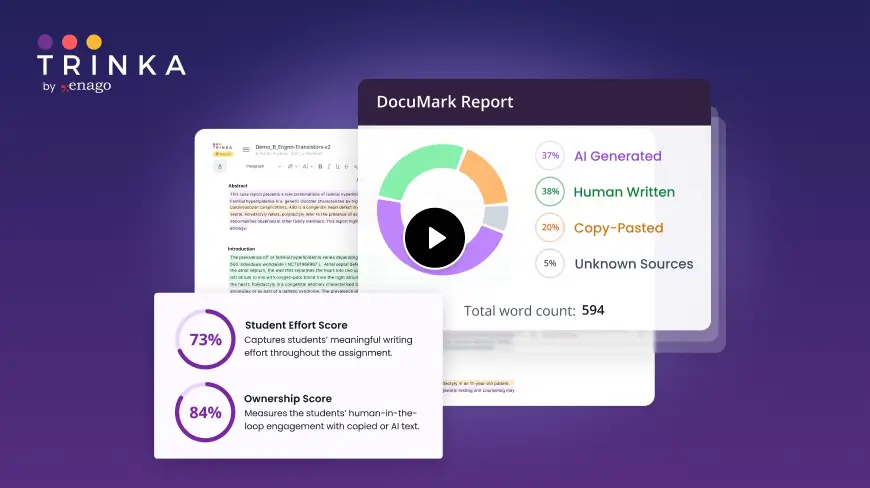
DocuMark: Responsible AI Use for Academic Integrity
Knowing your institution's AI policy is step one. DocuMark helps enforce it fairly by empowering universities to manage AI-generated content, prevent cheating, and support student writing through responsible AI use.
Common Questions About Gonzaga University's AI Policies
Gonzaga University has defined AI policies in 12 of 12 categories, with an overall coverage score of 100%.
Disclosure and attribution are required when AI use is permitted. Student guidance instructs students to ask instructors how to disclose or cite AI use and says they should always be honest and clear about how AI was used. The faculty guide also requires acknowledgment and appropriate citation or verification in scholarship and research uses.
The provided sources do not define a university stance on AI detection tools. They do define enforcement for academic integrity violations generally: violations are not tolerated, and the minimum sanction for a violation is a zero on the test or assignment, with any make-up option left to faculty discretion.
Gonzaga has explicit institution-level AI data protection rules. Users are urged to use university-managed or approved sandboxed AI systems for Gonzaga data, and Gonzaga data may only be used with tools approved through vendor review and managed by ITS. Sensitive data such as PII and PHI must not be uploaded to unapproved platforms. The approved list in the guideline permits Microsoft Copilot, Gemini, NotebookLM, and Consensus only when logged in using Gonzaga SSO, while ChatGPT, Claude, DeepSeek, Otter, and other non-sandboxed AI are marked not approved for Gonzaga data.