Teaching & Learning
- Use of AI for academic work is at instructor discretion
- Students must follow the AI guidelines for each class or project and consult the instructor and course policies before using AI
Students should make sure they understand AI guidelines for their classes and other academic projects (e.g. Clinic, thesis). Students must consult with the instructor and course policies – seeking clarification as needed – before using AI for academic work. The operational guidelines referenced on this site are intended to complement—not replace—the specific instructions and expectations set by individual faculty members.
- Harvey Mudd's Honor Code governs academic integrity in all assessments
- No AI-specific examination policy is defined in the available sources; the Honor Code establishes general integrity expectations that apply to all academic work, including exams, but does not enumerate AI-specific rules for formal assessments
The Honor Code means closed-book exams in your dorm room. No AI-specific examination rule is stated in the available sources; the Honor Code's general standards include honesty and integrity in both academic and personal matters and compliance with College regulations and policies.
- NotebookLM is explicitly described as supporting summaries, study guides, flash cards, and related learning uses
- The college provides approved AI tools that can be used for study support, and students are strongly encouraged to use those college-supported tools rather than consumer versions when AI use is approved
Harvey Mudd College students have access to AI that meets college data protection requirements for AI tools, included in Google Workspace (Gemini and NotebookLM) and Microsoft 365 (Copilot). If a student is using AI for an approved use, they are strongly encouraged to use these tools as opposed to consumer versions (whether free or paid) and especially if they are working with college data.
It allows users to ask questions, generate summaries, create study guides, flash cards, or produce mind maps and narrated slide videos directly from those sources.
- No explicit university-wide AI code generation policy was found in the extracted sources
- Code generation use falls under the general instructor-discretion framework: students must follow course-specific AI guidelines and consult instructors before using AI for programming assignments
Students should make sure they understand AI guidelines for their classes and other academic projects. Students must consult with the instructor and course policies – seeking clarification as needed – before using AI for academic work.
Research
- However, an advisor may permit specific AI uses in other parts of the research process, and any approved use requires full disclosure
- A department-specific chemistry thesis policy prohibits using generative AI to produce thesis text, treating it as an Honor Code violation
In alignment with the goals and intended outcomes of this thesis course (including independent information sourcing, effective communication, and fundamentally, the production of an original thesis), the use of generative artificial intelligence (i.e. tools like ChatGPT) for producing text in your thesis is not allowed. It will count as an Honor Code Violation.
All the text in your thesis must be solely your work, reflecting your unique perspective, arguments, and insights, which will be developed through your research. Text that is mechanically produced or derived using generative AI does not constitute your original work (academic journals are increasingly forbidding AI-generated text). However, recognizing that AI can have legitimate and powerful applications in other aspects of the research process, your research advisor may permit some specific uses for your particular thesis project. In instances where approval is given, you are required to offer full disclosure about the nature and extent of the AI usage.
- University-wide data rules also restrict which AI systems may be used with protected college data
- The chemistry thesis instructions allow the possibility of AI use in parts of the research process other than thesis text, but only if the research advisor permits specific uses
However, recognizing that AI can have legitimate and powerful applications in other aspects of the research process, your research advisor may permit some specific uses for your particular thesis project. In instances where approval is given, you are required to offer full disclosure about the nature and extent of the AI usage.
“Only Google Workspace for Education, Microsoft 365 for Education and Workday can be used on P3 and P4 data.”
“Make sure you know whether the AI you’re interested in is on the college approved list or not. If it is not, you cannot use it with P4 and P3 data but you can still use it with P2 data and P1 data.”
- The provided sources do not define AI rules for grant proposals, IRB submissions, or research ethics declarations
- The available research-related integrity guidance in the sources is limited to the chemistry thesis policy and general Honor Code expectations
not defined
Academic Integrity
- When AI use is approved in specific contexts, such as the chemistry thesis, full disclosure of the nature and extent of AI usage is required
- The broader AI guidelines direct users to understand which AI tools are approved and to comply with data handling rules, but a formal university-wide AI citation or attribution format is not explicitly defined in the available sources
In instances where approval is given, you are required to offer full disclosure about the nature and extent of the AI usage.
“Make sure you know whether the AI you’re interested in is on the college approved list or not.”
- The sources do not mention AI detection tools
- For enforcement, the chemistry thesis policy states that prohibited AI-generated thesis text will count as an Honor Code violation, and the college Honor Code emphasizes honesty, integrity, and compliance with college policies
In alignment with the goals and intended outcomes of this thesis course (including independent information sourcing, effective communication, and fundamentally, the production of an original thesis), the use of generative artificial intelligence (i.e. tools like ChatGPT) for producing text in your thesis is not allowed. It will count as an Honor Code Violation.
Harvey Mudd College is an inclusive community of faculty, staff and students. Students entering the community are assumed to have an earnest purpose. Diligent pursuit of this purpose is enhanced by standards of conduct agreed upon by the community. These standards are:
1. Thoughtful respect for the rights of others;
2. Honesty and integrity in both academic and personal matters;
3. Responsible behavior both on and off campus;
4. Appropriate use of campus buildings and equipment, and;
5. Compliance with College regulations and policies
Institutional & Administrative
- Faculty and staff may purchase premium AI licenses through CIS
- Harvey Mudd's AI materials address faculty and staff as users of college-supported AI tools and professional development resources
- No explicit policy on AI use for grading, feedback, recommendation letters, or administrative communications was found in the extracted sources
As the AI landscape evolves, Harvey Mudd College is implementing a proactive strategy focused on academic impact, faculty/staff professional development, and operational compliance. This site is a resource for this ongoing work.
Faculty and staff may contact CIS to purchase licenses for Google AI Pro for Education or Microsoft 365 Copilot.
- Harvey Mudd directs users to college-supported AI tools with enhanced data protection and strongly encourages use of approved institutional versions rather than consumer versions
- Protected data may only be used in approved systems, only certain platforms may be used with P3 and P4 data, and approved vendors must meet contract, privacy, security, and data-handling requirements
College-Supported AI Tools: The college provides AI tools with enhanced data protection through your official college accounts using your HMC credentials. The “basic” versions are included in each suite and we strongly encourage you to use these approved versions, because they provide better protections than the consumer versions.
“P3 and P4 data can only be used in systems that are approved by the college.“
“Only Google Workspace for Education, Microsoft 365 for Education and Workday can be used on P3 and P4 data.”
“Make sure you know whether the AI you’re interested in is on the college approved list or not. If it is not, you cannot use it with P4 and P3 data but you can still use it with P2 data and P1 data.”
The following are our current AI requirements for systems that may be used on P3 and P4 data:
* A formal contract between the software vendor and the college must be signed by an authorized signer and in accordance to HMC’s contract procedures.
* The vendor must not use HMC data to train its AI models.
* The vendor’s employees must not review HMC data.
* HMC must control whether data leaves the college “tenant”.
* The vendor’s service must meet the college’s privacy, security and compliance requirements.
* The vendor must agree to promptly destroy the tenant data at the end of the contract.
- Harvey Mudd states that it is pursuing a proactive institutional AI strategy focused on academic impact, professional development, and operational compliance
- AI governance is currently handled by a designated operational oversight group representing academic affairs, operations, and technology, with decisions described as still unfolding
As the AI landscape evolves, Harvey Mudd College is implementing a proactive strategy focused on academic impact, faculty/staff professional development, and operational compliance. This site is a resource for this ongoing work.
We recognize that many decisions about AI use are still unfolding. For now, the following will serve as the designated group for operational AI oversight:
Karl Haushalter, Vice President of Academic Affairs and Dean of Faculty
Andrew Dorantes, Senior Vice President and Chief Operating Officer
Joseph Vaughan, CIO/VP for Computing and Information Services
This group represents faculty, operations, and technology and their roles position them to gather feedback from across the community and ensure alignment with contractual and cybersecurity obligations.
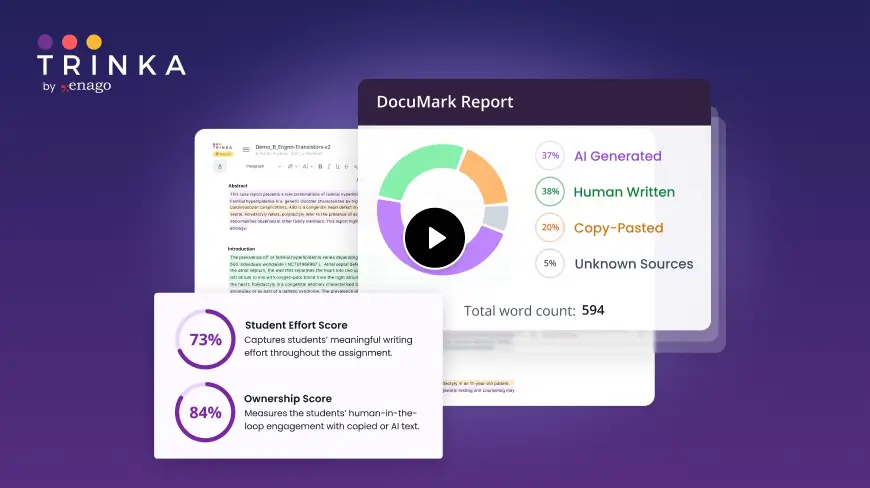
DocuMark: Responsible AI Use for Academic Integrity
Knowing your institution's AI policy is step one. DocuMark helps enforce it fairly by empowering universities to manage AI-generated content, prevent cheating, and support student writing through responsible AI use.
Common Questions About Harvey Mudd College's AI Policies
Harvey Mudd College has defined AI policies in 12 of 12 categories, with an overall coverage score of 100%.
When AI use is approved in specific contexts, such as the chemistry thesis, full disclosure of the nature and extent of AI usage is required. The broader AI guidelines direct users to understand which AI tools are approved and to comply with data handling rules, but a formal university-wide AI citation or attribution format is not explicitly defined in the available sources.
The sources do not mention AI detection tools. For enforcement, the chemistry thesis policy states that prohibited AI-generated thesis text will count as an Honor Code violation, and the college Honor Code emphasizes honesty, integrity, and compliance with college policies.
Harvey Mudd directs users to college-supported AI tools with enhanced data protection and strongly encourages use of approved institutional versions rather than consumer versions. Protected data may only be used in approved systems, only certain platforms may be used with P3 and P4 data, and approved vendors must meet contract, privacy, security, and data-handling requirements.