Teaching & Learning
- Haverford does not set a single college-wide rule for student AI use in coursework
- One cited example allows AI for short assignments with citation requirements but not for longer essays
- The institution states that departments and individual faculty members retain autonomy, and course-level approaches range from required use to outright bans
At this point, Haverford has no plans for a top-down, blanket policy, says Benjamin Le, senior associate provost for academic affairs.
Rather than imposing a stringent policy, White says, the College continues to respect the autonomy of each department and individual faculty members to develop discipline-specific approaches to AI's place in their classrooms.
The result is a range of approaches, from required usage for some classes and assignments to outright bans—and everything in between.
Elsewhere on campus, Professor of Political Science Craig Borowiak allows his students to use AI to produce snapshots of the state of the field for short assignments—as long as they cite the prompts and the model used—but not for longer essays or exams, he says.
- Haverford does not provide a uniform institution-wide exam rule in the provided sources
- AI use in exams is left to faculty or course-level discretion, and at least one faculty example explicitly prohibits it
At this point, Haverford has no plans for a top-down, blanket policy, says Benjamin Le, senior associate provost for academic affairs.
Rather than imposing a stringent policy, White says, the College continues to respect the autonomy of each department and individual faculty members to develop discipline-specific approaches to AI's place in their classrooms.
Elsewhere on campus, Professor of Political Science Craig Borowiak allows his students to use AI to produce snapshots of the state of the field for short assignments—as long as they cite the prompts and the model used—but not for longer essays or exams, he says.
- Haverford leaves AI use for learning support to individual instructors rather than imposing a college-wide rule
- The sources include a course example in which students are permitted to ask an AI assistant for help when they are stuck, while another faculty member states that outside courses explicitly focused on AI, she does not allow students to use AI tools in their academic work
Meanwhile, Professor of Computer Science David G. Wonnacott permits students in his "Introduction to Computer Science" course to ask an AI assistant for help when they're stuck.
At this point, Haverford has no plans for a top-down, blanket policy, says Benjamin Le, senior associate provost for academic affairs.
Rather than imposing a stringent policy, White says, the College continues to respect the autonomy of each department and individual faculty members to develop discipline-specific approaches to AI's place in their classrooms.
Turning to teaching and learning, Friedler expressed her firm stance on students' use of large language models, which, she stressed, does not necessarily reflect the views of her colleagues. Outside of courses explicitly focused on AI, she does not allow students to use AI tools in their academic work.
- Haverford has no college-wide programming-AI policy in the provided sources and instead defers to instructor discretion
- In computer science, one instructor permits students to use an AI assistant for help when stuck and demonstrates AI coding tools, while noting that he had previously banned AI for assignments
Meanwhile, Professor of Computer Science David G. Wonnacott permits students in his "Introduction to Computer Science" course to ask an AI assistant for help when they're stuck.
On a Thursday afternoon in September, he spent the last 20 minutes of class demonstrating AI coding tools.
Until this semester, Wonnacott had banned the use of AI for assignments.
At this point, Haverford has no plans for a top-down, blanket policy, says Benjamin Le, senior associate provost for academic affairs.
Rather than imposing a stringent policy, White says, the College continues to respect the autonomy of each department and individual faculty members to develop discipline-specific approaches to AI's place in their classrooms.
Research
- The College is described as broadly exploring AI's role in research, but no specific guidance for research writing has been issued
- Haverford has no explicit college-wide policy governing AI use in research writing or manuscript preparation in the provided sources
- However, the College's research integrity framework implicitly applies: fabrication, falsification, and plagiarism provisions in the research misconduct policy would cover undisclosed AI-generated content in manuscripts
Research misconduct means fabrication, falsification, or plagiarism in proposing, performing, or reviewing research, or in reporting research results.
Across this academic year, faculty, students, and staff are exploring AI's role in teaching, learning, research, and operations.
Professor of Chemistry Alexander Norquist and his student lab assistants regularly use machine learning to detect patterns in data and to augment understanding of experiments, he says, adding that the advent of large language models (LLMs), such as ChatGPT, offers another tool for advancing research into new materials.
- They note faculty and student use of machine learning to detect patterns in data and state that the College is exploring AI's role in research
- The provided sources describe AI and machine learning as being used in research and analysis contexts, but they do not set a formal university-wide rule governing such use
Professor of Chemistry Alexander Norquist and his student lab assistants regularly use machine learning to detect patterns in data and to augment understanding of experiments, he says, adding that the advent of large language models (LLMs), such as ChatGPT, offers another tool for advancing research into new materials.
Across this academic year, faculty, students, and staff are exploring AI's role in teaching, learning, research, and operations.
- Haverford's formal research misconduct policy addresses research integrity generally, but it does not mention AI specifically in the provided sources
- It requires honesty, rigor, and transparency in research and defines misconduct as fabrication, falsification, or plagiarism in proposing, performing, reviewing, or reporting research
Haverford College is committed to upholding the highest ethical standards in research and fostering an environment that promotes research integrity and the responsible conduct of research, discourages research misconduct, and deals promptly with allegations or evidence of possible research misconduct.[2]1
Research misconduct means fabrication, falsification, or plagiarism in proposing, performing, or reviewing research, or in reporting research results. Research misconduct does not include honest error or differences of opinion.
All institutional members are expected to conduct research with honesty, rigor, and transparency. Each institutional member is responsible for contributing to an organizational culture that establishes, maintains, and promotes research integrity and
Academic Integrity
- Haverford does not provide a college-wide disclosure rule in the provided sources
- However, one faculty example requires students using AI for certain short assignments to cite both the prompts and the model used
Elsewhere on campus, Professor of Political Science Craig Borowiak allows his students to use AI to produce snapshots of the state of the field for short assignments—as long as they cite the prompts and the model used—but not for longer essays or exams, he says.
At this point, Haverford has no plans for a top-down, blanket policy, says Benjamin Le, senior associate provost for academic affairs.
- Haverford has no AI-specific detection tools or enforcement procedures defined in the provided sources
- AI misuse in academic work would fall under the College's Honor Code framework, established in 1897, which governs academic integrity
- Breaches are addressed through informal peer-to-peer confrontation or formal Honor Council proceedings; the Honor Code operates on a trust-based model without reference to specific AI detection software
Generations of Haverford College students have demonstrated an abiding commitment to the shared community values of trust, concern, and respect. Established in 1897, our Honor Code provides an overarching framework for students to confront peers who may fall short of these community values in their academic pursuits and/or social lives.
Breaches of community values are most often resolved through informal peer-to-peer confrontation or through an Honor Council proceeding.
At this point, Haverford has no plans for a top-down, blanket policy, says Benjamin Le, senior associate provost for academic affairs.
Institutional & Administrative
- The college has created faculty/staff programs and groups around generative AI, and faculty and staff are described as exploring AI's role in teaching, learning, research, and operations
- Haverford actively supports faculty and staff engagement with AI, especially for pedagogy and shared practice development, but the provided sources do not set binding rules for grading, recommendation letters, or administrative communications
This academic year, the technology has increasingly taken center stage as the College launches various projects. They include a new Community of Practice focused on generative AI in pedagogy that Libraries and Instructional and Information Technology Services is organizing; a new faculty AI Working Group; and a Dec.
In addition, Haverford is offering faculty and staff AI Ready, a monthly webinar about leveraging generative AI developed by the Council for Independent Colleges.
Across this academic year, faculty, students, and staff are exploring AI's role in teaching, learning, research, and operations.
Alongside our colleagues at Bryn Mawr and Swarthmore, Haverford is engaged with the Council of Independent Colleges' AI Ready program, an opportunity for faculty and staff from liberal arts colleges to share resources and best practices.
- Haverford has identified Amplify GenAI, an open-source platform developed at Vanderbilt University, as an institutionally supported AI tool that provides secure access to multiple large language models including ChatGPT, Claude, Mistral, and DeepSeek
- No separate AI-specific data-entry policy exists in the provided sources, but the College's Acceptable Use of Information Technology Policy imposes general confidentiality and data-security requirements on all users, prohibiting unauthorized access or distribution of restricted data and requiring adherence to IITS security procedures
The College also is piloting Amplify GenAI, an open-source platform out of Vanderbilt University that gives secure access to ChatGPT, Claude, Mistral, DeepSeek and other LLMs.
Damage to Confidentiality. Intentional or negligent distribution of restricted data to non-authorized audiences. Unauthorized access, possession, or distribution of data that are confidential under the College's Confidentiality Policy, regarding privacy or confidentiality of student, administrative, personnel, archival, or other records.
Users must follow all IITS procedures and recommendations related to the security of college equipment and data.
Employees must adhere to the Data Confidentiality Policy & Employee Confidentiality Statement.
- Haverford is pursuing an AI governance approach centered on values, working groups, pilot programs, and community dialogue rather than a single blanket policy
- The college frames AI work around ethical engagement and critical inquiry, has launched a community of practice and a faculty AI working group, and is developing guidance and best practices aligned with institutional values
At this point, Haverford has no plans for a top-down, blanket policy, says Benjamin Le, senior associate provost for academic affairs. Instead, the College is supporting a collaborative process, helmed by faculty and staff, that includes working groups, pilot programs, and community dialogue to develop guidance aligned with the College's core values.
This academic year, the technology has increasingly taken center stage as the College launches various projects. They include a new Community of Practice focused on generative AI in pedagogy that Libraries and Instructional and Information Technology Services is organizing; a new faculty AI Working Group; and a Dec.
What we're doing is guided by our values as a college around integrity, academic excellence, and ethical engagement with AI.
Ultimately, Provost White says, Haverford is looking to establish best practices, particularly the principled use of AI, and lead in this space.
Few technological advancements have spurred as much excitement and concern as the rise of artificial intelligence. From our classrooms to our living rooms, AI—especially large language models like ChatGPT—is quickly reshaping how we work, learn, and create. At Haverford, we are considering AI's influence and potential with the same core values that have guided our community for nearly two centuries: ethical engagement and critical inquiry.
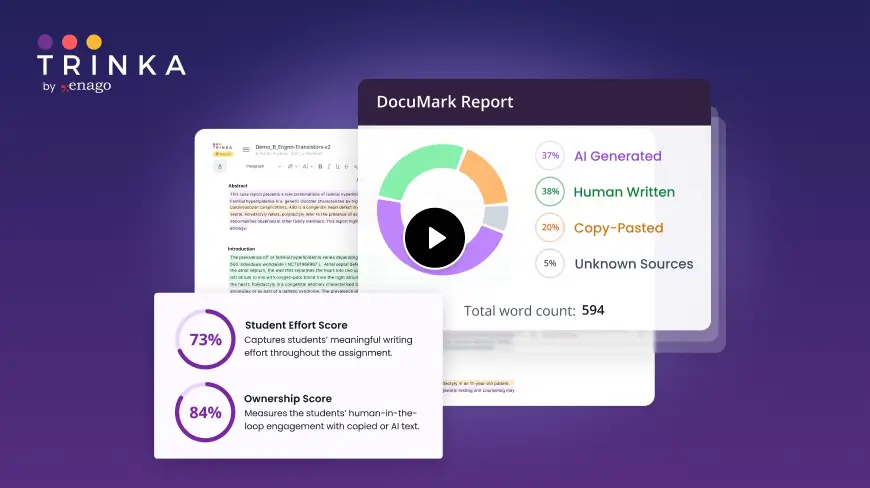
DocuMark: Responsible AI Use for Academic Integrity
Knowing your institution's AI policy is step one. DocuMark helps enforce it fairly by empowering universities to manage AI-generated content, prevent cheating, and support student writing through responsible AI use.
Common Questions About Haverford College's AI Policies
Haverford College has defined AI policies in 12 of 12 categories, with an overall coverage score of 100%.
Haverford does not provide a college-wide disclosure rule in the provided sources. However, one faculty example requires students using AI for certain short assignments to cite both the prompts and the model used.
Haverford has no AI-specific detection tools or enforcement procedures defined in the provided sources. AI misuse in academic work would fall under the College's Honor Code framework, established in 1897, which governs academic integrity. Breaches are addressed through informal peer-to-peer confrontation or formal Honor Council proceedings; the Honor Code operates on a trust-based model without reference to specific AI detection software.
Haverford has identified Amplify GenAI, an open-source platform developed at Vanderbilt University, as an institutionally supported AI tool that provides secure access to multiple large language models including ChatGPT, Claude, Mistral, and DeepSeek. No separate AI-specific data-entry policy exists in the provided sources, but the College's Acceptable Use of Information Technology Policy imposes general confidentiality and data-security requirements on all users, prohibiting unauthorized access or distribution of restricted data and requiring adherence to IITS security procedures.