Teaching & Learning
- Students may use AI only within the scope permitted by the instructor, and unauthorized use can constitute deception if the work no longer reflects the student's own independent performance
- For teaching and learning, AI use in coursework is not uniformly allowed or banned across the university; instructors are expected to decide course-specific rules and communicate them clearly
The use of AI applications in the classroom must be viewed in a differentiated manner and be decided by the teachers and lecturers in the context of the specific teaching and learning setting.
At the beginning of a course, teachers should specify if and to what extent the use of AI applications is possible and useful in the individual teaching-learning setting. This also applies to the examination setting and should be communicated transparently.
If the use of AI applications for independent study is not explicitly permitted by the examiner, students are not allowed to use them.
The unauthorized use of AI applications can always constitute an attempt to deceive if the work submitted is no longer the student's own independent and autonomous work.
- Use of AI in examinations is determined by the examiner or teaching staff and must be announced transparently
- If AI is not explicitly permitted in an exam context, students may not use it, and undisclosed or unauthorized use may be treated as attempted deception or grounds for failure
This also applies to the examination setting and should be communicated transparently.
If the use of AI applications for independent study is not explicitly permitted by the examiner, students are not allowed to use them.
The unauthorized use of AI applications can always constitute an attempt to deceive if the work submitted is no longer the student's own independent and autonomous work.
Any unauthorized use of AI applications in coursework, examinations and assessments may constitute cheating and may result in a fail if the student does not disclose and authorise such use.
- However, students are told not to rely on AI answers uncritically and must verify outputs because AI can generate incorrect or fabricated content
- The university encourages reflective and responsible use of AI as a study aid, such as using it as a learning partner, for feedback, language correction, or structuring ideas
How can ChatGPT and other AI applications support your studies?
Study partner and tutor
Feedback on texts and ideas
Language correction and translation
Structuring and brainstorming
Support with literature research and organization
Practice and exam preparation
Take note of where AI applications can support your learning process and where they have limitations. Critically question the results of AI applications. Be aware that these systems can produce errors or made-up information. See AI applications as support tools, not as replacement for your own critical thinking and learning.
Research
- AI tools cannot be listed as authors, and their use must be acknowledged and documented according to disciplinary and publisher requirements
- Heidelberg permits AI tools to support language revision and readability in academic writing, but authors remain fully responsible for the final text and must verify all content
The use of AI tools can facilitate the research and publication process, e.g. by helping to identify, summarise and structure texts or data, or by improving readability and language. However, the use of AI tools also carries risks: AI applications may provide incorrect information, generate fabricated references or produce results influenced by the training data used. This can lead to distorted, incomplete or false statements. Therefore, all information generated by AI applications should be carefully checked and documented.
The use of AI-based tools is only permissible if their use is clearly acknowledged and documented in accordance with the standards applicable in the respective subject area and the requirements of the relevant journal.
As AI tools cannot assume responsibility for a scientific paper, they cannot be listed as authors.
- Researchers must also ensure that no personal, confidential, or unpublished data are entered into AI systems unless legal and contractual requirements are satisfied
- The university allows AI tools to assist with identifying, summarizing, and structuring data, but requires researchers to critically check and document AI-generated information and results
The use of AI tools can facilitate the research and publication process, e.g. by helping to identify, summarise and structure texts or data, or by improving readability and language.
Therefore, all information generated by AI applications should be carefully checked and documented.
When using AI tools, please note that personal, confidential or unpublished data and information that may be relevant to patents may not be entered into AI applications.
- The university frames AI use in research under good academic practice: researchers remain responsible for accuracy, documentation, and compliance with disciplinary standards
- AI use is permissible only when transparently acknowledged, and researchers must protect confidential, personal, unpublished, and patent-relevant information when using such tools
The use of AI-based tools is only permissible if their use is clearly acknowledged and documented in accordance with the standards applicable in the respective subject area and the requirements of the relevant journal.
As AI tools cannot assume responsibility for a scientific paper, they cannot be listed as authors.
When using AI tools, please note that personal, confidential or unpublished data and information that may be relevant to patents may not be entered into AI applications.
Academic Integrity
- Disclosure of AI use is required when AI is used in assessed student work and in research writing
- Heidelberg provides a sample declaration for students to specify which AI tools were used, for what purpose, and to confirm responsibility for the submitted work
If I use AI-based applications in an examination, I undertake to identify this use in full. I provide information on which AI-based applications and other aids I have used and to what extent. I am responsible for the content generated by the AI application and integrated into my own work and assure that I have critically reviewed the texts and drafts generated by the AI. I take responsibility for any errors or omissions as if I had written this content entirely by myself.
The use of AI-based tools is only permissible if their use is clearly acknowledged and documented in accordance with the standards applicable in the respective subject area and the requirements of the relevant journal.
- Heidelberg treats unauthorized AI use as a potential attempt to deceive or cheat in coursework, examinations, and assessments, with possible failure as a consequence
- The provided sources do not define a university position on AI detection software; the enforcement language centers on authorization and disclosure rather than detector tools
The unauthorized use of AI applications can always constitute an attempt to deceive if the work submitted is no longer the student's own independent and autonomous work.
Any unauthorized use of AI applications in coursework, examinations and assessments may constitute cheating and may result in a fail if the student does not disclose and authorise such use.
Institutional & Administrative
- Faculty are expected to make context-specific decisions about AI use in teaching and to communicate permitted use to students at the start of a course
- The university also advises teaching staff to use AI critically and notes concrete applications such as preparing teaching materials, designing assessments, and supporting feedback, while emphasizing that AI does not replace instructors
The use of AI applications in the classroom must be viewed in a differentiated manner and be decided by the teachers and lecturers in the context of the specific teaching and learning setting.
At the beginning of a course, teachers should specify if and to what extent the use of AI applications is possible and useful in the individual teaching-learning setting.
For teachers, AI applications can support the preparation and implementation of teaching in many ways:
Creation of teaching materials and lesson planning
Development of assignments and assessments
Support for feedback processes
Research and information processing
Administrative tasks and communication
At the same time, critical questioning and conscious use are essential. AI applications do not replace the role of the teacher, but can be useful tools in many areas.
- Heidelberg also offers centrally provided AI services through the university computing center, including local and open-source options and a campus-wide Microsoft Copilot service
- The university warns that publicly accessible AI tools should not be used with personal, confidential, unpublished, or patent-relevant information, and it directs users to review providers' terms and privacy conditions carefully
It must be noted that data entered into publicly accessible AI tools can often be used to further train the models. Terms of use and data protection conditions should therefore be checked before use.
When using AI tools, please note that personal, confidential or unpublished data and information that may be relevant to patents may not be entered into AI applications.
The University Computing Center (URZ) offers a range of centrally provided AI-based services for members of Heidelberg University for use in research, teaching, studies, and administration.
We offer locally hosted open-source AI applications and university-wide licensed, proprietary AI applications such as Microsoft Copilot Chat. All services are intended to support university tasks and are available free of charge to members of Heidelberg University.
- Its guidance emphasizes responsible, reflective, and legally compliant use, along with centrally supported AI infrastructure and information services
- Heidelberg has adopted institution-level guiding principles for the research and use of AI and frames AI as a strategic, university-wide topic spanning research, teaching, studies, and administration
Heidelberg University's Guiding Principles for the Research and Use of AI aim to set out the opportunities and risks associated with AI and formulate principles for its use.
AI applications are increasingly becoming integrated into various areas of university life. Artificial intelligence offers new opportunities for research, studies, teaching and administration, but also presents challenges.
The University Computing Center (URZ) offers a range of centrally provided AI-based services for members of Heidelberg University for use in research, teaching, studies, and administration.
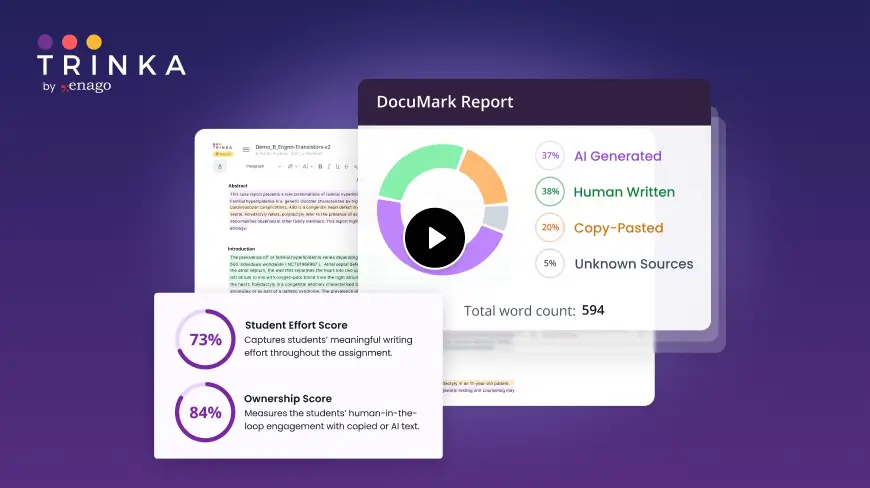
DocuMark: Responsible AI Use for Academic Integrity
Knowing your institution's AI policy is step one. DocuMark helps enforce it fairly by empowering universities to manage AI-generated content, prevent cheating, and support student writing through responsible AI use.
Common Questions About Heidelberg University's AI Policies
Heidelberg University has defined AI policies in 11 of 12 categories, with an overall coverage score of 92%.
Disclosure of AI use is required when AI is used in assessed student work and in research writing. Heidelberg provides a sample declaration for students to specify which AI tools were used, for what purpose, and to confirm responsibility for the submitted work.
Heidelberg treats unauthorized AI use as a potential attempt to deceive or cheat in coursework, examinations, and assessments, with possible failure as a consequence. The provided sources do not define a university position on AI detection software; the enforcement language centers on authorization and disclosure rather than detector tools.
The university warns that publicly accessible AI tools should not be used with personal, confidential, unpublished, or patent-relevant information, and it directs users to review providers' terms and privacy conditions carefully. Heidelberg also offers centrally provided AI services through the university computing center, including local and open-source options and a campus-wide Microsoft Copilot service.