Teaching & Learning
- Individual instructors may set a different class-specific AI policy in the syllabus, and that course policy takes precedence
- In the School of Law, the default rule prohibits generative AI on assessments, but instructors may allow it for graded or ungraded coursework under specified conditions
- For the MA-CBL graduate program, AI use on assignments is permitted only with instructor permission, and students are told AI should assist their work rather than replace it
The policy of the MA-CBL program is that students are allowed to use AI, with instructor permission. Students should be aware that copying and pasting content is considered plagiarism. Artificial Intelligence technology should be used to assist your work, not be a replacement for it.
An individual instructor may adopt a different AI policy specific to their class and clearly outline this in the course syllabus. For courses that have a policy that differs from the MA-CBL policy, the individual course policy will take precedent.
Instructors may develop more specific terms and conditions for the use of Generative AI in their courses. They may, for instance, allow students to use Generative AI tools for graded or ungraded course-work, but only under certain conditions, disclosures, or supervision.
- Instructors may create narrower course-specific exceptions, and students must follow those restrictions or consult the instructor if uncertain
- Separately, the OARS testing rules require technology devices, including AI glasses, to be placed in the Testing Coordinator’s office before exams
- The School of Law prohibits generative AI on law assessments by default at all stages, including writing, answering questions, and generating ideas or arguments
The use of Generative AI on School of Law Assessments is prohibited. This prohibition applies to all stages of the process of completing the assessment. Students may not use Generative AI to write any portion of an Assessment. Students may not use Generative AI to answer multiple-choice, short answer, or any other type of question on an Assessment. Students may not use Generative AI to generate ideas for topics to cover or arguments to make in a paper or other written Assessment.
Instructors may develop more specific terms and conditions for the use of Generative AI in their courses.
If there is uncertainty regarding permissible uses of Generative AI tools on a particular assignment, students must consult with the appropriate Instructor before making use of such tools.
All technology devices (cell phones, smart watches, AI glasses, etc.) must be placed in the Testing Coordinator’s office prior to the start of the exam.
- No binding university-wide student rule for personal study assistance is defined beyond these general statements
- In the QEP materials, the university describes AI-supported tutoring and practice tools as part of an AI-enhanced campus environment
- High Point University states an institutional goal of developing AI literacy and teaching students to use AI for enhancement rather than replacement
We foster a culture of ethical AI use, teaching students to use AI for enhancement rather than replacement, augmenting capabilities while maintaining authenticity, transparency, and respect for intellectual property.
Our goal is cultivating graduates who understand their obligation to use AI responsibly for society’s betterment. AI literacy is now fundamental to being an educated 21st-century citizen.
For students, tools like Socratic can provide personalized tutoring, helping students master challenging subjects through visual explanations, practice problems, and tailored follow-ups.
Research
Academic Integrity
- The MA-CBL graduate program requires students to cite AI-assisted assignment use under APA guidance
- The general university Honor Code also requires proper acknowledgment of quoted or paraphrased material and directs students to check syllabi for specific permissions
- The School of Law requires students to disclose generative AI use on written law assignments with a specific statement, and instructors may demand more detailed disclosure
When submitting an assignment that was assisted with the use of technology, the student must cite the use following APA guidelines found at https://apastyle.apa.org/blog/how-to-cite-chatgpt
Students must disclose the use of Generative AI on a written School of Law assignment by writing the following sentence at the end of the document: “I used Generative Artificial Intelligence in completing this assignment.” Individual Instructors may require more detailed disclosures, including the specific tool used and how it was used.
Proper acknowledgment involves clearly identifying the author and source of any quoted or paraphrased material, using quotation marks or indentation as needed.
Students should carefully read the syllabus designed for each class by the professor for specific permissions.
- No statement in the provided sources addresses AI detection software
- In the School of Law, violating restrictions on permitted generative AI use is explicitly an Honor Code violation, and law honor proceedings use a clear-and-convincing standard of proof
- High Point University's general Honor Code treats cheating, collusion, and plagiarism as violations and states the Honor Code is enforced by the Judicial Board with faculty and staff involvement
Every student is honor-bound to abstain from cheating;
Every student is honor-bound to abstain from collusion;
Every student is honor-bound to abstain from plagiarism;
The Honor Code is maintained and enforced by the Judicial Board of the Student Government Association, with faculty and staff involvement.
In the event that an Instructor permits or requires the use of Generative AI on an assignment but places restrictions on its use, students must comply with all restrictions, and it is a violation of this Honor Code to fail to comply with a restriction on Generative AI use.
The Respondent must be acquitted of a Complaint unless the violation alleged in the Complaint is proven by clear and convincing evidence to the satisfaction of all members of the Administrative Honor Panel hearing the case.
Institutional & Administrative
- No binding university-wide restrictions for faculty or staff AI use are defined in the provided sources
- High Point University provides AI resources for faculty and staff and describes AI as supporting faculty and staff across campus
- In the QEP materials, faculty are encouraged to use AI tools to streamline administrative tasks, provide feedback, and enrich teaching, while staff may use AI tools to automate forms, scheduling, and routine inquiries
Explore curated guides and tools designed to empower our campus community to thoughtfully navigate and leverage artificial intelligence.
Faculty members can also leverage AI to enhance their teaching experience. Gradescope can streamline administrative tasks, allowing professors to focus on mentorship and designing dynamic coursework. A professor can offer immediate and consistent feedback on assignments, enhancing student learning outcomes. Other tools like Perplexity can enrich classroom discussions with timely updates on recent developments and by posing hypothetical scenarios.
Similarly, faculty and staff can use Copilot or a similar tool to automate form processing and scheduling, along with the ability to manage routine student and parent inquiries.
- The provost frames AI literacy as fundamental and emphasizes authenticity, transparency, respect for intellectual property, and responsible use
- High Point University states a university-level strategy of integrating AI education across the curriculum while grounding adoption in traditional values and ethical use
- The QEP materials describe an AI-enhanced HPU in which AI supports students, faculty, and staff across campus life and positions the university as a leader in ethical, human-centered AI education
We provide educational experiences developing both AI literacy and timeless life skills, ensuring graduates leverage technology while maintaining the human engagement defining excellence. We foster a culture of ethical AI use, teaching students to use AI for enhancement rather than replacement, augmenting capabilities while maintaining authenticity, transparency, and respect for intellectual property.
At HPU we’re integrating AI education across our curriculum while ensuring traditional values guide technological adoption.
Embracing AI will not only future-proof our educational model but establish our institution as a leader in ethical, human-centered AI education.
Integration into Campus Life: At an AI-enhanced High Point University, AI seamlessly supports students, faculty, and staff, creating an engaging, supportive environment that blends innovation with liberal arts values. AI and technology integration will be incorporated throughout campus life, improving student learning, administrative processes, and resource access.
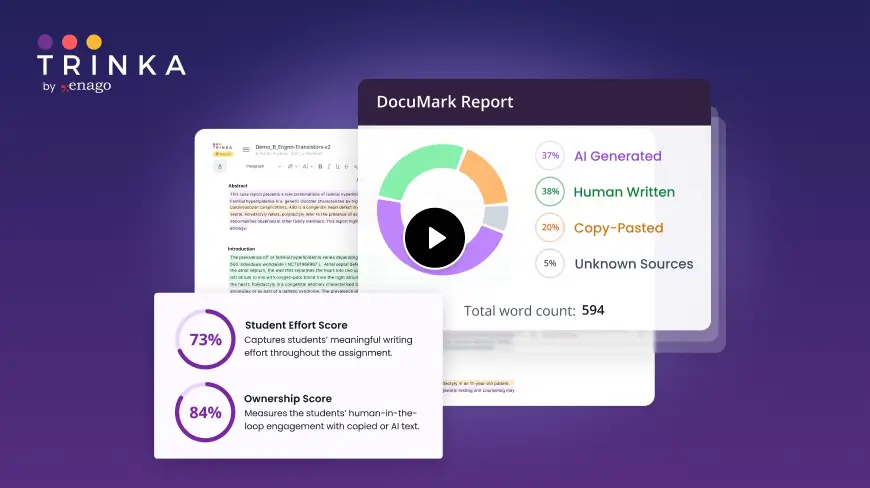
DocuMark: Responsible AI Use for Academic Integrity
Knowing your institution's AI policy is step one. DocuMark helps enforce it fairly by empowering universities to manage AI-generated content, prevent cheating, and support student writing through responsible AI use.
Common Questions About High Point University's AI Policies
High Point University has defined AI policies in 7 of 12 categories, with an overall coverage score of 58%.
The MA-CBL graduate program requires students to cite AI-assisted assignment use under APA guidance. The School of Law requires students to disclose generative AI use on written law assignments with a specific statement, and instructors may demand more detailed disclosure. The general university Honor Code also requires proper acknowledgment of quoted or paraphrased material and directs students to check syllabi for specific permissions.
High Point University's general Honor Code treats cheating, collusion, and plagiarism as violations and states the Honor Code is enforced by the Judicial Board with faculty and staff involvement. In the School of Law, violating restrictions on permitted generative AI use is explicitly an Honor Code violation, and law honor proceedings use a clear-and-convincing standard of proof. No statement in the provided sources addresses AI detection software.
No explicit data protection or approved AI platform policy is currently defined in the available policy sources.