Teaching & Learning
- Use of generative AI in graded coursework is at instructor discretion
- The library guidance also states that using AI for assignments without a professor's permission can be plagiarism
- Faculty are advised to set their own course policy and communicate it clearly, and students are directed to follow each professor's policy
Faculty establish policies for each class regarding the use of generative AI in coursework, and those policies need to be clearly communicated in every syllabus.
Those policies may include:
• Whether students may use generative AI in the course
• Under what conditions, or for what purposes, such use may occur
• What, if any, acknowledgments of the use of generative AI should accompany student work
Before using AI for your coursework, check your syllabus and/or ask your professor about the policy for use in your course.
If your professor or assignment guidelines permit you to use AI for your assignment, make sure to also understand the scope and limitations for that specific assignment. Remember, using AI in a way your professor hasn't authorized can be plagiarism.
- No institution-wide policy specifically addressing AI use in examinations or timed assessments is present in the available sources
- AI use in all assessed work, including exams, is implicitly governed by individual faculty course policies; students must consult their syllabus or instructor for guidance
Faculty establish policies for each class regarding the use of generative AI in coursework, and those policies need to be clearly communicated in every syllabus.
Before using AI for your coursework, check your syllabus and/or ask your professor about the policy for use in your course.
- The library guidance recommends verifying information, protecting privacy, and not treating AI output as an authoritative source
- Students are permitted to use AI for personal learning support such as explaining concepts, brainstorming search terms, building outlines, making glossaries, and generating practice questions
Use AI to explain concepts with examples.
Use AI to help with research, but remember to verify any sources it suggests. Ask it to suggest search terms, or help brainstorm ideas or keywords to aid your searching.
Use AI to help create an outline for writing.
Use AI to make a glossary based on notes or a textbook chapter.
Use AI to generate potential exam or discussion questions.
The information produced by generative AI is not always factual or accurate; therefore, AI should not be cited as an authoritative source itself.
Don't share any of your private information with an AI chatbot (or any personal, private, copyrighted, or class information).
Research
- The provided sources discuss AI use in classroom writing and learning, but they do not state a policy for using AI to draft, edit, or format research papers, theses, dissertations, or scholarly manuscripts
not defined
Academic Integrity
- Disclosure requirements are course-dependent
- The library provides example citation formats for ChatGPT and Microsoft Copilot
- Faculty are encouraged to specify whether acknowledgment of AI use is required, and students are directed to cite AI when their professor or assignment requires it
Those policies may include:
• Whether students may use generative AI in the course
• Under what conditions, or for what purposes, such use may occur
• What, if any, acknowledgments of the use of generative AI should accompany student work
When and How to Cite AI
You should cite AI in your work if your professor or assignment requires it.
How to cite it is going to depend on which citation style your professor wants you to use and what AI model you've used.
MLA Style (9th ed.)
Works Cited Example
“Describe the symbolism of the green light in The Great Gatsby.” Prompt. ChatGPT, 13 Feb. version, OpenAI, 15 Feb. 2023, chat.openai.com/chat.
APA Style (7th ed.)
In-text citation example
(OpenAI, 2023)
Reference list example
OpenAI. (2023). ChatGPT (Feb 13 version) [Large language model]. https://chat.openai.com/chat
Chicago Style (17th ed.)
Bibliography example
OpenAI. ChatGPT, February 13 Version. Large language model. February 15, 2023. https://chat.openai.com/chat.
MLA Style (9th ed.)
Works Cited Example
“Summarize the key themes in Beloved by Toni Morrison.” Prompt. Copilot, 26 Jan. 2024, copilot.microsoft.com.
APA Style (7th ed.)
In-text citation example
(Microsoft, 2024)
Reference list example
Microsoft. (2024). Copilot [Large language model]. https://copilot.microsoft.com
Chicago Style (17th ed.)
Bibliography example
Microsoft. Copilot. Large language model. Accessed January 26, 2024. https://copilot.microsoft.com.
- Faculty guidance advises against an adversarial or punitive framework, emphasising transparent expectations and dialogue instead
- Unauthorised AI use is framed as a potential plagiarism issue under existing academic integrity expectations rather than through a dedicated AI detection or enforcement protocol
Remember, using AI in a way your professor hasn't authorized can be plagiarism.
The use of AI in the classroom need not have an adversarial or punitive framework.
Institutional & Administrative
- The CTL resource provides sample syllabus language and guidance, advising faculty to set and clearly communicate class-specific AI rules
- Faculty are encouraged to become familiar with generative AI, experiment with its capabilities, and determine their own approach for each course
- A news article also describes faculty updating syllabus statements to specify how AI may and may not be used, with an emphasis on transparent expectations
It is important for faculty to become familiar with the use and capabilities of generative AI and determine where they stand on the issue in their teaching.
Faculty establish policies for each class regarding the use of generative AI in coursework, and those policies need to be clearly communicated in every syllabus.
Every faculty member has a syllabus statement. I am taking mine out and putting in one that says specifically how we are using AI in this class and under what circumstances it is appropriate.
Whether or not they decide to permit these technologies in the classroom, the important thing is that faculty set clear expectations about when and how students should engage with them and make those guidelines transparent to the students.
At the Center for Teaching and Learning, our goal is to provide information and resources to assist faculty in determining their own approaches to the use of generative AI in coursework and clarify those approaches to students.
- It also cautions that prompts may be used as training data
- No approved-platform list or formal institutional data classification scheme is stated in the provided sources
- The library guidance tells users not to enter private, personal, copyrighted, or class information into AI chatbots
Don't share any of your private information with an AI chatbot (or any personal, private, copyrighted, or class information).
Don't use chatbots for sensitive activities. Do not enter any information or concerns you'd want to keep private. Some chatbots may use prompts and input as training data, so imagine anything you type can be accessed by others.
- HWS is developing its AI governance capacity through an AI Advisory Committee, faculty-facing CTL resources, and campus programming rather than a single comprehensive written policy
- The Advisory Committee has organised events to demystify AI and build practical understanding among students, faculty, and staff, with the CTL focused on helping faculty determine and communicate their own course-level approaches
The HWS AI Advisory Committee has been working to provide opportunities for faculty and staff to better understand and effectively use these tools while also considering ethical and pedagogical implications.
Opening the Black Box, a workshop and panel event held in April by the HWS AI Advisory Committee, sought to demystify artificial intelligence and make AI education accessible to everyone—regardless of discipline or familiarity with technology.
The workshop and panel aimed to provide students, faculty and staff with a basic understanding of how AI systems function and practical strategies for incorporating them into teaching and learning.
At the Center for Teaching and Learning, our goal is to provide information and resources to assist faculty in determining their own approaches to the use of generative AI in coursework and clarify those approaches to students.
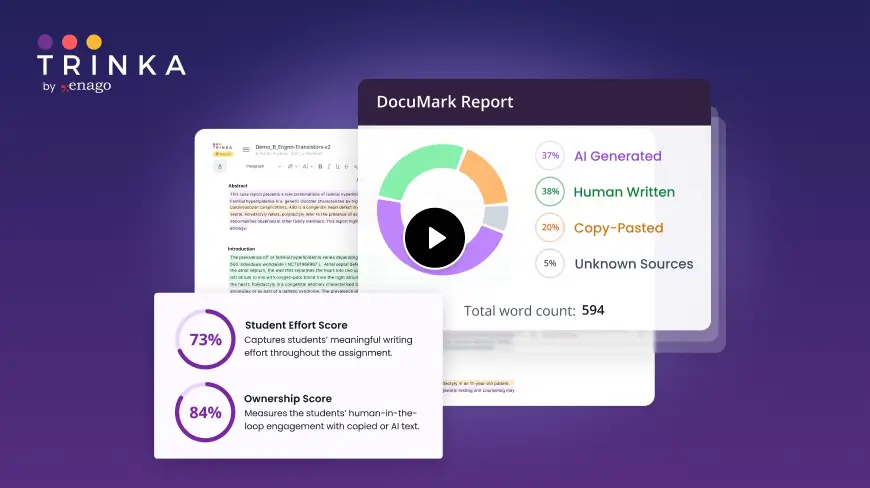
DocuMark: Responsible AI Use for Academic Integrity
Knowing your institution's AI policy is step one. DocuMark helps enforce it fairly by empowering universities to manage AI-generated content, prevent cheating, and support student writing through responsible AI use.
Common Questions About Hobart and William Smith Colleges's AI Policies
Hobart and William Smith Colleges has defined AI policies in 9 of 12 categories, with an overall coverage score of 75%.
Disclosure requirements are course-dependent. Faculty are encouraged to specify whether acknowledgment of AI use is required, and students are directed to cite AI when their professor or assignment requires it. The library provides example citation formats for ChatGPT and Microsoft Copilot.
Unauthorised AI use is framed as a potential plagiarism issue under existing academic integrity expectations rather than through a dedicated AI detection or enforcement protocol. Faculty guidance advises against an adversarial or punitive framework, emphasising transparent expectations and dialogue instead.
The library guidance tells users not to enter private, personal, copyrighted, or class information into AI chatbots. It also cautions that prompts may be used as training data. No approved-platform list or formal institutional data classification scheme is stated in the provided sources.