Teaching & Learning
- Use of AI for graded coursework is at instructor discretion
- Hofstra also provides model syllabus language under which AI may be used for assignments if it is acknowledged and cited
- Students must follow the AI rules stated in each course syllabus, and misuse of AI/ChatGPT may be treated as an Honor Code violation
Given the diverse topics, levels, pedagogies, and modes in education, instructors have broad discretion to determine the appropriate use of AI tools in their classrooms. This policy underscores the importance of instructor preference in defining suitable AI tool usage.
The right to use and the extent of AI tool use for a particular course is at the faculty's discretion. This includes specific conditions and criteria for permitted applications of the technology.
Students must read and abide by any statements in the syllabus regarding AI or seek further information from any instructor if needed. It is important for students to adhere to any established rules for using AI.
In general, the use of generative artificial intelligence tools must be consistent with the instructor’s stated course policy.
Refer to your course syllabi to learn about each of your instructor’s rules about the use of AI/ChatGPT in their classes. As we are beginning to see the potential benefits of artificial intelligence (AI), we must guard against potential misuse. It is imperative that you fully understand that misuse of AI/ChatGPT may be considered an Honor Code Violation. If you are unsure, ask your instructor.
Use of AI tools permitted with acknowledgement. Use of AI tools permitted with acknowledgement. You may use AI/ML tools such as ChatGPT or Dall-E on assignments, discussions, exams, and presentations in this course if you use clear and accurate citations in the assignment submission where and how AI/ML tools have been used. Any assignment that was completed with AI/ML tools must contain an appropriate citation.
- Exam use of AI is not governed by a single blanket rule; it depends on the instructor's course policy
- Hofstra's model syllabus language includes a version that permits AI on exams with acknowledgement and citation, while the Honor Code guidance stresses that students must follow the testing environment rules and instructor instructions
Given the diverse topics, levels, pedagogies, and modes in education, instructors have broad discretion to determine the appropriate use of AI tools in their classrooms. This policy underscores the importance of instructor preference in defining suitable AI tool usage.
In general, the use of generative artificial intelligence tools must be consistent with the instructor’s stated course policy.
Use of AI tools permitted with acknowledgement. Use of AI tools permitted with acknowledgement. You may use AI/ML tools such as ChatGPT or Dall-E on assignments, discussions, exams, and presentations in this course if you use clear and accurate citations in the assignment submission where and how AI/ML tools have been used. Any assignment that was completed with AI/ML tools must contain an appropriate citation.
Understand and respect the rules of the testing environment. Listen to your professor and/or read exam rules prior to starting the exam. In most cases, this means putting away all electronic devices including smart phones and watches, headphones, electronic glasses, etc. Make sure you understand whether you are permitted to use calculators and computers, and whether the test is in a “lockdown” mode.
- Hofstra encourages responsible AI use and positions AI tools as pedagogically valuable, but it does not set a separate university-wide rule specifically for private studying or tutoring use
- Students are encouraged to use AI responsibly and to critically evaluate AI-generated content, while faculty are also encouraged to direct students to non-AI academic support resources such as tutoring and writing support
Hofstra University recognizes the significant contributions and pedagogical value that Artificial Intelligence (AI) tools offer, while also recognizing the challenges and pitfalls presented by this emerging technology.
AI technologies, including generative text, image and other multimodal services, are integral to academic and professional disciplines and enhance courses and curricula across the University.
Incorporating these technologies requires an unwavering commitment to ethical considerations and recognition that appropriate ethical use will change over time. Faculty and students are encouraged to use AI responsibly, ensuring transparency, fairness, and respect for privacy.
All final works are the sole responsibility of the student. AI tools can generate false or biased content. Hence, it is essential for students to critically evaluate AI generated content before including it in submitted assignments.
Encourage students to take advantage of the academic support resources on campus that include Writing and Tutoring Centers and Student Access Services.
- Use of AI for programming-related work is at instructor discretion rather than governed by a separate university-wide coding rule
- Hofstra's model syllabus language treats a "computer program" as academic work subject to unauthorized-assistance rules, and faculty guidance includes having students evaluate AI-generated code
The right to use and the extent of AI tool use for a particular course is at the faculty's discretion. This includes specific conditions and criteria for permitted applications of the technology.
The academic community assumes that work of any kind--whether a research paper, a critical essay, a homework assignment, a test or quiz, a computer program, or a creative assignment in any medium--is done, entirely and without unauthorized assistance, by the individual(s) whose name(s) it bears. Students bear the ultimate responsibility for implementing the principles of academic integrity.
Submit a program or line of code then ask students to evaluate the response
Research
- No explicit rule on whether researchers may or may not use AI for manuscript preparation is stated in the provided sources
- Hofstra states that AI is being integrated across research and provides examples of AI use in research-related contexts, including grant proposal writing, but it does not define a specific university policy for drafting or editing research papers, theses, dissertations, or manuscripts
To support this vision, Hofstra has adopted a thoughtful and principled AI policy to ensure its ethical and effective integration across curriculum, research, and academic life.
In the 2024 academic year, Hofstra launched a pilot program for select faculty and staff to request a ChatGPT Edu license, supporting uses from instruction to research to operational tasks.
Explored the use of AI in grant proposal writing, to mixed results.
Explore upcoming workshops on ChatGPT Edu and other generative AI tools for teaching, learning, and research.
- Hofstra expresses a general commitment to ethical AI use in research and notes AI-related activity in grant proposal writing, but it does not define specific rules for AI use in grant proposals, IRB materials, or formal research ethics disclosures in the provided sources
To support this vision, Hofstra has adopted a thoughtful and principled AI policy to ensure its ethical and effective integration across curriculum, research, and academic life.
Incorporating these technologies requires an unwavering commitment to ethical considerations and recognition that appropriate ethical use will change over time. Faculty and students are encouraged to use AI responsibly, ensuring transparency, fairness, and respect for privacy.
Explored the use of AI in grant proposal writing, to mixed results.
AI challenges us with new ethical and legal questions. Hofstra welcomes the possibilities with open minds while keeping integrity and intellectual property front and center.
Academic Integrity
- Disclosure and citation of AI use are required when course policy permits AI with acknowledgement, and students must follow citation instructions in the syllabus
- If an instructor does not provide guidance, students are told to cite AI-derived content using the style closest to the course or department's normal academic format
Please note citation requirements in each course syllabus. If the instructor does not provide guidance, students should cite content derived from AI tools using the style most closely resembling the course or department's general academic submission format.
Use of AI tools permitted with acknowledgement. Use of AI tools permitted with acknowledgement. You may use AI/ML tools such as ChatGPT or Dall-E on assignments, discussions, exams, and presentations in this course if you use clear and accurate citations in the assignment submission where and how AI/ML tools have been used. Any assignment that was completed with AI/ML tools must contain an appropriate citation.
- The law school handbook also states penalties and procedures for violations of its Honor Code
- Hofstra cautions faculty against relying on AI detection tools as sole evidence because of inconsistent accuracy
- Instructors are told to consider multiple forms of evidence when evaluating suspected AI misuse, and misuse of AI/ChatGPT may be treated as an Honor Code violation under existing misconduct procedures
Faculty should exercise caution when using AI detection. Due to their inconsistent accuracy and the dynamic nature of the technologies involved, faculty should not rely on AI detection as the sole source of evidence in cases of suspected academic misconduct. Faculty Policy Series #11 should be consulted for guidance.
AI detection tools can provide useful insights, but instructors should consider multiple forms of evidence when evaluating potential misuses of AI to complete assignments.
Refer to your course syllabi to learn about each of your instructor’s rules about the use of AI/ChatGPT in their classes. As we are beginning to see the potential benefits of artificial intelligence (AI), we must guard against potential misuse. It is imperative that you fully understand that misuse of AI/ChatGPT may be considered an Honor Code Violation. If you are unsure, ask your instructor.
Students who are caught violating the Honor Code by cheating or plagiarizing, even if done so unintentionally or by mistake, may receive an Honor Code Violation and penalty.
Upon finding a violation, the Disciplinary Committee may:
i. Impose one or more of the following penalties:
A. Expulsion from Hofstra Law.
B. Suspension from Hofstra Law for a stated period of
time.
C. Probation for a stated period of time with specified
conditions.
D. Changing of grade in relevant courses.
E. Placement of a letter and final disciplinary
committee findings in the accused’s personal file.
F. Oral reprimand.
G. Restitution or restoration.
H. Notice and future notice to any bar or law school to
which the accused seeks admission.
Institutional & Administrative
- Faculty control AI rules in their courses and are expected to communicate those rules clearly in the syllabus and discuss them with students
- Hofstra also supports faculty and staff use of ChatGPT Edu and other tools for instruction, research, and operational tasks, and provides training and consultation through EdTech
The right to use and the extent of AI tool use for a particular course is at the faculty's discretion. This includes specific conditions and criteria for permitted applications of the technology.
The instructor should provide a clear statement about AI utilization in their course syllabus and respond to any student inquiries on the subject. It is also strongly recommended that the instructor discuss the statement at the course's beginning and as necessary throughout the semester.
This website offers faculty resources and recommendations to address the use of generative AI tools in your course(s), in addition to language for you to consider adding your syllabus.
In the 2024 academic year, Hofstra launched a pilot program for select faculty and staff to request a ChatGPT Edu license, supporting uses from instruction to research to operational tasks.
The team supports and provides training for a wide range of campus-supported instructional technologies, including Canvas, Zoom, Turnitin, Gradescope, Qualtrics, Kaltura, ChatGPT Edu, Respondus LockDown Browser and Monitor, VoiceThread, Simple Syllabus, WordPress, and Adobe Express.
- Hofstra does state generally that AI use should respect privacy
- The provided sources identify ChatGPT Edu and several other tools as campus-supported technologies, but they do not define a detailed data-classification or privacy-handling policy for what university information may be entered into AI tools
Faculty and students are encouraged to use AI responsibly, ensuring transparency, fairness, and respect for privacy.
Hofstra is the first institution on Long Island to launch ChatGPT Edu campus-wide.
The team supports and provides training for a wide range of campus-supported instructional technologies, including Canvas, Zoom, Turnitin, Gradescope, Qualtrics, Kaltura, ChatGPT Edu, Respondus LockDown Browser and Monitor, VoiceThread, Simple Syllabus, WordPress, and Adobe Express.
- Hofstra presents AI as part of its institutional strategy and says it has adopted a principled AI policy for integration across curriculum, research, and academic life
- Its governance and implementation structure includes campus initiatives, an AI Symposium for employees, EdTech support, and the Senate Committee on Education and Research Technology evaluating emerging technologies and recommending campus-wide initiatives
Hofstra 100, the strategic plan that charts the University’s path to its centennial in 2035, underscores the transformative role of technology, especially AI, as key to achieving organizational agility, student success, interdisciplinary innovation, and community impact.
To support this vision, Hofstra has adopted a thoughtful and principled AI policy to ensure its ethical and effective integration across curriculum, research, and academic life. In this way, AI is not just a tool but a catalyst woven into Hofstra’s future.
We want every member of the Hofstra community to be ready for the future. That’s why Hofstra has partnered with various technology leaders to launch initiatives that give all 10,000+ students and many faculty and administrators access to powerful AI tools and training.
In spring 2025, EdTech, Axinn Library, Office of the Provost, and ITS hosted the first AI Symposium for employees, highlighting how colleagues use AI in teaching, research, and operations
The team also collaborates with the Senate Committee on Education and Research Technology (SCERT) to evaluate emerging instructional technologies, recommend campus-wide technology initiatives, and promote the effective adoption of digital tools that support teaching, learning, and academic innovation across the University.
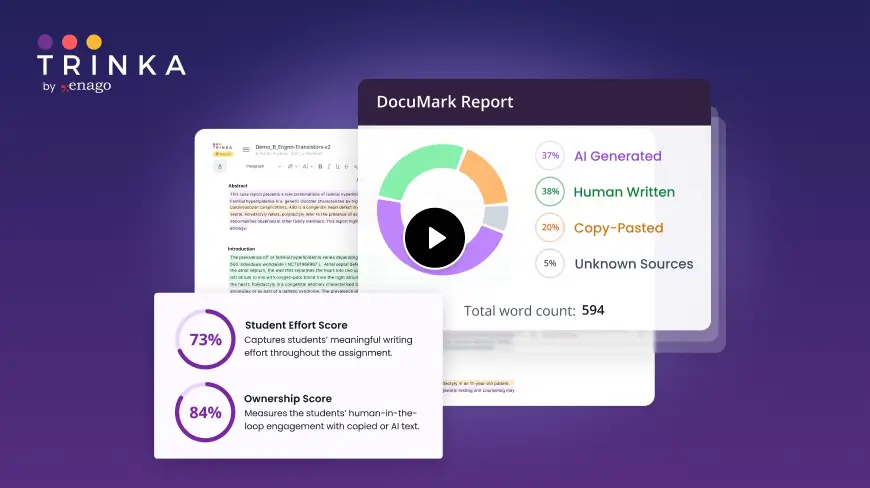
DocuMark: Responsible AI Use for Academic Integrity
Knowing your institution's AI policy is step one. DocuMark helps enforce it fairly by empowering universities to manage AI-generated content, prevent cheating, and support student writing through responsible AI use.
Common Questions About Hofstra University's AI Policies
Hofstra University has defined AI policies in 11 of 12 categories, with an overall coverage score of 92%.
Disclosure and citation of AI use are required when course policy permits AI with acknowledgement, and students must follow citation instructions in the syllabus. If an instructor does not provide guidance, students are told to cite AI-derived content using the style closest to the course or department's normal academic format.
Hofstra cautions faculty against relying on AI detection tools as sole evidence because of inconsistent accuracy. Instructors are told to consider multiple forms of evidence when evaluating suspected AI misuse, and misuse of AI/ChatGPT may be treated as an Honor Code violation under existing misconduct procedures. The law school handbook also states penalties and procedures for violations of its Honor Code.
The provided sources identify ChatGPT Edu and several other tools as campus-supported technologies, but they do not define a detailed data-classification or privacy-handling policy for what university information may be entered into AI tools. Hofstra does state generally that AI use should respect privacy.