Teaching & Learning
- Howard University does not set one uniform institution-wide rule for all coursework; the Provost guidance says schools, colleges, departments, and faculty should create their own AI-use policies
- Specific units have created explicit prohibitions: the Howard University School of Law prohibits submitting AI-generated text for coursework, the School of Social Work does not accept AI for completing student assignments, and the College of Medicine does not permit AI use for any assignment, assessment, or evaluation unless explicit, written permission is granted by the Course Director
Schools and colleges, as well as departments and faculty should develop their own policies regarding the use of AI tools in accordance with the research, writing, and citation expectations of the different disciplines housed within each school or college. There will likely be no one size fits all approach for deciding how AI technologies should or can be used for particular forms of research or learning.
a. To ensure all students have an equal opportunity to succeed and to preserve the integrity of the coursework, students are not permitted to submit text that is generated by artificial intelligence (AI) systems, including but not limited to ChatGPT, Bing Chat, Claude, Google Bard, Lexis+AI and Westlaw Precision with Gen AI, or any other automated assistance, for any coursework. This includes submitting assignments, exams, or projects in which the text in whole or in part was generated using AI.
• As such, the School of Social Work does not endorse, condone or accept the use of AI for the completion of student assignments.
The use of artificial intelligence (AI) platforms and tools (e.g., ChatGPT, Dall-E, Midjourney, etc.) is not permitted in any form for any assignment, assessment, or evaluation unless explicit, written permission is granted by the Course Director.
- Provost guidance says local units should define AI use expectations and penalties
- The School of Social Work also notes instructors may use AI-detection software on assignments
- Specific prohibitions exist for assessments: the Howard University School of Law bans AI-generated text in exams, and the College of Medicine forbids AI use for any assignment, assessment, or evaluation without explicit, written permission from the Course Director
But there should be a clear and understood set of parameters and expectations for usage of such tools that clearly outline penalties for violation of such expectations regarding academic work within the classroom, department, college, and university.
a. To ensure all students have an equal opportunity to succeed and to preserve the integrity of the coursework, students are not permitted to submit text that is generated by artificial intelligence (AI) systems, including but not limited to ChatGPT, Bing Chat, Claude, Google Bard, Lexis+AI and Westlaw Precision with Gen AI, or any other automated assistance, for any coursework. This includes submitting assignments, exams, or projects in which the text in whole or in part was generated using AI.
The use of artificial intelligence (AI) platforms and tools (e.g., ChatGPT, Dall-E, Midjourney, etc.) is not permitted in any form for any assignment, assessment, or evaluation unless explicit, written permission is granted by the Course Director.
• Students should be aware that software to detect AI may be used by any instructor for any and all assignments.
- Howard permits AI to be treated as a learning resource rather than a replacement for intellectual work in some contexts, but this varies by unit
- The law school specifically encourages students to use AI for learning and research in ways similar to search engines, grammar correction, and related support functions, while warning students to critically evaluate outputs and privacy risks
Schools, Colleges, instructors, and students should all participate in creating policies and guided materials that emphasize the value of intellectual and rigorous processes for learning and provide ethical guidelines for using such technologies as resources rather than replacements for intellectual work.
b. Students are encouraged to use AI as part of their learning and research in ways similar to search engines such as Google, for correction of grammar, and for other functions attendant to completing an assignment.
e. Students should be aware that using AI may undermine your ability to develop critical thinking, writing, or research skills that are essential for completing coursework and for your academic success. Students should also be aware of the potential risks and limitations of using AI as a tool for learning and research. AI systems can provide helpful information or suggestions, but they are not always reliable or accurate. AI systems are also vulnerable to leaks of users’ sensitive and confidential information. Students should critically evaluate the sources, methods, and outputs of AI systems.
Research
- The guidance also states that users are responsible for correcting misleading AI-generated information and providing verified sources for documents or products developed using AI tools
- Howard does not set a single university-wide rule for AI use in research writing; the Provost guidance says schools, colleges, departments, and faculty should establish policies aligned with disciplinary expectations
Schools and colleges, as well as departments and faculty should develop their own policies regarding the use of AI tools in accordance with the research, writing, and citation expectations of the different disciplines housed within each school or college. There will likely be no one size fits all approach for deciding how AI technologies should or can be used for particular forms of research or learning.
AI-tools tend to “scrape” or take information from a variety of unnamed sources to produce content or products. Users should be aware of this fact because AI tools can produce false, unverifiable, and confusing content or false images or products for which users are responsible for correcting such misleading information and providing verified sources for the documents or products developed using these tools.
- Howard does not provide AI-specific rules for using AI in research data collection, analysis, or synthetic data generation in the supplied sources
- However, its research misconduct policy applies to research broadly by prohibiting fabrication, falsification, and plagiarism in proposing, performing, reviewing, or reporting research results
A. Research Misconduct: Research misconduct is defined as fabrication, falsification, or plagiarism in proposing, performing, or reviewing research or in reported research results.
1. Fabrication is making up results and recording or reporting them.
2. Falsification is manipulating research materials, equipment, or processes or changing or omitting data or results such that the Research is not accurately represented in the research record.
- Howard's supplied sources do not give AI-specific rules for grant proposals, IRB applications, or ethics declarations
- The university does state that researchers must conduct research ethically and that research misconduct includes fabrication, falsification, and plagiarism in proposing, performing, reviewing, or reporting research
Howard University (“the University” or “HU”) upholds the scientific method in the conduct of research and is unequivocally committed to the ethical conduct of research by its personnel and students. Individuals charged with supervision of research and all individuals directly engaged in research and collaborators of researchers outside their laboratories bear obligations to pursue their studies ethically. All researchers bear
A. Research Misconduct: Research misconduct is defined as fabrication, falsification, or plagiarism in proposing, performing, or reviewing research or in reported research results.
3. Plagiarism is appropriating another person’s ideas, processes, results, or words without giving appropriate credit, including those obtained through confidential review of other’s research proposals and manuscripts.
Academic Integrity
- Howard's Provost guidance promotes transparency around AI use
- Specific units have defined rules: the Law School requires any student using AI to disclose the system used and cite the source and content obtained, and the College of Medicine requires appropriate citation and attribution when AI use is permitted
## Promote an ethic of transparency around any use of AI text
Schools, Colleges, instructors, and students should all participate in creating policies and guided materials that emphasize the value of intellectual and rigorous processes for learning and provide ethical guidelines for using such technologies as resources rather than replacements for intellectual work.
c. Any student using AI must disclose the system used and cite the source and content obtained.
When AI is permitted, its use must be cited and attributed appropriately by including the name of the AI platform and the date when the information was accessed. Failure to properly cite and attribute the use of AI tools is considered plagiarism.
- Howard states that AI-related academic dishonesty is a concern and says instructors may question a student's authorship of AI-related work, while students may defend themselves
- The School of Social Work says instructors may use AI-detection software on any assignment and treats assignments with more than 20% detectable AI content as plagiarized; the Provost guidance also calls for clear penalties, and the university's academic code allows discipline for academic infractions
Academic dishonesty is a clear concern related to such technologies. According to the Academic Code of Student Conduct, it is a cause for concern when students submit work for assessment as their own, which has been substantially created using artificial intelligence tools or other content-generating tools without obtaining permission from the instructor.
Any instructor has the right to inquire about a student's authorship of AI-related work, while at the same time, selected students also have the liberty to defend themselves against such allegations.
But there should be a clear and understood set of parameters and expectations for usage of such tools that clearly outline penalties for violation of such expectations regarding academic work within the classroom, department, college, and university.
• Students should be aware that software to detect AI may be used by any instructor for any and all assignments.
• Assignments with more than 20% detectable AI content will be considered plagiarized, with the associated penalties.
To better assure the realization of this goal any student enrolled for study at the University may be disciplined for the academic infractions defined below.
Institutional & Administrative
- Howard's supplied sources do not set detailed institution-wide rules for faculty or staff uses such as grading, feedback, recommendation letters, or administrative communications
- The Provost guidance does say faculty and other stakeholders should help create AI policies and that responsible exploration and experimentation by instructors and students in classroom environments is appropriate
Below is information and recommendations for learning and engaging these tools within academic settings by faculty, students, and other University stakeholders.
Schools, Colleges, instructors, and students should all participate in creating policies and guided materials that emphasize the value of intellectual and rigorous processes for learning and provide ethical guidelines for using such technologies as resources rather than replacements for intellectual work.
These technologies are relatively new to the general public and should be subject to responsible exploration and experimentation by both instructors and students within the classroom environments.
- The supplied sources do not identify approved AI platforms or licensed AI tools
- Howard warns users not to assume information shared with generative AI tools is private and says they should be mindful about exposing sensitive information
- More broadly, the university's research security policy requires safeguarding controlled unclassified information, and its acceptable-use policy requires protection of confidential information
Privacy remains an important consideration for all of these technologies as the collection and use of user information and habits has become a default setting within most of these tools. One should assume that information shared with generative AI tools is not private and one should be mindful of what sensitive information may be made accessible through usage of these AI tools and programs.
Summary: This Research Security Policy establishes standardized and simplified guidance to the Howard University community on the handling of unclassified information that requires safeguarding, or dissemination controls pursuant to and consistent with applicable laws, regulations, and government-wide policies. It guides the handling, marking, protecting, destroying, and decontrolling of Controlled Unclassified Information (CUI) for Howard University, subject to designating agency regulations.
This Policy applies to all faculty, staff, students, and contractor employees who may encounter CUI in the performance of official duties at Howard University and Affiliates.
* Protecting the integrity and privacy of personal, financial, and other confidential information stored on systems and networks they administer.
- Howard has an institution-wide AI initiative and formal governance structure
- The university describes Howard AI as an interdisciplinary effort centered on ethical and transformative AI, identifies four guiding pillars, and states that the President's AI Advisory Council and its subcommittees provide direction, implementation, strategy, governance, and institutional guidelines for AI across academic programs, offices, units, and strategic planning
Howard AI is our bold, interdisciplinary engine for ethical, transformative artificial intelligence, educating the next generation of AI leaders, accelerating breakthrough research, and deploying responsible technologies that uplift communities, drive operational excellence, and advance our nation’s progress.
The Artificial Intelligence (AI) Initiative supports the development and implementation of Howard AI across Howard University and harnesses the transformative potential of AI for the betterment of society.
There are 4 pillars guiding this initiative:
* Ethics and Societal Benefits
* Research and Innovation
* Education and Workforce Development
* Operational Efficiency
As a key component of this initiative, the President’s Artificial Intelligence Advisory Council (AIAC) provides direction and guidance on AI implementation throughout the institution, including academic programs, University offices and units, and strategic planning activities.
The President’s AI Advisory Council (AIAC) provides direction and implementation regarding AI throughout the institution in academic programs, University offices and units, and strategic planning activities. Made up of leaders from across the campus, the AIAC catalyzes interdisciplinary and cross-sector partnerships to develop and implement AI across the academy, in support of the AI Initiative.
The AI Strategy & Governance Subcommittee focuses on shaping Howard University's AI strategy by promoting access to advanced technologies, evaluating investments, and engaging stakeholders in AI development. It stewards governance, emphasizing ethical AI use, IT and data governance processes, and institutional guidelines. The goal is to develop a strategy to optimize the use and development of AI while providing a governance structure that fosters ethical and responsible AI.
The AI Capacity & Expertise Subcommittee subcommittee focuses on building AI literacy and expertise across Howard University. It evaluates and promotes AI understanding among students, faculty, staff, and leadership. The subcommittee supports staff development in evaluating, implementing, and managing AI tools and explores opportunities for AI training and development for students, faculty, staff, and leadership.
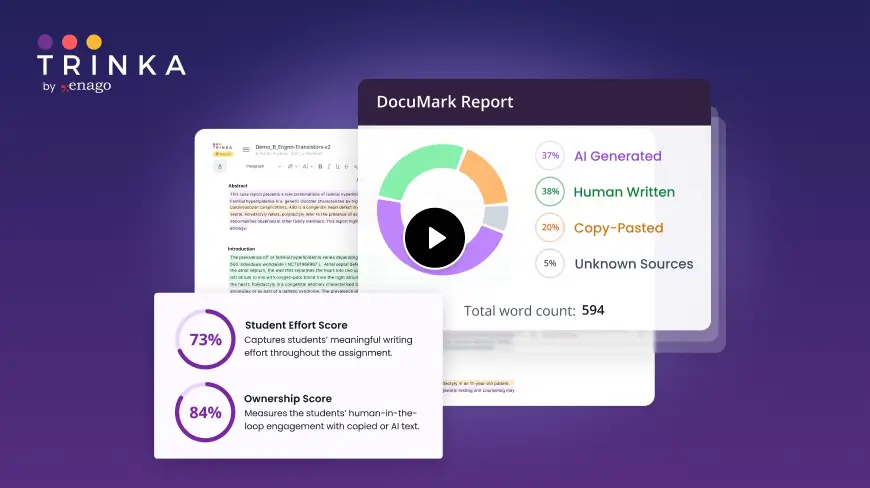
DocuMark: Responsible AI Use for Academic Integrity
Knowing your institution's AI policy is step one. DocuMark helps enforce it fairly by empowering universities to manage AI-generated content, prevent cheating, and support student writing through responsible AI use.
Common Questions About Howard University's AI Policies
Howard University has defined AI policies in 11 of 12 categories, with an overall coverage score of 92%.
Howard's Provost guidance promotes transparency around AI use. Specific units have defined rules: the Law School requires any student using AI to disclose the system used and cite the source and content obtained, and the College of Medicine requires appropriate citation and attribution when AI use is permitted.
Howard states that AI-related academic dishonesty is a concern and says instructors may question a student's authorship of AI-related work, while students may defend themselves. The School of Social Work says instructors may use AI-detection software on any assignment and treats assignments with more than 20% detectable AI content as plagiarized; the Provost guidance also calls for clear penalties, and the university's academic code allows discipline for academic infractions.
Howard warns users not to assume information shared with generative AI tools is private and says they should be mindful about exposing sensitive information. More broadly, the university's research security policy requires safeguarding controlled unclassified information, and its acceptable-use policy requires protection of confidential information. The supplied sources do not identify approved AI platforms or licensed AI tools.