Teaching & Learning
- Unauthorized or undisclosed AI use is treated as an academic integrity violation
- Use of AI for assignments and other course-related work is at instructor or instructional-unit director discretion
- Students must discuss proposed AI use before proceeding, and faculty must communicate the permitted level of AI use in syllabi and when introducing assessments or coursework
Use of AI tools for learning activities is at the discretion of the director of the instructional unit (e.g. course, module, clerkship or clinical rotation, or any other curricular element). Students should discuss proposed use of AI for assignments, reports, or other course-related work both inside and outside of the classroom with the director of the instructional unit prior to proceeding.
Students should discuss proposed use of AI for assignments, reports, or other academic or clinical learning work with the responsible director prior to proceeding.
Unauthorized or undisclosed use of AI is a violation of academic integrity and will be treated in accordance with institutional procedures.
To ensure consistency, all course syllabi must include a statement outlining the level of AI use permitted for assignments and assessments.
Instructors should choose the appropriate level of AI use for each assessment or coursework, based on what best serves their students and learning goals. They must clearly communicate these AI guidelines to students at the time of introducing any assessment and provide any needed instructions or resources.
- Faculty are expected to set and communicate the allowed level of AI use for each assessment
- Generative AI use during exams, quizzes, take-home tests, clinical write-ups, patient notes, and other graded assessments is prohibited unless the relevant instructor or director clearly permits it in course or assessment materials
Use of generative AI tools during exams, quizzes, take-home tests, clinical write-ups, patient notes, or any other graded assessments is strictly prohibited unless clearly permitted in the syllabus, course/module information sheet, or assessment instructions by the relevant instructor, module director, or clerkship director.
Instructors should choose the appropriate level of AI use for each assessment or coursework, based on what best serves their students and learning goals. They must clearly communicate these AI guidelines to students at the time of introducing any assessment and provide any needed instructions or resources.
- Students are expected to verify AI output for bias and accuracy, and faculty may decide whether students may use course materials with AI for tutoring or other learning strategies
- AI use for learning activities and tutoring is not uniformly allowed; it is subject to the discretion of the instructional-unit director or faculty member responsible for the materials
Use of AI tools for learning activities is at the discretion of the director of the instructional unit (e.g. course, module, clerkship or clinical rotation, or any other curricular element).
- Grow their AI literacy by understanding the mechanism, as generative AI reflects data patterns not true reasoning, and apply ethical and critical thinking to verify its output for bias and accuracy
Those who create module, clerkship, or course materials should be prepared for student questions about whether they will give permission for students to use their materials with AI for tutoring or other learning strategies.
- Programming-related AI use is permitted when an assessment explicitly allows it
- The sample syllabus language states that students may use generative AI to create and check code, but the same policy framework also allows instructors to prohibit all AI support for a given assessment
Programming For this assessment, you can use Generative AI to create and check code.
None
For this assessment, you are not allowed to use any type of AI support. This includes research support, structure support, writing/proofreading support and creative support, and all forms of clinical documentation in modules or clerkships.
Research
- Health-system policy also requires supervisor or manager approval before AI-generated content is published or distributed, and AI-generated content must be disclosed
- Student use of AI in research writing, including manuscripts, abstracts, and grant proposals, requires faculty advisor or PI approval and must follow funder or publisher guidelines
Any AI used in research writing (e.g., manuscripts, abstracts, grant proposals) must be approved by the faculty advisor or principal investigator (PI) and align with the research funding agency or publisher guidelines. Documenting advisor approval using a tool such as the Mentor – Learner Agreement Regarding Use of Generative AI should be maintained by the student.
Prior to publishing or distributing content generated by an AI Tool (in whole or in part), an AI User must receive approval from an appropriate supervisor or manager. When publishing or distributing content generated by an AI Tool (in whole or in part), AI Users must make known – through disclaimer, citation, or otherwise – that the content has been generated by AI.
- Students must discuss proposed AI use in research projects with a mentor or supervisor and may not enter unpublished, experimental, proprietary, or confidential material into public AI platforms
- Research involving clinical or health data must use secure, HIPAA-compliant infrastructure, should use synthetic or de-identified data when possible, and must describe AI methods in IRB submissions when applicable
Students should discuss proposed use of AI in research or scholarly projects with their mentor or supervisor.
Students must not enter their own or others’ unpublished or experimental data, grant proposals, proprietary or copyright-protected information, or confidential material into public AI platforms.
When possible, research should be performed using synthetic or de-identified data, and data analysis and storage should be done in a HIPAA compliant fashion, using secure infrastructure like the Minerva supercomputing cluster.
Research protocols should be submitted to the Mount Sinai Institutional Review Board (IRB) for approval, and clearly detail how artificial intelligence methods (such unsupervised, supervised, and reinforcement learning methods) are being used to analyze health data, and ensure that FAVES principles (Fairness, Appropriateness, Validity, Effectiveness, and Safety) are followed, while ensuring that computers, data storage, and other infrastructure (such as computing on the Minerva cluster) are HIPAA compliant.
- AI use in research is tied to existing research ethics and integrity requirements
- Research writing with AI must have advisor or PI approval and follow agency or publisher rules; misuse of AI in research may breach the school's ethical research policies; and projects involving clinical data require investigator and, where applicable, IRB approval
Any AI used in research writing (e.g., manuscripts, abstracts, grant proposals) must be approved by the faculty advisor or principal investigator (PI) and align with the research funding agency or publisher guidelines.
Misuse of AI in research may constitute a breach of the School’s Policies and Procedures on Ethical Practices in Research.
Any AI use in projects involving clinical data must have the approval of the responsible investigator and the Institutional Review Board (IRB) if applicable
Any use of AI in relation to patient care, patient records, or clinical data requires explicit approval from the supervising physician, the clerkship or module director, and, where applicable, the IRB.
Academic Integrity
- The university requires disclosure and citation of AI-assisted or AI-generated content in academic, educational, research, and scholarly work
- Students must identify the tool used, instructors may require submission of prompts and outputs, and the health-system policy requires AI-generated published or distributed content to be identified through disclaimer, citation, or similar means
AI-enhanced or generated content must be appropriately disclosed and cited. Students should identify the tool used. The instructor may also require students to provide the inputs and outputs used with the AI tool.
Members of the Icahn School of Medicine at Mount Sinai community are expected to appropriately cite and acknowledge all sources used in their educational, research, and scholarly work, including content generated or supported by artificial intelligence tools like Chat GPT Edu, Gemini, and NotebookLM, in accordance with institutional standards for academic integrity.
When publishing or distributing content generated by an AI Tool (in whole or in part), AI Users must make known – through disclaimer, citation, or otherwise – that the content has been generated by AI.
- Undisclosed or unauthorized AI use is handled as an academic integrity matter, and misuse may lead to institutional disciplinary processes
- Faculty are instructed not to enter student assignments into public AI detection tools; instead, ISMMS can provide or assist with iThenticate if checking is needed
Unauthorized or undisclosed use of AI is a violation of academic integrity and will be treated in accordance with institutional procedures.
Any misuse of AI tools will be reviewed as a potential violation of the Academic Integrity standards described in the Graduate and Medical Student Handbooks.
- Investigate potential unauthorized use of AI cautiously with the desire to understand what the student has done. Do not enter student assignments into public AI detection tools. If assessing potential plagiarism or AI use would be helpful, Educational Technology at ISMMS can provide a license or assistance with using iThenticate for this purpose (more information here).
AI Users who violate this Policy may be subject to appropriate disciplinary action, up to and including immediate termination of employment or termination of contract (as in the case of a contractor or third-party vendor).
Institutional & Administrative
- Faculty and staff are expected to set and communicate AI expectations for students, model ethical use, and update teaching, assessment, and supervision methods appropriately
- They are encouraged to use vetted ISMMS tools, must include AI-use statements in course syllabi, and the broader health-system policy bars AI-generated non-public outputs such as grading and certain personnel decisions
Faculty and staff demonstrate responsible and ethical AI use by committing to:
- Clearly stating the program, module, clerkship, and clinical learning expectations for AI use and advise students on acceptable practices
- Model ethical use of AI by complying with and advising colleagues and learners on institutional policies, including those related to academic integrity, student records privacy (FERPA), and patient confidentiality (HIPAA)
- Update teaching and assessment, and clinical supervision methods to include AI as appropriate while ensuring academic integrity and patient safety in accordance with ISMMS policies. Use AI tools available to all students such as vetted ISMMS tools (see more details).
To ensure consistency, all course syllabi must include a statement outlining the level of AI use permitted for assignments and assessments.
Where possible, faculty and staff should use AI tools provided by ISMMS, including but not limited to ISMMS Gemini and ChatGPT Edu. If licenses are not available, public tools should be used judiciously with any tool’s settings adjusted from the defaults to restrict data use for model training.
AI tools including but not limited to ChatGPT, Gemini, NotebookLM must not be used to generate output that would be considered non-public. Examples include, but are not limited to, generating proprietary or unpublished research; legal analysis or advice; recruitment, personnel or disciplinary decision making; completion of academic work in a manner not allowed by the instructor; creation of non-public instructional materials; plagiarized materials; and grading.
- The university prohibits entering protected, confidential, proprietary, unpublished, or sensitive information into AI tools unless contractual and institutional protections are in place and the tool has been designated appropriate
- ISMMS directs users toward licensed tools such as ChatGPT Edu and Gemini, while emphasizing that student, health, and sensitive data are protected in ChatGPT Edu and that data, prompts, and responses are not used to train OpenAI models
Nothing private or belonging to others should ever be uploaded to personal accounts or public AI platforms. With appropriate permissions and controls, some materials may be uploaded with permission to AI tools licensed by Mount Sinai.
Students must not upload any of the following to any AI platform, even a Mount Sinai-licensed platform, without permission from data owner or proper consent if applicable: unpublished, experimental or research data that needs to be kept private (data they have generated, data generated by a collaborator, or data included in a document for peer review)
Students should use AI tools provided by ISMMS, including but not limited to ISMMS Gemini and ChatGPT Edu, for any scholarly activity that is approved by ISMMS (see more details).
Any use of AI Tools including but not limited to ChatGPT, Gemini, NotebookLM must not include protected personal, confidential, proprietary, or otherwise sensitive information unless a contract is in place that specifically protects such ISMMS/Mount Sinai data from being used by training models or otherwise isolates ISMMS/Mount Sinai data into a separate instance that is not accessible by parties external to ISMMS/Mount Sinai.
In general, Student records subject to FERPA, health information subject to HIPAA, proprietary information, and any other information must not be used with AI Tools that have not been specifically designated as appropriate for this purpose.
Personal health, student, and sensitive information are safeguarded via a student data privacy agreement and business associate agreement between ISMMS and OpenAI.
No data, prompts, or responses will be used to train OpenAI's models.
- Mount Sinai has a formal AI governance structure and committee system for oversight, ethics, policy development, and strategy
- The teaching policy is reviewed annually by an AI committee, and the health-system governance framework states that AI policies and standards are guided by principles of safety, effectiveness, responsibility, security, and ethics
Maintenance This policy will be reviewed annually by the AI Committee on Teaching, Learning, and Discovery, who will recommend updates to leadership for approval.
Our AI governance structure establishes policies and standards for the ethical and effective use of artificial intelligence throughout the Health System. Several committees within this structure ensure alignment with our guiding principles of keeping AI safe, effective, responsible, secure, and ethical, while prioritizing organizational goals, regulatory compliance, and risk mitigation.
AI Executive Committee – Provides strategic guidance, determines AI investment strategy, and reports to the Strategy Group and Clinical Chairs committees. This committee oversees all others.
AI Risks, Ethics, and Policy Committee – Focuses on AI ethics and policy development, proactively identifying risks and facilitating progress across the following functional AI committees:
AI Teaching, Learning, Discovery, and Research Committee – Explores AI’s potential to enhance teaching and learning throughout the Health System.
DTP’s Technology and Enablement AI Governance advances system-wide clinical and operational AI priorities through standardized rules, guidelines, processes, and requirements that shape how AI is designed, procured, implemented and deployed across the Health System.
DocuMark: Responsible AI Use for Academic Integrity
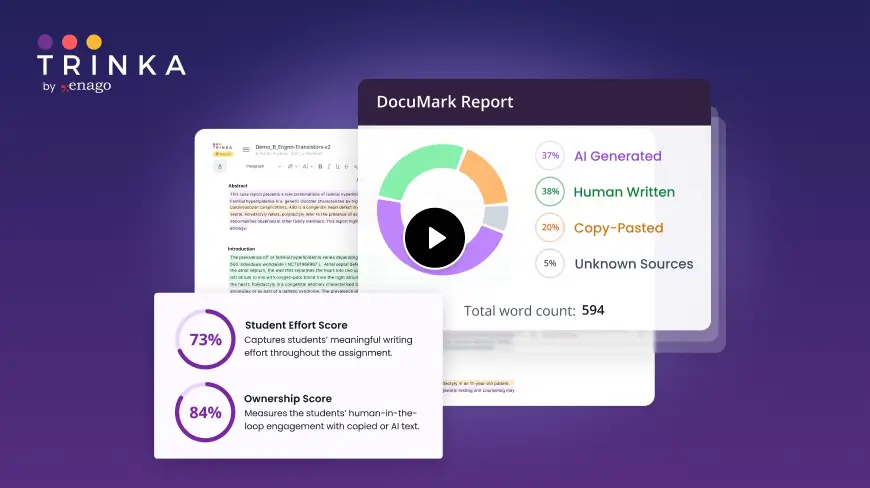
Knowing your institution's AI policy is step one. DocuMark helps enforce it fairly by empowering universities to manage AI-generated content, prevent cheating, and support student writing through responsible AI use.
Common Questions About Icahn School of Medicine at Mount Sinai's AI Policies
Icahn School of Medicine at Mount Sinai has defined AI policies in 12 of 12 categories, with an overall coverage score of 100%.
The university requires disclosure and citation of AI-assisted or AI-generated content in academic, educational, research, and scholarly work. Students must identify the tool used, instructors may require submission of prompts and outputs, and the health-system policy requires AI-generated published or distributed content to be identified through disclaimer, citation, or similar means.
Undisclosed or unauthorized AI use is handled as an academic integrity matter, and misuse may lead to institutional disciplinary processes. Faculty are instructed not to enter student assignments into public AI detection tools; instead, ISMMS can provide or assist with iThenticate if checking is needed.
The university prohibits entering protected, confidential, proprietary, unpublished, or sensitive information into AI tools unless contractual and institutional protections are in place and the tool has been designated appropriate. ISMMS directs users toward licensed tools such as ChatGPT Edu and Gemini, while emphasizing that student, health, and sensitive data are protected in ChatGPT Edu and that data, prompts, and responses are not used to train OpenAI models.