Teaching & Learning
- AI use in coursework is allowed only within course-level rules
- Submitting AI-generated content as one's own or using AI beyond those boundaries is treated as academic misconduct
- IE states that faculty may integrate AI into coursework, but individual instructors may restrict or prohibit AI in particular assignments or learning environments, and students must follow the syllabus for each course
We are working continuously with our faculty to meaningfully integrate AI into IE’s coursework, embedding its use alongside subject-matter expertise. That said, faculty members may choose to restrict or prohibit the use of AI for certain learning environments or assignments in order to support skill-building in areas such as research, critical and creative thinking, academic writing, and synthesis. The AI Policy for each course can be consulted in the course syllabus.
You are expected to respect the established boundaries. Misuse will be considered academic misconduct.
Learning is not something AI can do for you. Some coursework will require you to work without AI assistance. These are intentional “AI-free zones” where faculty want you to develop specific skills, e.g. writing in your own voice, solving a problem from scratch, engaging in open-ended reflection, or completing assessments that reflect your capabilities. You are expected to respect these boundaries.
Submitting work created by someone or something else as if it were your own is considered plagiarism and cheating.
- For assessments, IE indicates that AI rules are set at the course level and can include outright bans
- The university states that some assessments are designated AI-free, and using AI-generated content for assessment contrary to policy is treated as academic misconduct that can lead to failure of the assignment or course
Learning is not something AI can do for you. Some coursework will require you to work without AI assistance. These are intentional “AI-free zones” where faculty want you to develop specific skills, e.g. writing in your own voice, solving a problem from scratch, engaging in open-ended reflection, or completing assessments that reflect your capabilities. You are expected to respect these boundaries.
Generative artificial intelligence (GenAI) tools may be used in this cours e for [describe acceptable use cases, e.g. research, ideation, generating an outline, proofreading, grammar check, coding, image generation] with appropriate acknowledgement. GenAI may not be used for [describe the limitations, e.g. assignments, group submissions, exams].
If a student is found to have used AI-generated content for any form of assessment, it will be considered academic misconduct, and the student might fail the respective assignment or the course.
- IE encourages students to use AI as a study support tool rather than as a substitute for thinking
- The student guidance recommends AI for idea testing, concept clarification, quizzing, practice problems, alternative perspectives, simulated discussions, and feedback, while requiring students to remain critically engaged and accountable for the outputs they use
· Explore the appropriate and ethical use of AI to support and challenge – not replace! – your thinking.
Use AI to test your ideas, clarify complex concepts, or practice new skills.
Ask AI to quiz you, offer alternative perspectives, or generate practice problems.
Use AI to get feedback, proofread, polish writing, or simulate discussions.
Reflect critically on AI outputs, what it gets wrong and what it misses entirely.
When you do use AI, you are fully accountable for any work you submit or share with faculty, peers, or the wider public.
- IE does not set a single university-wide rule for coding use; instead, code-related AI use is left to course-level policy
- Faculty sample syllabus language explicitly lists coding as a possible acceptable use case, but also says instructors may bar AI use for assignments or exams, with acknowledgement required when permitted
Generative artificial intelligence (GenAI) tools may be used in this cours e for [describe acceptable use cases, e.g. research, ideation, generating an outline, proofreading, grammar check, coding, image generation] with appropriate acknowledgement. GenAI may not be used for [describe the limitations, e.g. assignments, group submissions, exams].
If a student is found to have used AI-generated content inappropriately, it will be considered academic misconduct, and the student might fail the respective assignment or the course.
Research
Academic Integrity
- IE also provides a recommended no-AI disclosure when AI was permitted but not used
- IE requires disclosure when AI is used to produce content, especially for assignments submitted for evaluation
- Students must identify the AI tools used, explain how they used them, document significant prompts so faculty can review their collaboration with AI on request, and clearly label AI-generated visuals
If AI was used to produce content, particularly if used in the context of assignments submitted for evaluation, you must disclose its use and specify the following:
· Identifying the specific AI-powered platforms or tools used, such as Grammarly, ChatGPT, Gemini, Canva, etc.
· Explaining how the AI tools were used (e.g., brainstorming, proofreading, language polishing, generation of images or other visuals, etc.).
· Documenting the prompts you used, to allow faculty to evaluate your skills and/or your proficiency in collaborating with AI for a specific task upon request.
· Clearly indicating any visuals, e.g. images, videos, graphics, conceptual maps and the like, that were generated using AI, with clear reference to the tool used.
Suggested format to disclose the use of AI tools*:
I used [AI systems link] to [specify how you used generative AI]. The prompts used include [list of significant prompts]. The output of these prompts was used to [explain how you used the outputs in your work].
If AI was permitted to use in your assignment, but you have chosen not to include any AI generated content, the following disclosure is recommended:
No content generated by AI technologies has been used in this assignment.
- IE treats undisclosed or improper AI use as academic misconduct under the student conduct system
- For assessment monitoring, faculty guidance says proctoring and review tools do not replace faculty responsibility and must be combined with active review and supervision
- Violations may be reviewed under the IE Student Code of Conduct, serious cases may be referred to the Academic Ethics Committee, and sanctions can include failing the assignment or course
Violations of IE University and/or IE faculty guidelines will be reviewed under the IE Student Code of Conduct.
Submitting work created by someone or something else as if it were your own is considered plagiarism and cheating. Fail ure to acknowledge AI usage violates academic honesty policies.
If a student is found to have used AI-generated content for any form of assessment, it will be considered academic misconduct, and the student might fail the respective assignment or the course.
If there has been a violation of the academic integrity and conduct outlined in this Code, the Program Direction will review the case. If the violation is deemed a serious breach of academic integrity and conduct, the Program Direction will refer the case to the Academic Ethics Committee. The committee will review the case, gather all relevant information, and make a final decision based on precedent, ensuring the response is proportional to the severity of the violation.
While both tools are integrated into Blackboard and can be enabled easily, but they do not replace faculty responsibility, which includes carefully reviewing reports (Smowl) and maintaining active vigilance in the classroom during activities.
Institutional & Administrative
- However, faculty must retain direct responsibility for key academic decisions, especially grading and feedback
- IE supports faculty and staff use of AI for teaching and administration, while keeping human responsibility central
- Faculty are receiving training to integrate AI into teaching and research, AI tools in Blackboard support rubric creation, question banks, tutoring and feedback, and planning teams may use AI for management tasks such as attendance and teaching calendars
Our professors are already using AI tools in Bachelor, Master, and Executive Education programs to improve knowledge delivery, while planning teams use them to cover management tasks such as measuring attendance, class participation, and designing teaching calendars.
This continuous improvement is fed by a “train the trainers” approach. IE’s faculty has organized a roadmap of periodic training sessions where professors share uses and good practices among IE’s Faculty community.
On Blackboard, AI supports teaching in several practical ways. It can assist with rubrics by quickly generating clear evaluation criteria and learning outcomes that remain fully editable. For tests and assignments, AI supports the creation of multiple-choice tests and question banks based on course materials. AI Conversations, lastly, enable guided, customized interactions that help students practice concepts and receive formative feedback within a controlled, proctored environment.
AI Tutor functions as a chatbot that helps students prepare for a course and check their progress based on the professor’s materials and guidance. Feedback Assistant supports professors in improving the quality and efficiency of feedback for written essays.
Regardless of how AI is used in a course, human involvement should remain central, with students engaging in genuine critical thinking and faculty maintaining direct responsibility for key academic decisions, especially, grading and feedback.
Faculty members across the university, many of whom have been working with AI for a number of years, will continue to receive specialized training to integrate AI into their research and teaching, developing innovative programs, simulators, and immersive experiences that prepare students for a technology-transformed workplace. Additionally, administrative staff will continue to use OpenAI's latest technology to enhance operational efficiency and productivity.
- The university also identifies ChatGPT Edu as an institutionally provided platform available to students, faculty, and staff
- IE warns students not to enter sensitive, private, or confidential information into public or free AI tools and tells them to review terms of use and privacy settings
Never use sensitive, private, or confidential information, either your own or someone else’s, when using any public or “free” AI tool. Always read the Terms of Use and manage your privacy settings.
This new collaboration marks a significant expansion of IE University's 2023 AI initiative and will make ChatGPT Edu available for students, faculty, and staff.
Each student will receive an AI certification and access to ChatGPT Edu, a version of ChatGPT built specifically for students, faculty and staff.
- IE has an institution-wide AI strategy centered on expanding AI across its academic ecosystem, pairing adoption with training, ethical usage, critical thinking, and responsible application
- The university describes its AI initiative and manifesto as evolving institutional efforts that aim to enhance pedagogy, research, and innovation, with specialized student training and continuing faculty development
IE University, one of the world's most innovative education institutions, has today announced a new initiative with OpenAI, a global leader in artificial intelligence development and deployment, to implement AI tools across its entire academic ecosystem.
This new collaboration marks a significant expansion of IE University's 2023 AI initiative and will make ChatGPT Edu available for students, faculty, and staff.
IE University's Master’s and Bachelor’s students will take a specialised training course, 'AI for Productivity' and 'AI 101', in which they will develop crucial digital competencies. This training emphasizes ethical usage, critical thinking, and responsible technology application. Each student will receive an AI certification and access to ChatGPT Edu, a version of ChatGPT built specifically for students, faculty and staff.
The document, which will continue to evolve as the technology develops, highlights the main programs, initiatives, and research projects developed by IE University to enrich the learning experience of students, foster critical thinking, and encourage a human-centered approach to innovation.
We see the arrival of generative AI as an immense opportunity to enhance our pedagogy, mold responsible leaders capable of facing today’s world challenges, and enable them to be more creative, agile, and productive.
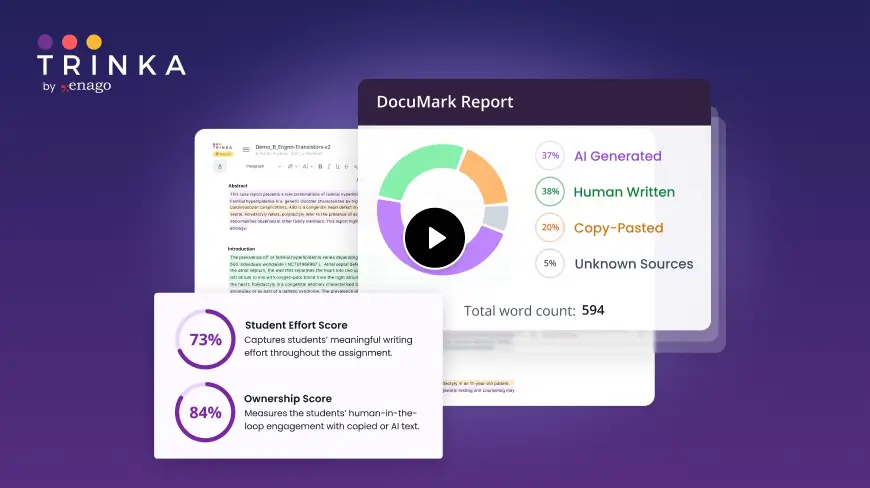
DocuMark: Responsible AI Use for Academic Integrity
Knowing your institution's AI policy is step one. DocuMark helps enforce it fairly by empowering universities to manage AI-generated content, prevent cheating, and support student writing through responsible AI use.
Common Questions About IE University's AI Policies
IE University has defined AI policies in 9 of 12 categories, with an overall coverage score of 75%.
IE requires disclosure when AI is used to produce content, especially for assignments submitted for evaluation. Students must identify the AI tools used, explain how they used them, document significant prompts so faculty can review their collaboration with AI on request, and clearly label AI-generated visuals. IE also provides a recommended no-AI disclosure when AI was permitted but not used.
IE treats undisclosed or improper AI use as academic misconduct under the student conduct system. Violations may be reviewed under the IE Student Code of Conduct, serious cases may be referred to the Academic Ethics Committee, and sanctions can include failing the assignment or course. For assessment monitoring, faculty guidance says proctoring and review tools do not replace faculty responsibility and must be combined with active review and supervision.
IE warns students not to enter sensitive, private, or confidential information into public or free AI tools and tells them to review terms of use and privacy settings. The university also identifies ChatGPT Edu as an institutionally provided platform available to students, faculty, and staff.