Teaching & Learning
- The university frames submitting work that is not the student’s own (including indirectly using someone else’s product) as academic dishonesty and subject to disciplinary action
- Illinois Tech states that what is allowed for generative AI use in graded coursework is course-specific and should be defined in each course syllabus based on learning objectives
- Illinois Tech also provides sample syllabus language indicating that students might be permitted to use generative AI for specific assignments, but if allowed, AI-created content should not exceed 25% of the submitted work and AI-generated portions must be identified
“Determination of what is and is not allowed in a specific course, although having many things in common with other courses, is, by definition, somewhat specific to that course.”
“This means that each syllabus needs to clearly define what the learning objectives are and be clear as to what is and is not allowed in terms of “outside” resources to demonstrate proficiency with that learning objective.”
“Therefore, misrepresentation of proficiency by (getting either directly or indirectly someone else’s) product is dishonesty.”
“It cheats the student of their needed personal development, and it is academic dishonesty, which results in disciplinary action.”
“You might be permitted to use generative AI tools for specific assignments or class activities. However, assignments created with AI should not exceed 25% of the work submitted and must identify the AI-generated portions. Presenting AI-generated work as your own will have consequences according to university policies.”
- Illinois Tech’s Code of Academic Honesty prohibits “unauthorized assistance” in quizzes, tests, or examinations
- The university does not explicitly name generative AI for exams in the cited materials, but it frames exam assistance as a category where unauthorized help is a violation
“The use of any unauthorized assistance in taking quizzes, tests or examinations;”
- The cited guidance does not define a university-wide rule for non-graded personal study use beyond these general statements
- Illinois Tech provides guidance that generative AI tools (e.g., ChatGPT) can be used for idea generation, while cautioning that they can be inaccurate and that overreliance can hinder independent thinking and creativity
“While AI programs like ChatGPT can help with idea generation, they are not immune to inaccuracies and limitations. Overreliance on AI can hinder independent thinking and creativity.”
- Illinois Tech indicates that whether tools such as ChatGPT are allowed is something instructors should specify based on course learning objectives, including for programming-related learning objectives
- The cited guidance provides sample syllabus language framing submission of coursework “that is not your own” as dishonest and a misrepresentation of skills development, but it does not set a universal rule about AI code generation across all courses
“Having defined the learning objectives, explain what is and is not allowed (e.g., working together or not, using repositories of other people’s work or not, using tools such as ChatGPT or not, etc.) or the limitations on the use of various resources.”
““One learning objective is to become proficient in a programming language. Contributing course work that is not your own to get course credit is dishonest and a misrepresentation of your skills development. This will not only lead to academic honesty discipline, but it may also mean that you will carry a sense of dissatisfaction with you through your entire professional career because you haven’t learned the fundamental skills that you need to thrive”.”
Research
- Illinois Tech’s Code of Academic Honesty includes “research” within the category of conduct that must not be obstructed, and the academic honesty guidance frames misrepresentation of work as dishonesty subject to disciplinary action
- The cited materials do not provide explicit rules for AI use in research ethics documents (e.g., IRB, grant proposals), but they do reference that academic honesty concerns can relate to “research” and that academic honesty is connected to learning objectives
“Deliberate and harmful obstruction of the studies, research or academic work of any member of the Illinois Tech community;”
“Therefore, misrepresentation of proficiency by (getting either directly or indirectly someone else’s) product is dishonesty.”
“It cheats the student of their needed personal development, and it is academic dishonesty, which results in disciplinary action.”
Academic Integrity
- Illinois Tech states that using others’ ideas without attribution is a form of plagiarism and a violation of the Code of Academic Honesty
- The AI teaching guidance also states that if AI is permitted, AI-generated portions must be identified, and the academic honesty guidance provides an example syllabus policy requiring submission of prompts and raw AI outputs plus tracked changes when ChatGPT is used for a writing assignment
“The misrepresentation of any work submitted for credit or otherwise as other than the product of a student’s sole independent effort, such as using the ideas of others without attribution and other forms of plagiarism;”
“However, assignments created with AI should not exceed 25% of the work submitted and must identify the AI-generated portions.”
““For this writing assignment, students will specifically use ChatGPT to generate the text of the assignment. Students must: 1. Submit the prompt texts and the raw generated response. 2. Submit the finished assignment in its final formatted version. 3. Submit their edited document (with tracked changes) so that the marked text is clear as to what they did to get to the second step.””
- Illinois Tech’s academic honesty guidance similarly states that evidence from a detection tool alone is not decisive and that a conversation with the student is required
- The Code of Academic Honesty describes sanctions (e.g., grade reduction, expulsion from a course) and states that instructors who determine a violation occurred are required to report it to the DDAD
- Illinois Tech states that Turnitin’s AI writing indicator is visible only to instructors and that Turnitin does not determine misconduct; it provides data for educators, and the AI percentage should not be used as the sole basis for action or grading
“Turnitin has an AI writing indicator included in the Similarity Report.”
“Please note, only instructors are able to see the indicator.”
“Turnitin does not make a determination of misconduct, rather it provides data for the educators to make an informed decision based on their academic and institutional policies.”
“The percentage on the AI writing indicator should not be used as the sole basis for action or a definitive grading measure by instructors.”
“For academic honesty complaints, the evidence from a detection tool alone is not decisive. There must be a conversation with the student so that they can explain themselves (and this is also, per our current rules, a requirement).”
“Following the meeting, if the course instructor determines the violation occurred, they are required to report the violation, a summary of the facts evidencing the violation (including the course syllabus and or course materials that explain or point to sources that explain academic honesty and plagiarism appropriate to the discipline) and the sanction to the DDAD. Appropriate sanctions include:”
“Reduction in grade. A reduction in grade for the assignment or exam involved or for the course may be applied.”
“Expulsion from a course. The student is assigned a punitive failing grade of ‘E’ for the course and can no longer participate in the course or receive further evaluation of coursework from the instructor; provided, however, the course instructor may only impose this sanction after discussing it with and securing the written agreement of the DADD.”
Institutional & Administrative
- The provided sources do not define specific rules for faculty/staff using AI for grading, writing recommendation letters, or administrative communications
- Illinois Tech states that the Center for Learning Innovation supports faculty in “responsible use of AI in academic environments” and offers workshops to help faculty integrate AI into teaching, improve assessment design, and align course policies with university-wide AI guidelines
“The Center for Learning Innovation (CLI) hosts AI for Faculty: a series of 7 workshop to support your teaching, assessment design, and responsible use of AI in academic environments.”
“We invite you to join us and your colleagues across the university to explore how AI can enhance teaching, learning, productivity, and student engagement at Illinois Tech.”
“Learn how to integrate AI meaningfully and responsibly into your teaching”
“Align your course policies with university-wide AI guidelines”
- Illinois Tech’s AI for Teaching and Learning page describes an AI workshop session focused on “AI + Security + Data,” including “campus-supported AI tools” and “data privacy” and “FERPA considerations,” but the provided sources do not define a specific enforceable data-classification policy or an approved/prohibited list of AI platforms within the extracted text
“Understanding AI Risk: What to use, What to avoid, and Why (AI + Security + Data) (December 16, 2025) (Online) Overview of campus-supported AI tools, data privacy, FERPA considerations, and responsible use.”
- Illinois Tech describes university support structures for AI in teaching and learning through the Center for Learning Innovation and states an aim to “effectively and ethically leverage AI in teaching and learning.” It also describes a workshop session on “Policy Development for Teaching, Learning & Research” focused on creating department-level or course-level AI policies and “campus alignment,” but the provided sources do not define a formal university-wide AI governance body or strategy document in the extracted text
“Artificial intelligence has become an integral part of modern education, even as it continues to rapidly evolve. The Center for Learning Innovation is dedicated to partnering with and supporting faculty across the university to effectively and ethically leverage AI in teaching and learning.”
“Policy Development for Teaching, Learning & Research (February 10, 2026) (7th Floor, CLI Conference Room, Galvin Tower & Zoom) Creating department-level or course-level AI policies; research considerations; campus alignment.”
DocuMark: Responsible AI Use for Academic Integrity
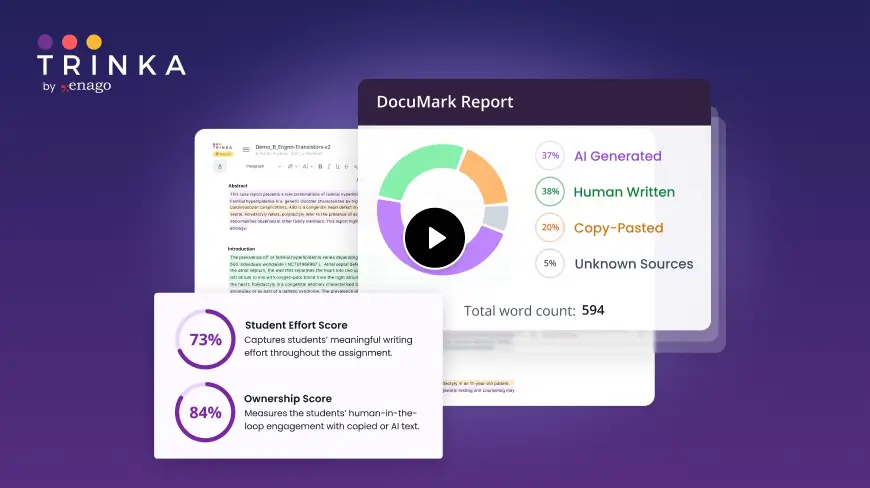
Knowing your institution's AI policy is step one. DocuMark helps enforce it fairly by empowering universities to manage AI-generated content, prevent cheating, and support student writing through responsible AI use.
Common Questions About Illinois Institute of Technology's AI Policies
Illinois Institute of Technology has defined AI policies in 10 of 12 categories, with an overall coverage score of 83%.
Illinois Tech states that using others’ ideas without attribution is a form of plagiarism and a violation of the Code of Academic Honesty. The AI teaching guidance also states that if AI is permitted, AI-generated portions must be identified, and the academic honesty guidance provides an example syllabus policy requiring submission of prompts and raw AI outputs plus tracked changes when ChatGPT is used for a writing assignment.
Illinois Tech states that Turnitin’s AI writing indicator is visible only to instructors and that Turnitin does not determine misconduct; it provides data for educators, and the AI percentage should not be used as the sole basis for action or grading. Illinois Tech’s academic honesty guidance similarly states that evidence from a detection tool alone is not decisive and that a conversation with the student is required. The Code of Academic Honesty describes sanctions (e.g., grade reduction, expulsion from a course) and states that instructors who determine a violation occurred are required to report it to the DDAD.
Illinois Tech’s AI for Teaching and Learning page describes an AI workshop session focused on “AI + Security + Data,” including “campus-supported AI tools” and “data privacy” and “FERPA considerations,” but the provided sources do not define a specific enforceable data-classification policy or an approved/prohibited list of AI platforms within the extracted text.