Teaching & Learning
- Use of AI in coursework is at instructor discretion
- Students are directed to check the syllabus or ask the professor before using AI tools in coursework, and unauthorized use may be treated as cheating
Check your syllabus for a statement about ChatGPT or AI from your professor first. If there is no statement, ask your professor before using any AI tools in your coursework. Unauthorized use of AI could be considered cheating.
- Distinctively, the guidance also raises a faith-based reflective question about reliance on technology versus God and human relationships in learning, consistent with IWU's Christian mission
- The library guidance presents AI as something students should approach cautiously in learning contexts, warns that AI can invent citations, and encourages reliance on library research specialists and professors
AI tools such as ChatGPT may make up credible-sounding citations to sources that do not exist, which is called "hallucinating." Make sure you locate the full source and read it before using it in your research project.
A quick trip to the library or chat with a library research specialist can quickly clarify solid sources for your topic. Why be in doubt when you have academic specialists to help guide you?
Question: What does it really mean for us to rely on machines vs. God and other humans ... especially in learning contexts like college? If something is shiny, new and faster, is it better for you?
Research
- This is presented as guidance tied to research projects rather than a uniform university-wide manuscript policy
- The university's library guidance requires students to cite AI-derived quotes, paraphrases, and ideas, and notes that some professors may require an explanation of how AI was used and submission of the AI-generated content
To avoid plagiarism, it is necessary to cite any quotes, paraphrasing and ideas you get from AI, just as you would with other sources. Some professors may also want you to explain how you used AI in completing the assignment and/or turn in the content the AI tool generated.
AI tools such as ChatGPT may make up credible-sounding citations to sources that do not exist, which is called “hallucinating.” Make sure you locate the full source and read it before using it in your research project.
- No AI-specific research data policy is defined in the available sources
- The university's IRB manual does not mention AI tools in research data collection or analysis
- It does require IRB approval for all human-subjects research conducted by IWU faculty, staff, students, or external investigators, and mandates privacy and confidentiality protections for identifiable research data
No research involving human subjects at Indiana Wesleyan University may be executed by IWU faculty, staff, students or external investigators without IRB approval.
The information obtained is recorded by the investigator in such a manner that the identity of the human subjects can readily be ascertained, directly or through identifiers linked to the subjects, and an IRB conducts a limited IRB review to make the determination that there are adequate provisions to protect the privacy of subjects and to maintain the confidentiality of data.
- The IRB is responsible for ensuring compliance with federal and state human-subjects regulations and evaluates risks and benefits of research
- For human-subjects research, IRB approval is mandatory for faculty, staff, students, and external investigators before the research is conducted
Indiana Wesleyan University (IWU or “the institution”) is committed to the protection of the rights and welfare of human subjects in all research, class projects and related activities.
No research involving human subjects at Indiana Wesleyan University may be executed by IWU faculty, staff, students or external investigators without IRB approval.
Federal guidelines require the IRB to weigh the risks to human subjects against the value of the proposed research.
Academic Integrity
- The guidance also ties unauthorized AI use to cheating, reinforcing the need for disclosure when instructors require it
- Students are instructed to cite quotes, paraphrases, and ideas obtained from AI, and some professors may additionally require students to explain how AI was used and submit the AI-generated output
To avoid plagiarism, it is necessary to cite any quotes, paraphrasing and ideas you get from AI, just as you would with other sources. Some professors may also want you to explain how you used AI in completing the assignment and/or turn in the content the AI tool generated.
Check your syllabus for a statement about ChatGPT or AI from your professor first. If there is no statement, ask your professor before using any AI tools in your coursework. Unauthorized use of AI could be considered cheating.
- No dedicated AI detection tool policy is defined
- The library guidance states that unauthorized use of AI could be considered cheating
- Separately, the technology acceptable use policy provides that the university may monitor and examine information stored on university systems without prior notice, and that violations of technology policy may result in disciplinary action up to dismissal; these provisions are not AI-specific
Unauthorized use of AI could be considered cheating.
At any time and without prior notice, Indiana Wesleyan University administration reserves the right to examine email, personal file directories and other information stored on Indiana Wesleyan University computers.
Individuals found to be in violation of any part of the policy will be subject to disciplinary action up to and including dismissal from the university.
Institutional & Administrative
- The IRB manual requires IRB approval for any human-subjects research conducted by faculty, staff, or students, but this is not an AI-specific provision
- The available sources do not define a specific AI policy for faculty or staff use in teaching, grading, feedback, lesson planning, or administrative communications
not defined
- The provided sources do not identify approved AI platforms or AI-specific data-classification rules
- The technology policy states that information on university-owned hardware and systems should not be considered private and may be reviewed, monitored, and disclosed by the university
No information residing on any computer hardware owned by IWU should be considered private and therefore is subject to review by university staff.
At any time and without prior notice, Indiana Wesleyan University administration reserves the right to examine email, personal file directories and other information stored on Indiana Wesleyan University computers.
Email messages cannot be considered private and may be monitored by university personnel. Such messages may be subject to disclosure to outside third parties, including the court system and law enforcement agencies, under certain circumstances.
Similarly, all information composed, transmitted, received or stored via the IWU computer system is also considered the property of Indiana Wesleyan University. As such, all stored information is subject to disclosure to management, law enforcement and other third parties, with or without notice to the student.
- The only formal governance structure in the sources is the IRB for human-subjects research
- The university provides library guidance on integrity with artificial intelligence, but the provided sources do not define an institution-wide AI governance framework, AI committee, or strategic roadmap
Integrity with Artificial Intelligence
The Institutional Review Board (IRB or “the Board”) is guided by the standards of U.S. government agencies (Code of Federal Regulations Title 45, Part 46) and ensures institutional compliance with all federal and state regulations regarding human subjects’ research.
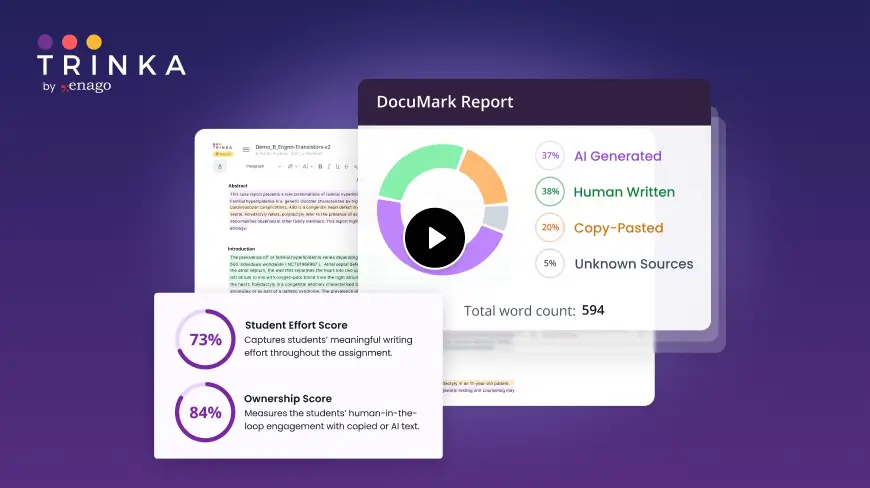
DocuMark: Responsible AI Use for Academic Integrity
Knowing your institution's AI policy is step one. DocuMark helps enforce it fairly by empowering universities to manage AI-generated content, prevent cheating, and support student writing through responsible AI use.
Common Questions About Indiana Wesleyan University, Marion's AI Policies
Indiana Wesleyan University, Marion has defined AI policies in 10 of 12 categories, with an overall coverage score of 83%.
Students are instructed to cite quotes, paraphrases, and ideas obtained from AI, and some professors may additionally require students to explain how AI was used and submit the AI-generated output. The guidance also ties unauthorized AI use to cheating, reinforcing the need for disclosure when instructors require it.
No dedicated AI detection tool policy is defined. The library guidance states that unauthorized use of AI could be considered cheating. Separately, the technology acceptable use policy provides that the university may monitor and examine information stored on university systems without prior notice, and that violations of technology policy may result in disciplinary action up to dismissal; these provisions are not AI-specific.
The technology policy states that information on university-owned hardware and systems should not be considered private and may be reviewed, monitored, and disclosed by the university. The provided sources do not identify approved AI platforms or AI-specific data-classification rules.