Teaching & Learning
- The only student-facing policy in the plagiarism document addresses plagiarism penalties generally, not AI use
- The university's provided sources do not define any AI-specific rules for students using AI in coursework or assignments
not defined
Research
- Any AI-generated text in manuscripts must be disclosed and attributed, and undisclosed AI-generated text is treated as plagiarism
- For the journal source, AI tools are allowed only for understanding or analyzing data and cannot replace an author's original work in submitted manuscripts
- The general plagiarism policy also requires originality in submitted and published work and applies to researchers, teachers, students, and staff involved in writing or publishing
Ulūm al-Sunnah follows strict anti-plagiarism guidelines in line with the HEC Anti-Plagiarism Policy 2023. All submitted manuscripts must represent original work and properly acknowledge all sources, including text, ideas, graphics, tables, or figures.
* Use of AI tools (e.g., ChatGPT) is allowed only for understanding or analyzing data, but cannot replace the author’s original work.
* Any AI-generated text must be properly disclosed and attributed; copying AI-generated content without attribution is considered plagiarism.
5. Applicability: The policy is applicable to students, teachers, researchers
and staff of all institutions and organizations in Pakistan who are involved in writing or
publishing their work.
- For the journal source, AI tools are allowed for understanding or analyzing data, but they cannot replace the author's original work
- No broader university-wide AI policy on research data handling, analysis workflows, or synthetic data is defined in the provided sources
* Use of AI tools (e.g., ChatGPT) is allowed only for understanding or analyzing data, but cannot replace the author’s original work.
- The provided sources treat undisclosed AI-generated text in journal manuscripts as plagiarism and frame plagiarism as a serious academic offense with possible disciplinary consequences
- The general plagiarism policy applies to researchers, teachers, students, and staff involved in writing or publishing, but it does not specifically address AI use in grant proposals, IRB applications, or ethics declarations
* Any AI-generated text must be properly disclosed and attributed; copying AI-generated content without attribution is considered plagiarism.
* Ulūm al-Sunnah aligns with HEC’s policy that plagiarism is a serious academic offense with potential disciplinary or legal consequences.
5. Applicability: The policy is applicable to students, teachers, researchers
and staff of all institutions and organizations in Pakistan who are involved in writing or
publishing their work.
Academic Integrity
- For journal manuscripts, disclosure and attribution of AI-generated text are mandatory
- Separately, the plagiarism policy requires all journal authors to sign a declaration that submitted creative work is not plagiarized
- The journal also requires proper acknowledgment of all sources and states that copying AI-generated content without attribution is plagiarism
All submitted manuscripts must represent original work and properly acknowledge all sources, including text, ideas, graphics, tables, or figures.
* Any AI-generated text must be properly disclosed and attributed; copying AI-generated content without attribution is considered plagiarism.
2. All Journals in Pakistan must require ALL authors to sign a
declaration that the material presented in the creative work is not
plagiarized (Sample Attached)
- Improper citation or high similarity may lead to rejection or further investigation
- The journal states that manuscripts are checked with electronic detection systems such as Turnitin, and that subject experts interpret similarity reports in context
- The broader plagiarism policy allows manual and automated similarity testing and provides penalties for students, teachers, researchers, and staff, including failure grades, expulsion, dismissal, blacklisting, rejection of submitted papers, and other sanctions depending on seriousness
* Manuscripts are checked using electronic detection systems (EDS) such as Turnitin.
* Similarity reports are interpreted by subject experts in context; high similarity or improper citation may lead to rejection or further investigation.
a) Manual and / or automated tests for content similarity [1]
11. Plagiarism is an intellectual crime. As such the penalties for plagiarism should
not only take into account the severity and recurrence of the offence, but also the
intellectual standing of the offender.
(iv) The offender may be given a failure grade in the subject.
(ii) The offender may be expelled/ rusticated from the University and from
joining any institution of Higher Education in Pakistan for a period as
deemed appropriate by the "Plagiarism Standing Committee”.
In cases where most of the paper (or key results) have been exactly
copied from any published work of other people without giving the
reference to the original work, then (a) a major penalty of dismissal from
service needs to be prescribed, along with (b) the offender may be
“Black Listed” and may NOT be eligible for employment in any academic
/ research organization
c) If the paper is submitted but not published yet, the paper will be rejected
by the Editor-in-Chief or the Program Chair without further revisions and
without any further plagiarism investigation conducted.[1]
Institutional & Administrative
- The provided sources do not define AI-use rules for faculty or staff in grading, feedback, lesson planning, recommendation letters, or administrative communications
- The plagiarism policy does apply to teachers, researchers, and staff involved in writing or publishing their work, but it does not address administrative or teaching-use AI practices
not defined
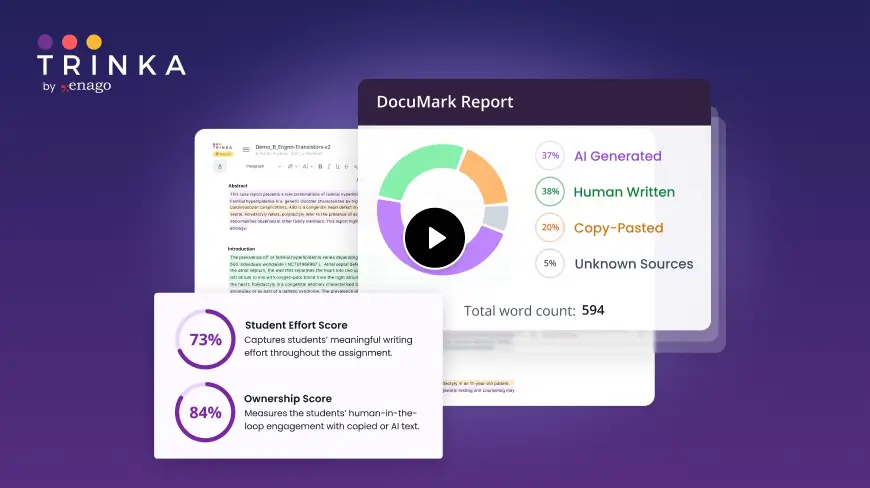
DocuMark: Responsible AI Use for Academic Integrity
Knowing your institution's AI policy is step one. DocuMark helps enforce it fairly by empowering universities to manage AI-generated content, prevent cheating, and support student writing through responsible AI use.
Common Questions About Intercontinental University of Business's AI Policies
Intercontinental University of Business has defined AI policies in 7 of 12 categories, with an overall coverage score of 58%.
For journal manuscripts, disclosure and attribution of AI-generated text are mandatory. The journal also requires proper acknowledgment of all sources and states that copying AI-generated content without attribution is plagiarism. Separately, the plagiarism policy requires all journal authors to sign a declaration that submitted creative work is not plagiarized.
The journal states that manuscripts are checked with electronic detection systems such as Turnitin, and that subject experts interpret similarity reports in context. Improper citation or high similarity may lead to rejection or further investigation. The broader plagiarism policy allows manual and automated similarity testing and provides penalties for students, teachers, researchers, and staff, including failure grades, expulsion, dismissal, blacklisting, rejection of submitted papers, and other sanctions depending on seriousness.
No explicit data protection or approved AI platform policy is currently defined in the available policy sources.