Teaching & Learning
- Use of AI for coursework is generally prohibited unless an instructor explicitly permits it
- The student conduct guidance states this applies across common coursework formats and treats unauthorized AI use for academic requirements as academic misconduct
Use of Artificial Intelligence (AI) tools like ChatGPT, Grammarly, Google Gemini, and other AI platforms are prohibited in most courses, except where instructors provide explicit permission for use, including drafts, outlines, essays, coding, discussion prompts, exams, etc. Using an AI platform to produce work or provide an "example" for students to rely on for academic requirements regularly results in identification of use of unauthorized resources and constitutes academic misconduct.
- AI use in exams and other assessments is generally prohibited unless the instructor gives explicit permission
- Iowa State also advises faculty to set course-level expectations about allowable AI use and possible penalties in course policy
Use of Artificial Intelligence (AI) tools like ChatGPT, Grammarly, Google Gemini, and other AI platforms are prohibited in most courses, except where instructors provide explicit permission for use, including drafts, outlines, essays, coding, discussion prompts, exams, etc.
Openly discuss the ethics of using AI: A course policy that specifies allowable uses of AI and/or penalties for its use can help manage everyone's expectations.
- Separate conduct guidance warns that AI use tied to academic requirements is prohibited unless explicitly allowed by the instructor
- The university describes AI tools as usable for learning new topics, explanations, summaries, and related study support, but it does not set a specific university-wide student policy distinguishing study assistance from graded work
Chat and ask questions: Get help with writing, brainstorming, summarizing and learning new topics.
Chat and ask questions: Get answers, summaries, explanations and writing help.
Use of Artificial Intelligence (AI) tools like ChatGPT, Grammarly, Google Gemini, and other AI platforms are prohibited in most courses, except where instructors provide explicit permission for use, including drafts, outlines, essays, coding, discussion prompts, exams, etc.
- AI-assisted coding for coursework is generally prohibited unless the instructor explicitly allows it
- The university also identifies institutional AI tools that can generate, explain, and debug code, but student conduct rules still place course use under instructor permission
Use of Artificial Intelligence (AI) tools like ChatGPT, Grammarly, Google Gemini, and other AI platforms are prohibited in most courses, except where instructors provide explicit permission for use, including drafts, outlines, essays, coding, discussion prompts, exams, etc.
Get help with code: Generate, explain and debug code in multiple programming languages.
Get help with code: Get assistance with programming, debugging and code generation.
Research
- Researchers are expected to follow publication rules, document and cite AI use where required, disclose it when required by publishers, and remain fully responsible for the manuscript content
- For research papers, the university's research guidance says the default stance should generally be no, especially for creative contributions, but editorial assistance may be used if the target publication allows it
The default stance on using GenAI for writing research papers should generally be no – particularly for creative contributions – due to issues around authorship, copyright, and plagiarism. However, GenAI can be beneficial for editorial assistance, provided you are aware of what your target publication deems acceptable.
Because this is a rapidly evolving and controversial area, many journals and research conferences have been, and will continue to, update their policies. Again, it’s critical that you carefully review and understand the author guidelines of your targeted journal.
Science journals require full disclosure for the use of GenAI to generate text; GenAI-generated images and multimedia can be used only with explicit permission of their editors. AI is not granted authorship.
JAMA and the JAMA network journals do not allow GenAI to be listed as authors. However, GenAI content or assistance in writing/editing are allowed in manuscripts but should be reported in the manuscript.
Publishers’ policies constantly evolve, but most require authors to document their use of AI and to properly cite the tools used.
Bottom line, as the author, you are fully responsible for the content of your manuscript, even those parts produced by an AI tool, and are thus liable for any breach of publication ethics.
- Researchers are told to verify AI outputs, prioritize human oversight, and avoid using tools in ways that could expose inventions or confidential material
- The university does not provide a direct across-the-board permission statement for using AI in research data analysis, but its research guidance permits use only with strong human verification and warns against uploading protected or disclosure-sensitive content
When using GenAI in research collaborations, be respectful and transparent about its use:
* Thoroughly verifying GenAI content;
* Ensuring all collaborators understand the limitations of GenAI and their responsibility in reviewing outputs carefully; and
* Always prioritizing human oversight and critical thinking in the research process.
You are responsible for verifying the summaries that GenAI gives you.
If an inventor were to upload their invention to a GenAI system or chat about an invention with a GenAI system, it is possible that such a disclosure could be considered a public disclosure if the GenAI system is operated by a third party.
- Use of AI to review grant proposals or research papers is discouraged due to confidentiality concerns
- Research guidance frames AI use as an ethics and integrity issue and warns that inappropriate use may lead to research misconduct as defined in Iowa State's Research Misconduct policy
- For grants, the guidance states that risks outweigh benefits, that principal investigators remain fully responsible for all proposal content, and that NIH has implemented a policy effective September 25, 2025 stating it will not consider applications substantially developed by AI to be original; post-award detection may result in enforcement actions
Although the university does not have a specific policy on the use of GenAI, inappropriate use of the technology may lead to research misconduct as defined in the Iowa State Research Misconduct policy.
The downside risks of using GenAI in the process of writing research grants far surpasses any upside benefit. Keep in mind that you, as principal investigator, sign off on the proposal and promise to do the work if funded, so you are responsible for every part of the proposal content, even if GenAI assisted in the development of that content.
Effective September 25, 2025, the National Institutes of Health (NIH) implemented new policy to support fairness and originality in NIH research grant applications. The agency will not consider applications that are either substantially developed by AI, or contain sections substantially developed by AI, to be original ideas of applicants.
If the detection of AI is identified post award, NIH may refer the matter to the Office of Research Integrity to determine whether there is research misconduct while simultaneously taking enforcement actions including but not limited to disallowing costs, withholding future awards, wholly or in part suspending the grant, and possible termination.
The main rationale is that this would constitute a breach of confidentiality, which is essential in the grant review process.
Academic Integrity
- Students must follow instructor-specified disclosure requirements or risk academic misconduct findings
- For research, Iowa State requires researchers to cite AI tools, document AI use when publishers require it, and report AI assistance per publication rules, while remaining fully responsible for manuscript content
- For teaching, faculty are encouraged to include AI-use expectations in the syllabus, including any disclosure or transcript-submission requirements when AI is permitted; CELT also provides syllabus statement resources to support this
When using GenAI in research collaborations, be respectful and transparent about its use:
* Appropriately citing the GenAI tool used;
Publishers' policies constantly evolve, but most require authors to document their use of AI and to properly cite the tools used.
JAMA and the JAMA network journals do not allow GenAI to be listed as authors. However, GenAI content or assistance in writing/editing are allowed in manuscripts but should be reported in the manuscript.
Faculty are encouraged to provide information in their syllabus regarding expectations related to coursework completion, academic integrity and the academic/grade consequences for students who complete their work dishonestly.
Faculty and instructors may wish to add specific information in their syllabus related to use of AI content generation.
For example, a course might allow for certain uses of AI, as long as the work includes the transcript and how the output was evaluated, coordinated with other research, and fact-checked.
- Unauthorized AI use in academic work is treated as academic misconduct
- No university-wide endorsement or rule about specific AI detection software is defined in the provided sources
- Suspected AI-generated coursework referrals are reviewed through the same misconduct process as other cases, and faculty are advised to set penalties and expectations in course policies
Using an AI platform to produce work or provide an "example" for students to rely on for academic requirements regularly results in identification of use of unauthorized resources and constitutes academic misconduct.
Suspected AI-generated coursework referrals will be reviewed similar to any other form of academic misconduct.
Openly discuss the ethics of using AI: A course policy that specifies allowable uses of AI and/or penalties for its use can help manage everyone's expectations.
Institutional & Administrative
- Faculty and staff are provided institutional AI tools and dedicated teaching guidance through CELT and the Iowa State AI portal
- Faculty are encouraged to set syllabus expectations around AI use, including consequences for academic integrity violations, and may consult CELT resources on AI in teaching and academic integrity
- Research guidance also permits some administrative writing assistance such as drafting letters of support, while emphasizing the human author remains fully responsible and should not use AI where confidentiality cannot be assured
The resources below are designed to support ISU instructors as they navigate AI use from a teaching and learning lens.
Faculty are encouraged to provide information in their syllabus regarding expectations related to coursework completion, academic integrity and the academic/grade consequences for students who complete their work dishonestly.
Faculty and instructors may wish to add specific information in their syllabus related to use of AI content generation.
In some situations, GenAI can be useful to help you draft a letter or edit your letter to adopt a certain tone and carry it throughout. However, please keep the following in mind:
* You are still fully responsible for everything in the letter because you are still the author.
* You should consider the issue of confidentiality. If there is confidential information in the letter, GenAI should not be used if you're not certain about what the system will do with the information you feed into it.
- Iowa State's data-classification framework defines Restricted, High, Moderate, and Low data levels and requires data to be protected according to sensitivity throughout its lifecycle
- Confidential data classified as moderate or above may not be entered into generative AI products unless assessed and approved under university data-classification and compliance processes
- The university recommends logged-in enterprise versions of Microsoft Copilot, Copilot 365, Gemini, and NotebookLM as safer tools for confidential data, and it warns against the public free version of Copilot
For data protection, Microsoft Copilot on the web and Microsoft Copilot 365 are recommended tools because of enterprise data protection, but only when you are logged in with your Iowa State email and password. Avoid using the “free to the public” version. When logged into Copilot, you can use it for confidential data. Google’s AI tools — Gemini and NotebookLM — are also safe to use when logged in with your university email and password. You can use these for confidential data too, when logged in.
Confidential data (data classified as “moderate” or above), may not be entered into any generative AI product unless the confidential data has been assessed and approved for such use in accordance with ISU’s data classification policy and other appropriate institutional compliance offices as applicable.
Use of generative AI must align with the university’s mission, vision, and values and comply with all state and federal laws and institutional regulations and requirements, including the university policies regarding:
* Acceptable use of information technology resources
* IT security
* Data classification
* Research data policies
Data are classified in four categories depending on sensitivity and importance. Subsets of data shall have the same classification level and utilize the same protective measures as the original data in the system of record. Data must be consistently protected throughout its life cycle in a manner commensurate with its sensitivity, regardless of where it resides or what purpose(s) it serves.
1.1. Restricted
Data that are required to be protected by applicable law, statute (e.g., Iowa Code 22.7, HIPAA,
ITAR, or other statute) or university policy, or which, if disclosed to the public could expose the
university to legal or financial obligations.
1.2. High
Data that are protected by the Family Educational Rights and Privacy Act (FERPA) or Iowa Code
22.7(1) regarding student records and which has been classified by the Office of the Registrar as
confidential student information.
1.3. Moderate
Data for which access must be guarded due to proprietary, ethical, or privacy considerations.
1.4. Low
Data which may or must be open to the general public.
- All generative AI use must comply with state and federal laws and institutional regulations including acceptable use, IT security, data classification, and research data policies
- Iowa State has an institution-level AI governance framework centered on its AI portal, which frames AI use around the university's mission, vision, values, safety, compliance, teaching, and research
- The Office of the Vice President for Research provides complementary guidance aimed at fostering responsible and ethical AI use as part of a strategic culture of research professionalism, and an ISU AI project committee is referenced as an institutional oversight body for AI initiatives
Use of generative AI must align with the university's mission, vision, and values and comply with all state and federal laws and institutional regulations and requirements, including the university policies regarding:
* Acceptable use of information technology resources
* IT security
* Data classification
* Research data policies
Reflecting our strategic aspiration to lead a culture of research professionalism at Iowa State, the Office of the Vice President for Research has compiled the following FAQ to provide guidance to our research community on the responsible and ethical use of GenAI in research endeavors.
ISU's AI project committee [referenced on ai.iastate.edu as an institutional oversight body for AI initiatives].
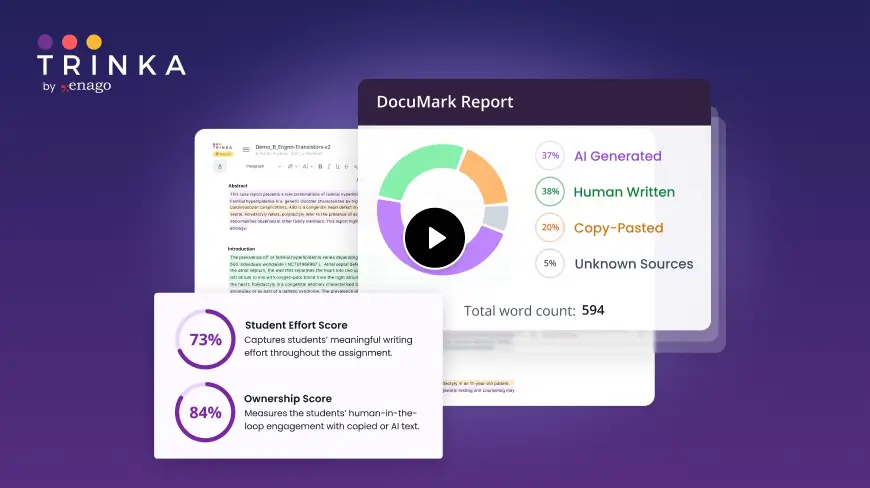
DocuMark: Responsible AI Use for Academic Integrity
Knowing your institution's AI policy is step one. DocuMark helps enforce it fairly by empowering universities to manage AI-generated content, prevent cheating, and support student writing through responsible AI use.
Common Questions About Iowa State University of Science and Technology's AI Policies
Iowa State University of Science and Technology has defined AI policies in 12 of 12 categories, with an overall coverage score of 100%.
For research, Iowa State requires researchers to cite AI tools, document AI use when publishers require it, and report AI assistance per publication rules, while remaining fully responsible for manuscript content. For teaching, faculty are encouraged to include AI-use expectations in the syllabus, including any disclosure or transcript-submission requirements when AI is permitted; CELT also provides syllabus statement resources to support this. Students must follow instructor-specified disclosure requirements or risk academic misconduct findings.
Unauthorized AI use in academic work is treated as academic misconduct. Suspected AI-generated coursework referrals are reviewed through the same misconduct process as other cases, and faculty are advised to set penalties and expectations in course policies. No university-wide endorsement or rule about specific AI detection software is defined in the provided sources.
The university recommends logged-in enterprise versions of Microsoft Copilot, Copilot 365, Gemini, and NotebookLM as safer tools for confidential data, and it warns against the public free version of Copilot. Confidential data classified as moderate or above may not be entered into generative AI products unless assessed and approved under university data-classification and compliance processes. Iowa State's data-classification framework defines Restricted, High, Moderate, and Low data levels and requires data to be protected according to sensitivity throughout its lifecycle.