Teaching & Learning
- Use of generative AI for graded coursework is governed at the course level
- Students are expected to acknowledge non-incidental AI use and disclose it when in doubt
- Individual instructors may allow or disallow some or all uses in their courses, and if the instructor has not made a clear statement, students may not use generative AI to substantially complete an assignment
3. Generative AI has the potential to enhance the learning experience, support students and educators, and promote accessibility to knowledge. It can also be used by students to complete assignments and such use of generative AI may violate our standards of academic conduct as defined above.
4. Individual course instructors are free to set their own policies regulating the use of generative AI tools in their courses, including allowing or disallowing some or all uses of such tools. Course instructors should set such policies in their course syllabi and clearly communicate such policies to students. Students who are unsure of policies regarding generative AI tools are encouraged to ask their instructors for clarification.
5. Absent a clear statement from a course instructor, use of or consultation with generative AI shall be treated analogously to assistance from another person. Using generative AI tools to substantially complete an assignment or exam (e.g., by entering exam or assignment questions in an AI chat or search) is not permitted. Students should acknowledge the use of generative AI (other than incidental use) and default to disclosing such assistance when in doubt.
- AI use during exams is prohibited unless an instructor clearly states otherwise
- The academic conduct policy also classifies reviewing online or other electronic information during an examination as misconduct, and absent a clear instructor statement, using generative AI to substantially complete an exam is not permitted
* reviewing, without authorization, material during an examination (e.g., personal notes, another student's exam, online or other electronic information);
4. Individual course instructors are free to set their own policies regulating the use of generative AI tools in their courses, including allowing or disallowing some or all uses of such tools. Course instructors should set such policies in their course syllabi and clearly communicate such policies to students. Students who are unsure of policies regarding generative AI tools are encouraged to ask their instructors for clarification.
5. Absent a clear statement from a course instructor, use of or consultation with generative AI shall be treated analogously to assistance from another person. Using generative AI tools to substantially complete an assignment or exam (e.g., by entering exam or assignment questions in an AI chat or search) is not permitted.
- The college states that generative AI can support learning and accessibility, but it does not set a single university-wide student rule for study assistance
- Instead, students are directed to instructor policies for course-related use, and the institution also promotes AI literacy and personalized learning support more broadly
3. Generative AI has the potential to enhance the learning experience, support students and educators, and promote accessibility to knowledge.
4. Individual course instructors are free to set their own policies regulating the use of generative AI tools in their courses, including allowing or disallowing some or all uses of such tools. Course instructors should set such policies in their course syllabi and clearly communicate such policies to students. Students who are unsure of policies regarding generative AI tools are encouraged to ask their instructors for clarification.
We are committed to integrating AI literacy into our curriculum and programming, ensuring that our graduates are equipped with the knowledge, strategies, and skills needed to thrive in an AI-driven world.
Beyond the classroom, AI will be utilized to enrich student experiences through personalized services and proactive support.
- Programming-related AI use is addressed through the general generative AI academic conduct policy rather than a coding-specific rule
- The college defines generative AI as able to generate computer code, allows instructors to set course-level rules, and absent a clear instructor statement, students may not use AI to substantially complete an assignment or exam
2. Generative artificial intelligence (AI) refers to the application of AI technologies that utilize machine learning models to create new and original content or augment existing content. Generative AI can generate content such as text, images, music, and computer code by recognizing patterns and learning from existing data gathered from the internet.
4. Individual course instructors are free to set their own policies regulating the use of generative AI tools in their courses, including allowing or disallowing some or all uses of such tools. Course instructors should set such policies in their course syllabi and clearly communicate such policies to students. Students who are unsure of policies regarding generative AI tools are encouraged to ask their instructors for clarification.
5. Absent a clear statement from a course instructor, use of or consultation with generative AI shall be treated analogously to assistance from another person. Using generative AI tools to substantially complete an assignment or exam (e.g., by entering exam or assignment questions in an AI chat or search) is not permitted.
Research
- Its research-facing language emphasizes ethical standards, transparency, and protection of individual ideas and personal data
- The university states broad support for responsible AI in research, but it does not define specific rules for using AI to draft, edit, or prepare scholarly manuscripts
We will uphold and promote responsible AI research and use. As a community of scholars and innovators, we conduct AI research with rigorous ethical standards by considering these technologies’ benefits, risks, and potential impacts. Our commitment to responsible AI use ensures that we contribute positively to societal progress while upholding the values that define Ithaca College regarding academic excellence, individual ideas, and personal data.
• Commit to Transparency and Ethics: Reinforce institutional dedication to transparent processes and robust ethical oversight in all AI deployments.
- The college encourages AI applications that support research and data-informed work, but it does not set a detailed research-data policy for AI analysis
- Institutionally, AI use must follow data-protection precautions, and users are responsible for avoiding unauthorized exposure and complying with FERPA and other applicable requirements
• AI for Research and Institutional Support: Encouraging innovation in faculty research, informed decision-making, and proactive student services through responsible AI applications.
The Information Technology and Analytics department advises the campus community to avoid entering personal, confidential, or proprietary data into Generative AI tools unless adequate data protection measures are in place. Sharing such information could result in unintended access by third parties.
As a general rule, don't put anything in an AI tool that you wouldn't be willing to post publicly to the Internet. The exception is when using an IC approved AI tool with data protection that has been reviewed and approved by the college (see list below).
Use of Artificial Intelligence (AI) should follow the Ithaca College Guiding Principles for AI and must comply with College policies and all applicable laws and regulations, including FERPA requirements that limit uses of student education records. Users of AI tools are responsible for taking reasonable precautions against unauthorized data exposure, bias, and other vulnerabilities.
- The articulated position is a general requirement for responsible, ethically governed AI research and risk management
- Ithaca College states that AI research and use must follow rigorous ethical standards and transparent oversight, but it does not define AI-specific rules for grant proposals, IRB applications, or research ethics declarations
We will uphold and promote responsible AI research and use. As a community of scholars and innovators, we conduct AI research with rigorous ethical standards by considering these technologies’ benefits, risks, and potential impacts.
• Commit to Transparency and Ethics: Reinforce institutional dedication to transparent processes and robust ethical oversight in all AI deployments.
We ensure data security and proactive risk management through rigorous practices and regular evaluations involving campus stakeholders.
Academic Integrity
- For student academic work, disclosure of generative AI use is expected unless the use is merely incidental
- The policy does not prescribe a formal citation style, but it says students should acknowledge AI use and default to disclosing assistance when in doubt
5. Absent a clear statement from a course instructor, use of or consultation with generative AI shall be treated analogously to assistance from another person. Using generative AI tools to substantially complete an assignment or exam (e.g., by entering exam or assignment questions in an AI chat or search) is not permitted. Students should acknowledge the use of generative AI (other than incidental use) and default to disclosing such assistance when in doubt.
- No institutional policy on AI-detection tools is defined in the provided sources
- The university treats impermissible generative AI use as a possible violation of its standards of academic conduct, with enforcement tied to that misconduct framework and to instructor policies
3. Generative AI has the potential to enhance the learning experience, support students and educators, and promote accessibility to knowledge. It can also be used by students to complete assignments and such use of generative AI may violate our standards of academic conduct as defined above.
4. Individual course instructors are free to set their own policies regulating the use of generative AI tools in their courses, including allowing or disallowing some or all uses of such tools. Course instructors should set such policies in their course syllabi and clearly communicate such policies to students. Students who are unsure of policies regarding generative AI tools are encouraged to ask their instructors for clarification.
1. Academic honesty is a cornerstone of the mission of the College. Unless it is otherwise stipulated, students may submit for evaluation only that work that is their own and that is submitted originally for a specific course. According to traditions of higher education, forms of conduct that will be considered evidence of academic misconduct include but are not limited to the following:
Institutional & Administrative
- Faculty are offered programs to integrate AI into teaching, assignments, and assessments, and staff are encouraged to use AI for routine tasks so they can focus on higher-value work
- The college explicitly supports faculty and staff use of AI through training, grants, and administrative adoption, while emphasizing human oversight, transparency, and mission alignment
We center on people, not technology, ensuring that AI is used as a tool to enhance human skills and capabilities. We believe AI cannot replace the vital human relationships, creativity, and decision-making that define our educational experience. Rather, AI is one tool among many that allows our community to focus on innovation while maintaining human oversight and autonomy.
We will empower our staff by supporting their use of AI tools that handle routine tasks, thereby enabling them to focus on higher-value activities such as professional growth, innovation, and strategic thinking.
This initiative includes four levels of faculty engagement to allow multiple opportunities to learn and apply AI to course practices. Whether you are looking to get started or want to go deeper into the use of AI, each level builds on prior experiences and understanding of artificial intelligence and its application to teaching and learning.
Ten faculty (five per semester in 2025–2026) will each receive a stipend to pilot AI integration into an instructional unit. Projects may include a lesson redesign or an AI-based assessment.
Faculty members who complete the AI Literacy Institute may apply for a stipend to redesign a course. The redesign will integrate AI concepts throughout instruction, assignments, and assessments, with implementation occurring in 2026–2027.
- Microsoft Copilot is specifically identified as an approved tool with enterprise data protection when used with college credentials
- Ithaca identifies IC-approved tools with reviewed data protection, requires compliance with FERPA and other laws, and states that users are responsible for taking reasonable precautions against unauthorized data exposure, bias, and vulnerabilities
- The college advises the campus community not to enter personal, confidential, or proprietary information into generative AI tools unless adequate protections are in place, and generally to avoid putting anything into AI that they would not post publicly
The Information Technology and Analytics department advises the campus community to avoid entering personal, confidential, or proprietary data into Generative AI tools unless adequate data protection measures are in place. Sharing such information could result in unintended access by third parties.
As a general rule, don't put anything in an AI tool that you wouldn't be willing to post publicly to the Internet. The exception is when using an IC approved AI tool with data protection that has been reviewed and approved by the college (see list below).
Examples of sensitive or internal information include:
* Personally Identifiable Information (PII): Full names, addresses, social security numbers
* Student Academic Information: Grades, evaluations, or records affecting student privacy and academic integrity
* Financial Details: Bank accounts, credit card numbers, transaction data, internal reports
* Health Records: Personal medical information, health records
* Login Credentials: Usernames, passwords, PINs, security questions
* Confidential Academic Work: Unpublished research, patents
Use of Artificial Intelligence (AI) should follow the Ithaca College Guiding Principles for AI and must comply with College policies and all applicable laws and regulations, including FERPA requirements that limit uses of student education records. Users of AI tools are responsible for taking reasonable precautions against unauthorized data exposure, bias, and other vulnerabilities.
* Microsoft Copilot: General AI chat tool with Enterprise Data Protection (when logged in with College credentials
* When signed in with your Ithaca College account, enterprise data protection applies.
* Your prompts and responses are protected and not used to train AI models.
- Ithaca College has a formal AI governance and strategy structure centered on guiding principles and a Presidential Working Group on AI
- The broader strategy emphasizes transparency, ethics, data security, regular review, and campus-wide AI readiness for faculty, staff, and administrators
- The working group was charged with recommending a strategic framework for responsible, mission-aligned AI in administrative and operational domains, while academic instruction and curriculum issues are being explored separately by faculty-led committees
The following guiding principles for the use of AI at Ithaca College were developed by the Presidential Working Group on AI, informed by best practices, a thorough review of the College’s vision, mission, and values, and feedback from faculty, staff, and student governance groups. We recommend these principles be formally adopted to guide the implementation and evaluation of AI initiatives.
Recognizing both the promise and the complexity of artificial intelligence (AI), President La Jerne Terry Cornish established the Presidential Working Group on Artificial Intelligence in July 2024. The group was tasked with recommending a strategic framework for the responsible, mission-aligned use of AI within Ithaca College’s administrative and operational domains.
Importantly, AI use in academic instruction, course content, and curriculum design falls outside the scope of this group’s charge. These areas are being actively explored by faculty-led committees across Ithaca College.
We engage in continuous evaluation and communication. Regular reviews, transparent communication, and opportunities for community feedback will ensure our AI initiatives remain aligned with institutional values and community expectations.
Ithaca College is participating in the AI Ready program All Campus Essentials initiative, offered by the The Council of Independent Colleges (CIC). This program is designed for faculty, staff, and administrators, to foster learning, share resources, and increase the effective adoption of artificial intelligence (AI) across our campus.
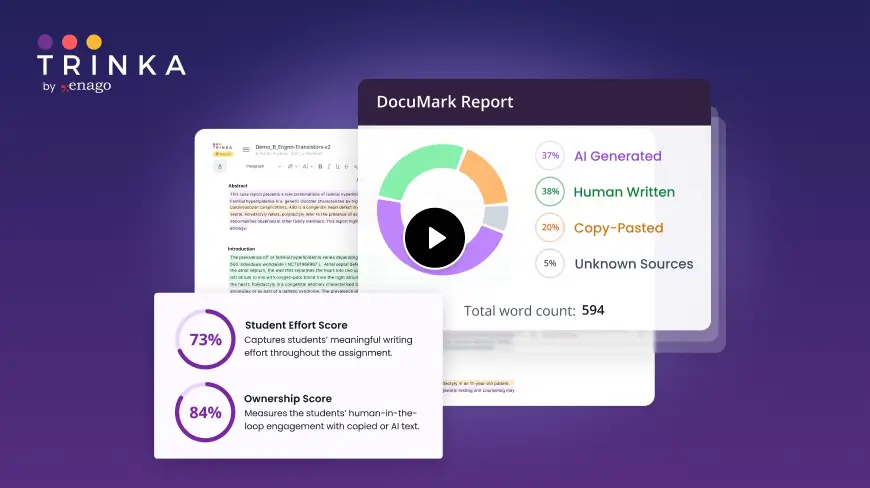
DocuMark: Responsible AI Use for Academic Integrity
Knowing your institution's AI policy is step one. DocuMark helps enforce it fairly by empowering universities to manage AI-generated content, prevent cheating, and support student writing through responsible AI use.
Common Questions About Ithaca College's AI Policies
Ithaca College has defined AI policies in 12 of 12 categories, with an overall coverage score of 100%.
For student academic work, disclosure of generative AI use is expected unless the use is merely incidental. The policy does not prescribe a formal citation style, but it says students should acknowledge AI use and default to disclosing assistance when in doubt.
The university treats impermissible generative AI use as a possible violation of its standards of academic conduct, with enforcement tied to that misconduct framework and to instructor policies. No institutional policy on AI-detection tools is defined in the provided sources.
The college advises the campus community not to enter personal, confidential, or proprietary information into generative AI tools unless adequate protections are in place, and generally to avoid putting anything into AI that they would not post publicly. Ithaca identifies IC-approved tools with reviewed data protection, requires compliance with FERPA and other laws, and states that users are responsible for taking reasonable precautions against unauthorized data exposure, bias, and vulnerabilities. Microsoft Copilot is specifically identified as an approved tool with enterprise data protection when used with college credentials.