Teaching & Learning
- If an instructor permits AI use, students are expected to acknowledge and cite it
- Use of AI in graded course work is set at instructor discretion rather than by a single university-wide rule
- Instructors are strongly encouraged to state permitted and prohibited uses in their syllabus, and students are told to check those expectations for each course
Instructors are strongly encouraged to establish syllabus language that outlines their expectations and defines the appropriate or inappropriate use of GenAI tools in relationship to course- or discipline-specific student learning outcomes.
Students should consult with their instructors and read the syllabus to clarify expectations regarding the use of GenAI tools or platforms in each course. When permitted by the instructor, students should appropriately acknowledge and cite their use of GenAI applications.
- JMU does not provide a separate university-wide AI rule specific to exams or quizzes in the cited sources
- Expectations for use in assessed work are deferred to instructors through course-specific syllabus language
Instructors are strongly encouraged to establish syllabus language that outlines their expectations and defines the appropriate or inappropriate use of GenAI tools in relationship to course- or discipline-specific student learning outcomes.
Students should consult with their instructors and read the syllabus to clarify expectations regarding the use of GenAI tools or platforms in each course.
- The Libraries offer AI learning materials and self-paced instruction, and Microsoft Copilot Chat is available as an approved resource for the campus community
- JMU provides learning resources and approved AI access for study and learning support, but students still must follow instructor expectations within each course
Students should consult with their instructors and read the syllabus to clarify expectations regarding the use of GenAI tools or platforms in each course.
The Libraries recommends th e Student Guide to Artificial Intelligence from the Imagining the Digital Future Center, and JMU students may sign up for a self-paced Libraries course on AI basics here.
JMU Libraries offers a variety of ways for faculty, staff, and students to learn about artificial intelligence (AI), critically examine its implications and effects, and use it appropriately in their work. We invite you to connect with us for consultations related to AI in research, teaching, and learning—and to explore the learning resources we’ve curated here for you.
JMU IT provides Microsoft Copilot Chat, a generative artificial intelligence (GenAI) tool with commercial data protections, as an approved GenAI resource for JMU students, staff, and faculty.
Research
- AI-generated material must be reviewed for accuracy and bias
- JMU allows research-related AI use only with strong cautions around integrity, attribution, and human review
- Researchers are encouraged to consult collaborators and relevant experts about whether AI is appropriate, and if they use it they should disclose that use with proper attribution
Researchers are encouraged to consult with co-investigators, advisors, collaborators, funding agencies and field experts to evaluate the appropriateness of using AI in research activities.
When using GenAI tools, maintaining research integrity and safeguarding intellectual property, confidentiality, and ethical standards is essential. All users should review and evaluate the output for accuracy and potential bias and should disclose the use of GenAI with proper attribution.
Human oversight is required with the use of AI tools. Users must review all AI-generated material for accuracy, reliability, and appropriateness. Outputs must be verified and refined to reflect human judgement and ethical standards.
- Research use of AI with data is restricted by university data-protection requirements
- Researchers should not enter federal, state, or university data into externally sourced tools that are not JMU-sanctioned
- Microsoft Copilot Chat is the only broadly approved AI tool for the JMU community, other AI tools require IT review and approval, and human review of outputs is required
Researchers should not input federal, state or university data into externally sourced (non JMU sanctioned) GenAI tools due to the high risk of exposing sensitive information to public or open-source domains.
No GenAI or AI tools are authorized for use with JMU data without prior approval from JMU Information Technology.
The University’s licensed GenAI tool, Microsoft Copilot Chat (“Copilot Chat”) is the only GenAI tool currently approved for use by the entire JMU community.
Requests for the use of AI tools, other than Microsoft Copilot Chat, must be submitted to IT for review and approval through a Technology Solution Request.
Human oversight is required with the use of AI tools. Users must review all AI-generated material for accuracy, reliability, and appropriateness. Outputs must be verified and refined to reflect human judgement and ethical standards.
- JMU explicitly ties AI use in research to research integrity, confidentiality, intellectual property, and ethical standards
- Researchers should disclose AI use with proper attribution, review outputs for accuracy and bias, and may need additional IRB review for research uses of AI
When using GenAI tools, maintaining research integrity and safeguarding intellectual property, confidentiality, and ethical standards is essential. All users should review and evaluate the output for accuracy and potential bias and should disclose the use of GenAI with proper attribution.
Please note that the use of AI tools for research purposes may require additional review by JMU's Institutional Review Board (IRB).
Human oversight is required with the use of AI tools. Users must review all AI-generated material for accuracy, reliability, and appropriateness. Outputs must be verified and refined to reflect human judgement and ethical standards.
Academic Integrity
- Students must acknowledge and cite AI use when an instructor allows it, and researchers should disclose use with proper attribution
- JMU requires transparency when AI is used to generate shared content and expects attribution when AI is permitted in coursework or used in research
Students should consult with their instructors and read the syllabus to clarify expectations regarding the use of GenAI tools or platforms in each course. When permitted by the instructor, students should appropriately acknowledge and cite their use of GenAI applications.
When using GenAI tools, maintaining research integrity and safeguarding intellectual property, confidentiality, and ethical standards is essential. All users should review and evaluate the output for accuracy and potential bias and should disclose the use of GenAI with proper attribution.
Transparency matters. Any AI tool used to generate content that is then shared must include a disclaimer noting that an AI tool was used to generate it, the platform utilized, and the date of use.
- The cited sources do not state AI-specific penalties for undisclosed use
- JMU uses Turnitin for plagiarism and citation checking, but its Turnitin instance does not include AI-writing detection
- The academic integrity site says Turnitin is available to faculty and students, and the library page says instructors can choose to enable it for Canvas assignments
The JMU community uses a plagiarism detection system called Turnitin. Turnitin is integrated into Canvas and is available for use by all JMU faculty and students.
Instructors at James Madison University have access to Turnitin, a tool integrated into Canvas can check submitted work for plagiarism and citation mistakes. Instructors can choose to enable Turnitin for Canvas assignments via SpeedGrader in Canvas.
JMU’s instance of Turnitin does not include the feature that looks for text that appears to be written by generative artificial intelligence (gAI).
Institutional & Administrative
- Faculty and staff are also encouraged to discuss responsible use and costs before requesting review of additional tools
- JMU permits faculty and staff to use approved AI tools for work, but within university guidance, supervisor discussion, and human-oversight requirements
- Instructors are encouraged to set course AI expectations in syllabi, while staff and administrative users are directed to use approved tools such as Copilot and discuss workplace use with supervisors
Instructors are strongly encouraged to establish syllabus language that outlines their expectations and defines the appropriate or inappropriate use of GenAI tools in relationship to course- or discipline-specific student learning outcomes.
Staff and administrative/day-to-day use of approved GenAI tools such as CoPilot can enhance work efficiency and productivity. However, any usage should align with the guidelines listed below. JMU employees should discuss the appropriate use of GenAI in the workplace with their supervisors.
Faculty and staff are encouraged to discuss the responsible use and costs of AI tools and systems with their supervisors before requesting review.
Human oversight is required with the use of AI tools. Users must review all AI-generated material for accuracy, reliability, and appropriateness. Outputs must be verified and refined to reflect human judgement and ethical standards.
- Use of other AI tools requires an IT review and approval process
- JMU designates Microsoft Copilot with commercial data protection as the only broadly approved AI platform for community use and for handling university data
- Users are prohibited from inputting Highly Confidential (Class 1) data into Copilot and must not use DeepSeek tools on university devices or networks, per a state-level directive
The University’s licensed GenAI tool, Microsoft Copilot Chat (“Copilot Chat”) is the only GenAI tool currently approved for use by the entire JMU community. Protected data (including personally identifiable information) as defined in the Data Stewardship Standard may be used in Microsoft Copilot Chat as necessary. The use of Highly Confidential Data in the JMU-licensed Copilot Chat is strictly prohibited.
No GenAI or AI tools are authorized for use with JMU data without prior approval from JMU Information Technology.
Requests for the use of AI tools, other than Microsoft Copilot Chat, must be submitted to IT for review and approval through a Technology Solution Request.
In accordance with EO 46, JMU faculty, staff, employees, affiliates, and contractors are prohibited from using DeepSeek AI Chatbot, or other tools developed by DeepSeek, on any Commonwealth of Virginia issued devices or through Commonwealth of Virginia owned, operated, or maintained wireless networks.
- The task force report shows JMU is still developing a common campus set of expectations for AI use in teaching, learning, and research
- JMU has an institution-level AI governance approach centered on responsible experimentation, disciplinary difference, academic freedom, and ongoing policy development
- The university states that its AI resources and guidance have been assembled through campus partners and the 2023-25 Task Force on Artificial Intelligence, and that all AI technologies require IT review and approval
These pages were developed to provide an overview of our university community’s current approach to the evaluation and use of generative artificial intelligence (GenAI) platforms and tools.
The educational resources, guidelines, policies, and technology support pathways listed here have been assembled and refined by campus partners and through the work of the 2023-25 JMU Task Force on Artificial Intelligence.
JMU’s basic stance toward AI is to support disciplinary difference and academic freedom in a framework of responsible experimentation & appropriate, ethical use — while preparing our students for exciting future careers.
Due to state-level restrictions and university policy protections, all JMU technology requires review and approval by Information Technology — including AI and GenAI applications. This requirement applies to AI in research and teaching, as well as for more general use.
Given the changing nature of AI-related technologies and regulations, review and updates to these guidelines will be on-going.
Each of these responses can be summarized under the broader heading of how JMU might develop a common, campus set of expectations related to AI use in teaching, learning, and research across all of our fields and programs.
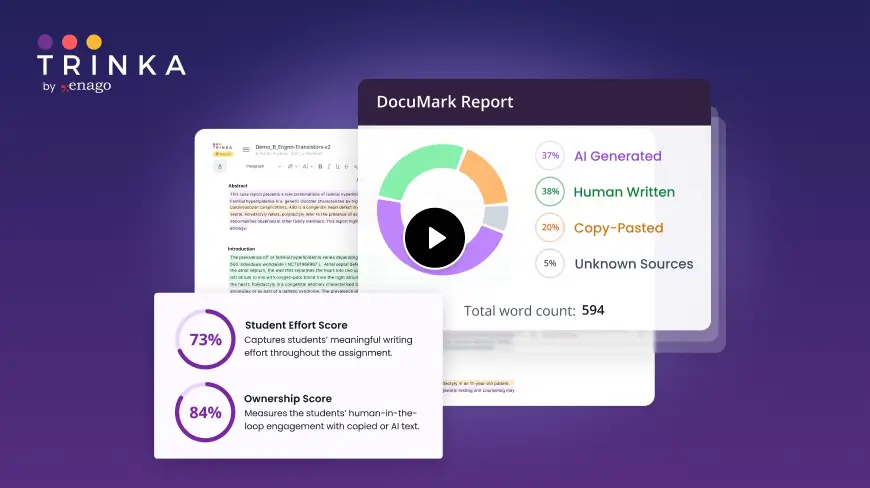
DocuMark: Responsible AI Use for Academic Integrity
Knowing your institution's AI policy is step one. DocuMark helps enforce it fairly by empowering universities to manage AI-generated content, prevent cheating, and support student writing through responsible AI use.
Common Questions About James Madison University's AI Policies
James Madison University has defined AI policies in 11 of 12 categories, with an overall coverage score of 92%.
JMU requires transparency when AI is used to generate shared content and expects attribution when AI is permitted in coursework or used in research. Students must acknowledge and cite AI use when an instructor allows it, and researchers should disclose use with proper attribution.
JMU uses Turnitin for plagiarism and citation checking, but its Turnitin instance does not include AI-writing detection. The academic integrity site says Turnitin is available to faculty and students, and the library page says instructors can choose to enable it for Canvas assignments. The cited sources do not state AI-specific penalties for undisclosed use.
JMU designates Microsoft Copilot with commercial data protection as the only broadly approved AI platform for community use and for handling university data. Use of other AI tools requires an IT review and approval process. Users are prohibited from inputting Highly Confidential (Class 1) data into Copilot and must not use DeepSeek tools on university devices or networks, per a state-level directive.