Teaching & Learning
Research
Academic Integrity
- The student conduct materials prohibit forms of dishonesty such as plagiarism and cheating, but the provided sources do not state any AI-specific disclosure or citation requirement for academic work
Plagiarism - Submission of work that is not entirely one’s own, such as submitting either the ideas, words, data or project of another person without proper attribution or citation.
Cheating - Engaging in prohibited actions in relation to any academic exercise, such as: copying another’s work; sharing information about a test or assignment unless specifically permitted; receiving or using unauthorized materials during an examination; collaborating on work intended to be completed individually; or using technology or software tools in violation of course or exam instructions.
- Juilliard treats unauthorized use of technology or software tools in academic work as cheating under the student code of conduct
- The provided sources do not mention AI detection systems, but they do establish that misuse can be handled through academic misconduct rules
Cheating - Engaging in prohibited actions in relation to any academic exercise, such as: copying another’s work; sharing information about a test or assignment unless specifically permitted; receiving or using unauthorized materials during an examination; collaborating on work intended to be completed individually; or using technology or software tools in violation of course or exam instructions.
Institutional & Administrative
- Juilliard permits staff use of AI only within the limits of its staff AI policy and information security rules
- Staff must not submit confidential, regulated, or personal institutional information into public AI tools, and any AI-assisted work remains the staff member’s responsibility, including review for accuracy, bias, confidentiality, and appropriateness
Staff may use generative AI tools to assist with drafting, summarizing, brainstorming, coding, data analysis, and other work-related tasks, provided such use complies with this policy and all other School policies.
Do not input Confidential, Restricted, or Personal Data into public AI tools unless explicitly approved by Information Security and Governance.
Staff are responsible for verifying the accuracy, appropriateness, and bias of AI-generated content before use.
Generative AI output must be reviewed by a human before being used in official School business.
Staff remain accountable for all decisions, communications, and work products, even if AI tools are used in their creation.
- Juilliard bars entry of confidential, restricted, and personal data into public AI tools unless Information Security and Governance explicitly approves it
- Its security policy also requires that institutional data be classified and protected based on sensitivity, with special controls for personal and regulated information and strict handling expectations for restricted data
Do not input Confidential, Restricted, or Personal Data into public AI tools unless explicitly approved by Information Security and Governance.
Data will be classified according to its sensitivity, legal and contractual obligations, and criticality to business operations.
All members of the Juilliard community are responsible for handling institutional data in accordance with its classification level and associated controls.
Personal Data shall be collected, stored, and processed only for legitimate business or educational purposes, in compliance with applicable law.
Restricted Data shall be stored only in approved environments with the highest level of technical and administrative safeguards. Access to Restricted Data must be limited to the minimum necessary personnel and governed by strong authentication, audit logging, and data encryption at rest and in transit.
- Juilliard has an institutional AI governance structure centered on Information Security and Governance approval and oversight
- The provided sources show governance through policy controls and human accountability, but they do not set out a broader university AI strategy, roadmap, or committee framework beyond those controls
Do not input Confidential, Restricted, or Personal Data into public AI tools unless explicitly approved by Information Security and Governance.
This policy establishes the framework for the classification, protection, governance, and responsible use of Juilliard’s information assets.
Generative AI output must be reviewed by a human before being used in official School business.
Staff remain accountable for all decisions, communications, and work products, even if AI tools are used in their creation.
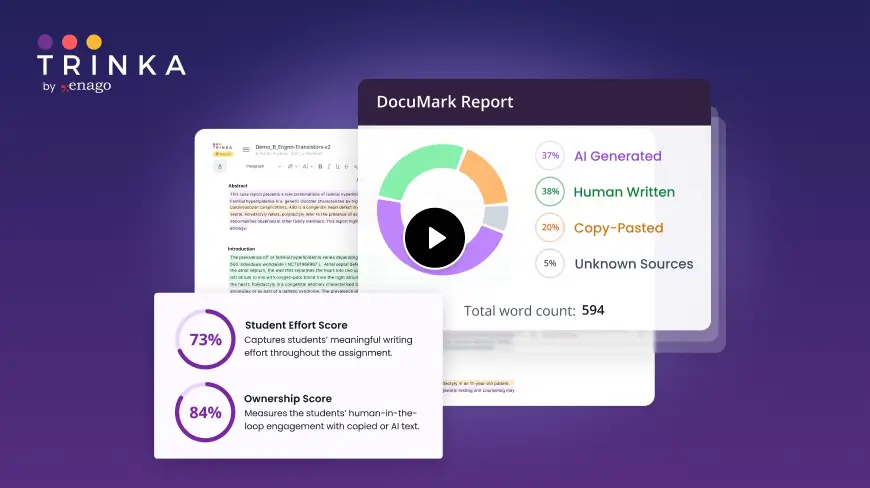
DocuMark: Responsible AI Use for Academic Integrity
Knowing your institution's AI policy is step one. DocuMark helps enforce it fairly by empowering universities to manage AI-generated content, prevent cheating, and support student writing through responsible AI use.
Common Questions About Juilliard School's AI Policies
Juilliard School has defined AI policies in 5 of 12 categories, with an overall coverage score of 42%.
The student conduct materials prohibit forms of dishonesty such as plagiarism and cheating, but the provided sources do not state any AI-specific disclosure or citation requirement for academic work.
Juilliard treats unauthorized use of technology or software tools in academic work as cheating under the student code of conduct. The provided sources do not mention AI detection systems, but they do establish that misuse can be handled through academic misconduct rules.
Juilliard bars entry of confidential, restricted, and personal data into public AI tools unless Information Security and Governance explicitly approves it. Its security policy also requires that institutional data be classified and protected based on sensitivity, with special controls for personal and regulated information and strict handling expectations for restricted data.