Teaching & Learning
- The policy treats such use as academic dishonesty under the university Code of Conduct
- Kansas Wesleyan University prohibits students from using any artificial intelligence content generator on assignments
Academic dishonesty includes, but is not limited to:
• Use of any Artificial Intelligence Content Generator on any assignment.
- In the online handbook, the university also references Lockdown Respondus and Turn-it-In as part of its technical requirements and verification environment for online learning
- Kansas Wesleyan University does not state an AI-specific exam rule, but it prohibits unauthorized aid, materials, equipment, or devices on tests, quizzes, projects, assignments, and examinations
• Giving unauthorized aid to another student or receiving unauthorized aid from another person on tests, quizzes, assignments, projects or examinations;
• Using or consulting unauthorized materials or using unauthorized equipment or devices on tests, quizzes, assignments, projects or examinations;
If your computer meets the minimum specifications for KWU’s technical requirements, you will
far surpass what is required for both Lockdown Respondus and Turn-it-In.
Research
Academic Integrity
- Kansas Wesleyan University requires students to properly cite all sources of references and ideas as part of their academic honesty responsibilities
- There is no AI-specific disclosure or citation requirement stated in the provided documents; however, given that AI content generator use is categorically prohibited under the academic dishonesty policy, no AI attribution framework is provided
It is the student's responsibility to protect their own work from inappropriate use by others and to protect the work of others by properly citing the sources of references and ideas. It is the student's responsibility to ensure that examinations are honestly held and that work for a course is honestly done.
- For online learning, the handbook also references Turn-it-In and states that faculty training includes ways to reduce cheating and that academic integrity policies explicitly cover online learning
- Kansas Wesleyan University enforces academic dishonesty through faculty and provost action, with penalties that can include redoing work with penalty, failing the assignment or examination, failing the course, suspension, ineligibility for honors, dismissal, and transcript notations such as XF or XW
When penalties for cheating or plagiarism that involve failure of an assignment or course are given by a faculty member, the faculty
member will inform the provost of the occurrence in writing. That faculty member will also provide the student with a copy of the
report. Based on the severity of the situation, that faculty member may, independently and without prior notice, take any of the
following actions:
• Require a re-do of the work or a re-take of an examination, with penalty;
• Fail the assignment or examination; or
• Fail the course.
The following actions may be taken only by the provost when presented with the faculty member’s evidence:
• Suspension from one or more university components;
• Ineligibility for honors;
• Dismissal from the university for one semester.
Students who fail a course for academic dishonesty will receive a grade of “XF.” This grade will affect the student’s grade point average
in the same way as a similar failing grade and will indicate on the student’s transcript that the failing grade was assigned for reasons of
academic dishonesty. Students who withdraw from a course in which they would otherwise receive a grade of “XF” will receive a grade
of “XW” on their transcript. An “XW” will not affect the student’s grade point average, but it will note on the transcript that the student
withdrew for reasons of academic dishonesty.
If your computer meets the minimum specifications for KWU’s technical requirements, you will
far surpass what is required for both Lockdown Respondus and Turn-it-In.
• The institution’s policies on academic integrity include explicit references to online learning;
• Issues of academic integrity are discussed during the orientation for online students;
• Training for faculty members engaged in online learning includes consideration of issues of academic integrity, including ways
to reduce cheating.
Institutional & Administrative
- Kansas Wesleyan University does not define any AI-specific rules for faculty or staff use of AI tools in grading, feedback, lesson planning, or administrative tasks
- The online handbook references faculty training on academic integrity for online learning, including ways to reduce cheating, but this is not an AI-specific faculty use policy
• Training for faculty members engaged in online learning includes consideration of issues of academic integrity, including ways to reduce cheating.
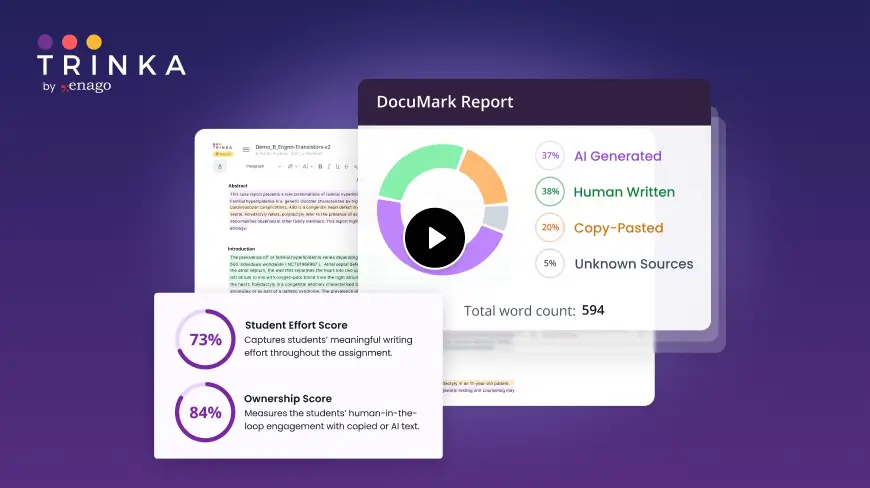
DocuMark: Responsible AI Use for Academic Integrity
Knowing your institution's AI policy is step one. DocuMark helps enforce it fairly by empowering universities to manage AI-generated content, prevent cheating, and support student writing through responsible AI use.
Common Questions About Kansas Wesleyan University's AI Policies
Kansas Wesleyan University has defined AI policies in 5 of 12 categories, with an overall coverage score of 42%.
Kansas Wesleyan University requires students to properly cite all sources of references and ideas as part of their academic honesty responsibilities. There is no AI-specific disclosure or citation requirement stated in the provided documents; however, given that AI content generator use is categorically prohibited under the academic dishonesty policy, no AI attribution framework is provided.
Kansas Wesleyan University enforces academic dishonesty through faculty and provost action, with penalties that can include redoing work with penalty, failing the assignment or examination, failing the course, suspension, ineligibility for honors, dismissal, and transcript notations such as XF or XW. For online learning, the handbook also references Turn-it-In and states that faculty training includes ways to reduce cheating and that academic integrity policies explicitly cover online learning.
No explicit data protection or approved AI platform policy is currently defined in the available policy sources.