Teaching & Learning
- AI-generated content presented without proper acknowledgement is treated as plagiarism, and the university also identifies "unacceptable use of generative artificial intelligence" as a form of academic misconduct
- Students must ensure that the core work in assessed submissions remains their own and must not use a third party, including generative AI, to produce the writing, creativity, arguments, analysis, or reasoning on their behalf
This guidance is for use when a student is considering whether to employ a third party such as a professional copy editing or proof-reading company or software tool (including generative artificial intelligence (GAI)) when producing work in draft or final version.
All of the core work including the writing, creativity, arguments, analysis and reasoning must be the students own work, and a student must not employ a third party to do this work, whether in draft or as a final version, on their behalf.
The University defines plagiarism as the act of presenting the work of another person (or people) and/or content generated by artificial intelligence (AI) tools, as one’s own without proper acknowledgement.
The Academic Induction Period (AIP) covers first and concurrent occurrences of plagiarism, copying, self-plagiarism, collusion and unacceptable use of generative artificial intelligence.
- The provided sources do not set out a distinct AI rule specifically for exams, quizzes, or in-exam use beyond the general academic misconduct and assessment rules
- For student assessment generally, Kingston requires the submitted work's core intellectual content to be the student's own, and undisclosed AI-generated content counts as plagiarism
All of the core work including the writing, creativity, arguments, analysis and reasoning must be the students own work, and a student must not employ a third party to do this work, whether in draft or as a final version, on their behalf.
The University defines plagiarism as the act of presenting the work of another person (or people) and/or content generated by artificial intelligence (AI) tools, as one’s own without proper acknowledgement.
Concurrent offences exclusively relate to instances of plagiarism, copying, self-plagiarism, collusion and unacceptable use of Generative Artificial Intelligence . Instances of other types of academic misconduct, such as cheating in an examination or other forms of misconduct, cannot be classified as concurrent offences.
- The supplied sources do not define a specific policy on using AI for personal tutoring, revision, concept explanation, or other non-graded study support
- The university provides students with access to Adobe generative AI tools and states that students should use AI responsibly and ethically in their creation
As an Adobe Creative Campus, Kingston University is committed to providing students of all disciplines with the tools that are foundational to building their creative, productivity, and AI skill sets. Equitable access to Adobe Creative Cloud, Adobe Express, and the generative AI features of Adobe Firefly to all students enables Kingston University to expand its innovative teaching practices and properly prepare students for the workplace in the age of AI.
All students and staff have full access to Adobe Creative Cloud, Adobe Express Premium, and generative AI features from Adobe Firefly. Students can learn to communicate more effectively in the workplace, through impactful formats like presentations, videos, data visualisations, visually rich documents, and podcasts, while using AI responsibly and ethically in their creation.
Research
- The research guidance requires researchers to conduct research to high ethical standards, including when using AI
- The provided sources do not give a specific rule on using AI to draft, edit, or format research papers, theses, dissertations, or manuscripts
Researchers should:
a) recognise their responsibility to conduct research of high ethical standards, including the use of AI;
- The research guidance states that researchers must conduct research to high ethical standards, including the use of AI
- The provided sources do not define specific rules for AI in research data collection, analysis, statistics, synthetic data generation, or interpretation of results
Researchers should:
a) recognise their responsibility to conduct research of high ethical standards, including the use of AI;
- The sources do not provide more detailed AI-specific rules for grant proposals, IRB applications, or ethics declarations
- Kingston's research guidance explicitly brings AI within research ethics responsibilities: researchers are expected to use AI to high ethical standards, comply with university research policies and procedures, and seek guidance where needed
Researchers should:
a) recognise their responsibility to conduct research of high ethical standards, including the use of AI;
b) be aware of Kingston University’s policies and procedures on good practice in research, including safety, safeguarding and wellbeing considerations for all involved;
c) make sure that their research complies with these policies and procedures, and seek guidance where necessary;
Academic Integrity
- Disclosure is required when generative AI is used as part of editorial help for student assessment
- More broadly, AI-generated content must be properly acknowledged; otherwise it is treated as plagiarism
When submitting work, the student must acknowledge what form of contribution the third party has made, by stating for example, ‘this thesis/essay/dissertation was copy edited for conventions of language, spelling and grammar by ABC Editing Ltd’.
Where a Generative AI has been used as part of the editorial process, then this must be acknowledged by the student.
The University defines plagiarism as the act of presenting the work of another person (or people) and/or content generated by artificial intelligence (AI) tools, as one’s own without proper acknowledgement.
The University will not accept a lack of understanding of the requirements for acknowledging the work of others and/or content generated by artificial intelligence (AI) tools as a defence to an allegation of plagiarism.
- The provided sources do not state a position on AI detection tools such as Turnitin or GPTZero
- During the Academic Induction Period, first and concurrent occurrences are covered under that process, and second or subsequent occurrences are escalated under the wider academic misconduct procedures
- Undisclosed AI-generated content is enforceable under Kingston's plagiarism and academic misconduct procedures, and "unacceptable use of generative artificial intelligence" is expressly named in the misconduct framework
The University defines plagiarism as the act of presenting the work of another person (or people) and/or content generated by artificial intelligence (AI) tools, as one’s own without proper acknowledgement.
The Academic Induction Period (AIP) covers first and concurrent occurrences of plagiarism, copying, self-plagiarism, collusion and unacceptable use of generative artificial intelligence. It does not apply to other forms of academic misconduct.
All second and subsequent occurrences of plagiarism, copying, self-plagiarism, collusion and unacceptable use of generative artificial intelligence during the Academic Induction Period (AIP) should be considered under the Academic Misconduct procedures.
Concurrent offences exclusively relate to instances of plagiarism, copying, self-plagiarism, collusion and unacceptable use of Generative Artificial Intelligence .
Institutional & Administrative
- Kingston states that AI work is already being developed by staff across the university and that staff are part of initiatives focused on AI in teaching and curricula development
- The provided sources describe support and practice-sharing for staff use of AI in teaching, but they do not set out a formal policy on staff use for grading, feedback, recommendation letters, or administration
"While being focused on both students and staff and the opportunities AI brings, we will also be mindful of the ethical considerations of using emerging technologies," Dr Hughes said.
Collaboration will be a key element, with all 11 institutions working together to collate resources that support academics using AI in their teaching and students applying the technology in their learning.
Over the last 32 months, since the public launch of ChatGPT3, staff across Kingston University have been developing their practice with generative AI (GAI) and assessing the implications for their discipline and learning, teaching and assessment.
This compendium aims to share some of this practice, and hopefully there will be a few more editions to come! This compendium has 23 examples of practice from across every faculty, including learning and teaching activities that can be adapted, discussion of concepts, AI app developments, and even the use of AI to support app development.
All students and staff have full access to Adobe Creative Cloud, Adobe Express Premium, and generative AI features from Adobe Firefly.
- No explicit AI-specific data classification, privacy restriction, or list of prohibited platforms is defined in the supplied materials
- The provided sources identify one institutionally available AI platform set: students and staff have full access to Adobe Creative Cloud, Adobe Express Premium, and Adobe Firefly's generative AI features
All students and staff have full access to Adobe Creative Cloud, Adobe Express Premium, and generative AI features from Adobe Firefly.
- The sources emphasize ethical considerations, support for staff and students, and ongoing resource and framework development, but they do not present a single formal university-wide AI governance policy document
- Kingston has active institution-level AI strategy and development activity centered on learning and teaching, including a project to create a framework for generative AI opportunities in higher education and a university compendium of AI practice
The project is now in its first stage of collating existing AI resources from each institution to create a framework that articulates the opportunities of generative AI to learning and teaching and curricula development to support HE providers.
"While being focused on both students and staff and the opportunities AI brings, we will also be mindful of the ethical considerations of using emerging technologies," Dr Hughes said.
Over the last 32 months, since the public launch of ChatGPT3, staff across Kingston University have been developing their practice with generative AI (GAI) and assessing the implications for their discipline and learning, teaching and assessment.
This compendium aims to share some of this practice, and hopefully there will be a few more editions to come! This compendium has 23 examples of practice from across every faculty, including learning and teaching activities that can be adapted, discussion of concepts, AI app developments, and even the use of AI to support app development.
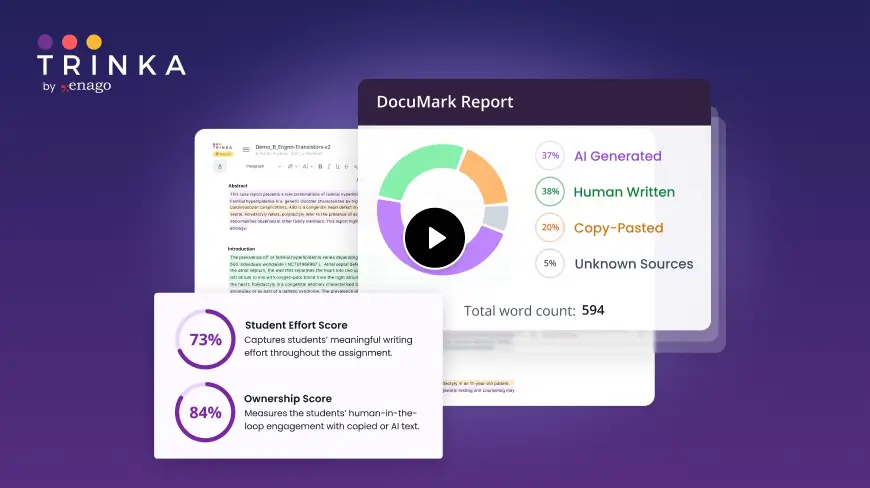
DocuMark: Responsible AI Use for Academic Integrity
Knowing your institution's AI policy is step one. DocuMark helps enforce it fairly by empowering universities to manage AI-generated content, prevent cheating, and support student writing through responsible AI use.
Common Questions About Kingston University's AI Policies
Kingston University has defined AI policies in 11 of 12 categories, with an overall coverage score of 92%.
Disclosure is required when generative AI is used as part of editorial help for student assessment. More broadly, AI-generated content must be properly acknowledged; otherwise it is treated as plagiarism.
Undisclosed AI-generated content is enforceable under Kingston's plagiarism and academic misconduct procedures, and "unacceptable use of generative artificial intelligence" is expressly named in the misconduct framework. During the Academic Induction Period, first and concurrent occurrences are covered under that process, and second or subsequent occurrences are escalated under the wider academic misconduct procedures. The provided sources do not state a position on AI detection tools such as Turnitin or GPTZero.
The provided sources identify one institutionally available AI platform set: students and staff have full access to Adobe Creative Cloud, Adobe Express Premium, and Adobe Firefly's generative AI features. No explicit AI-specific data classification, privacy restriction, or list of prohibited platforms is defined in the supplied materials.