Teaching & Learning
- Lafayette treats submitting AI-generated work as one’s own as academic dishonesty under the college-wide academic integrity policy
- Department- and program-level policies add that AI use in graded coursework is generally at instructor discretion, and in some units students must have explicit permission before using AI on graded assignments
Submitting work that was completed, in whole or in part, by someone else or (in the case of Artificially Intelligent Large Language Models such as Chat GPT) something else, and representing the work as your own is an act of academic dishonesty.
Using unauthorized assistance on any paper, project, assignment, examination or other academic work; re-using material from previous courses without the explicit permission of the current course instructor; engaging in unauthorized collaboration with other students (including online discussion groups); copying answers from other students; accessing electronic messages or online content without the instructor’s permission; altering or misrepresenting experimental data, and programming calculators to store equations and other information; using the textbook or your instructor’s solutions, using instructors’ versions of textbooks, or using previously administered tests without the instructor’s permission.
Individual instructors determine the use of AI tools like ChatGPT and DALL-E. They will specify their policies in course syllabi and assignment instructions. AI use is allowed only if explicitly stated in the instructions. If AI use is not mentioned, students should assume it is prohibited.
If an instructor permits AI use, students need prior permission to use AI in graded assignments and must document and cite any AI assistance.
Your instructor will provide a syllabus that outlines the academic integrity policy as well as a statement about the use of generative AI (also known as ChatBots) in their classroom. You should abide by the guidelines laid out in the syllabus. At the discretion of the instructor, some uses of generative AI may be allowed in some classes but not others.
In any setting, using generative AI to produce written work and presenting it as your own violates both departmental and college academic integrity policies.
- Biology states that this applies to examinations and quizzes, while instructor syllabi may specify whether any generative AI use is allowed
- For examinations and other assessed work, Lafayette prohibits unauthorized assistance, and department guidance says students must follow whatever test-taking conditions the instructor sets
Using unauthorized assistance on any paper, project, assignment, examination or other academic work; re-using material from previous courses without the explicit permission of the current course instructor; engaging in unauthorized collaboration with other students (including online discussion groups); copying answers from other students; accessing electronic messages or online content without the instructor’s permission; altering or misrepresenting experimental data, and programming calculators to store equations and other information; using the textbook or your instructor’s solutions, using instructors’ versions of textbooks, or using previously administered tests without the instructor’s permission.
The Department’s academic integrity policy governs both novel and traditional assessments (written, audiovisual or verbal) including but not limited to examinations, quizzes, laboratory reports, oral presentations, poster presentations, artwork or other electronic projects which you submit for a grade.
Your instructor will provide a syllabus that outlines the academic integrity policy as well as a statement about the use of generative AI (also known as ChatBots) in their classroom. You should abide by the guidelines laid out in the syllabus. At the discretion of the instructor, some uses of generative AI may be allowed in some classes but not others.
During course assessments, students are expected to know and abide fully by any test-taking condition (written, audiovisual or verbal) established by the course instructor. Unless explicitly stated otherwise, it will be understood that any unauthorized use of notes, books, electronic aids or other reference materials, or collaboration in any way with another person, is prohibited and will be treated as a violation of Lafayette College policy on academic integrity.
- Lafayette does not set a single college-wide prohibition on using AI for ungraded study assistance
- Students are advised to fact-check AI outputs due to hallucination risks, and best-practice prompting guidance is also available institutionally
- CITLS and technology-help resources permit AI for ungraded activities such as brainstorming, creating flashcards, quizzes, and understanding complex topics with instructor guidance
AI tools may be used for ungraded activities like brainstorming with instructor guidance. The aim is to help students understand AI's benefits and limitations, not to replace traditional research methods.
Study Assistance: Ask for help understanding a complex topic. You can even create flashcards or quizzes from your notes. For example, you could prompt it to 'Create a 10-question quiz about the major themes in Hamlet and highlight key literary devices.'
The effectiveness of AI tools is directly tied to the quality of your prompts. Be aware that AI can 'hallucinate,' generating plausible-sounding but factually incorrect, fabricated, or non-existent information. Always fact-check AI responses and their sources.
- Lafayette’s college-wide academic integrity policy covers computer code and prohibits submitting code produced by someone or something else as one’s own
- The provided technology guidance also presents AI as able to assist with coding and data work, but no uniform rule specific to programming assignments is defined beyond instructor authorization and academic integrity requirements
Submitting work that was completed, in whole or in part, by someone else or (in the case of Artificially Intelligent Large Language Models such as Chat GPT) something else, and representing the work as your own is an act of academic dishonesty.
This includes published or unpublished writings, phrases, images, computations, data, analysis, artworks, performances, videos, computer code (including open source code or code described in textbooks, blogs, and discussion groups), or other products of a person’s intellectual work.
Coding & Data Analysis: For programming or data-heavy courses, Copilot Chat can assist with writing and explaining code, and help you analyze data or create visualizations.
Research
- Users are advised to fact-check outputs and not to submit private or confidential information into AI tools
- Lafayette does not publish a dedicated policy governing AI use in faculty or student research writing and manuscript preparation
- However, CITLS guidance acknowledges that generative AI holds promise in research activities, and institutional technology resources describe AI tools as capable of assisting with research
The usage of generative AI technologies in some teaching and learning; research; and administrative activities holds promise in higher education.
Research: Ask questions to get information on a topic, with responses often including cited sources.
The effectiveness of AI tools is directly tied to the quality of your prompts. Be aware that AI can 'hallucinate,' generating plausible-sounding but factually incorrect, fabricated, or non-existent information. Always fact-check AI responses and their sources.
Privacy: Any data imputed could become part of the public dataset from which the tool pulls, thus it is important not to submit private or confidential information.
- Technology-help materials also describe AI tools as capable of assisting with research and data analysis, with users responsible for checking accuracy
- The sources do not provide a dedicated research-data policy for student or faculty research use of AI, but they do state that AI may be used in research-related contexts and warn users not to submit private or confidential information
Privacy: Any data imputed could become part of the public dataset from which the tool pulls, thus it is important not to submit private or confidential information.
The usage of generative AI technologies in some teaching and learning; research; and administrative activities holds promise in higher education.
Research: Ask questions to get information on a topic, with responses often including cited sources.
Coding & Data Analysis: For programming or data-heavy courses, Copilot Chat can assist with writing and explaining code, and help you analyze data or create visualizations.
The effectiveness of AI tools is directly tied to the quality of your prompts. Be aware that AI can “hallucinate,” generating plausible-sounding but factually incorrect, fabricated, or non-existent information. Always fact-check AI responses and their sources.
- The provided sources do not set an AI-specific rule for grant proposals, IRB applications, or research-ethics disclosures
- They do state that all human-subjects research by Lafayette faculty, students, and staff is reviewed by the IRB, and generative-AI guidance warns that some uses can create ethical issues and breaches of confidentiality
The Lafayette College Institutional Review Board (IRB) reviews all research involving human participants conducted by Lafayette College faculty, students, and staff, as well as research by outside investigators involving Lafayette students or personnel.
Ethics: Some usages of generative AI can have ethical implications and might be considered breaches of confidentiality.
Academic Integrity
- Lafayette requires attribution of AI use in some department and program policies
- Biology requires students to cite the use of generative AI tools, and Environmental Science & Studies requires students with permission to document, cite, and briefly explain any AI assistance in assignments
In crediting the work of others, all sources must be acknowledged. You must cite material produced by other students, material found in the primary or secondary literature, course handouts, material obtained from student collaboration, use of any utility (including generative artificial intelligence tools or Chatbots) and content available on the internet.
If an instructor permits AI use, students need prior permission to use AI in graded assignments and must document and cite any AI assistance.
If AI is permitted in a class and students have received permission from their instructor to use it, students must properly cite it. For example, text generated by ChatGPT should be cited as: “ChatGPT. (2024, July 28). ‘Text of your query.’ Generated using OpenAI. https://chat.openai.com/”. Students should also briefly explain how they used the AI tool in their assignments.
- Lafayette enforces unauthorized AI use through its academic integrity process, and sanctions can reach suspension or expulsion
- At the same time, the College Writing Program states that it does not support or recommend AI detection software and that Writing Associates are not trained to detect AI
Submitting work that was completed, in whole or in part, by someone else or (in the case of Artificially Intelligent Large Language Models such as Chat GPT) something else, and representing the work as your own is an act of academic dishonesty.
A student who is found responsible for violating the Academic Integrity Policy may receive a range of possible sanctions, including suspension or expulsion.
Regarding our program, we don’t support or recommend the use of any AI detection software. Our Writing Associates (WAs) are not trained to detect AI. WAs will respond to any and all writing as if it was student-created.
Institutional & Administrative
- CITLS says instructors should build basic AI literacy, and technology-help pages say the college provides Gemini, NotebookLM, and Copilot Chat to support faculty and staff in their work
- Lafayette provides faculty and staff access to institutionally licensed AI tools for work and offers guidance and literacy development resources rather than a single restrictive use policy in the provided sources
Lafayette College provides access to the Gemini Web App, NotebookLM, and Copilot Chat to support faculty and staff in their work.
We are at a time in higher education where it is imperative for all instructors to develop basic literacy in generative artificial intelligence technologies and have an awareness of their impacts on teaching and students’ learning experiences. The rapid development of the tools necessitates continuous learning by instructors.
All instructors can benefit from developing a basic understanding of generative artificial intelligence, commonly used tools such as ChatGPT, and related issues of privacy, ethics, bias, copyright, and academic integrity. Instructors can develop such literacy by learning about and experimenting with the technologies.
- Lafayette identifies institutionally provided AI platforms for faculty and staff and ties their use to college credentials and licensing-based data protections
- The sources also warn users not to put private or confidential information into AI tools generally, and the college’s data stewardship policy requires all community members to protect sensitive information, including student records and regulated data
Lafayette College provides access to the Gemini Web App, NotebookLM, and Copilot Chat to support faculty and staff in their work.
Using these tools when logged into your Lafayette credentials ensures data privacy and protection under the College’s existing licensing. Data is not being used to train these models.
Included with Google Workspace for Education licensing, the College provides the following AI tools to faculty and staff at no additional cost. These tools ensure data protection and security when users are logged in with their Lafayette credentials.
Privacy: Any data imputed could become part of the public dataset from which the tool pulls, thus it is important not to submit private or confidential information.
Members of the Lafayette College community frequently have access to sensitive information in the course of their work or studies. Everyone is responsible for ensuring the confidentiality, integrity, and security of such information.
Personal information (e.g., social security numbers, dates of birth, student records, and financial aid data).
Regulated Information (e.g., data subject to HIPAA, FERPA, GLBA, and other compliance regulations).
- Lafayette has an institutional AI governance effort through a Provost-appointed working group and an informational guide for faculty and staff
- The guidance frames AI as relevant across teaching and learning, research, and administrative work, and indicates the college is putting structures in place to help the institution respond and evolve
This summer a Provost-appointed working group gathered to familiarize “themselves with the rapidly growing conversations about LLMs (large language models) and to propose the appropriate structures that the College should employ in the upcoming academic year to help the College respond and evolve appropriately.”
All Lafayette instructors have access to an Informational AI Guide developed by a summer 2023 working group. This resource includes the findings from a fall 2023 Lafayette College student perceptions and usage survey, sample course policies, and more.
The usage of generative AI technologies in some teaching and learning; research; and administrative activities holds promise in higher education.
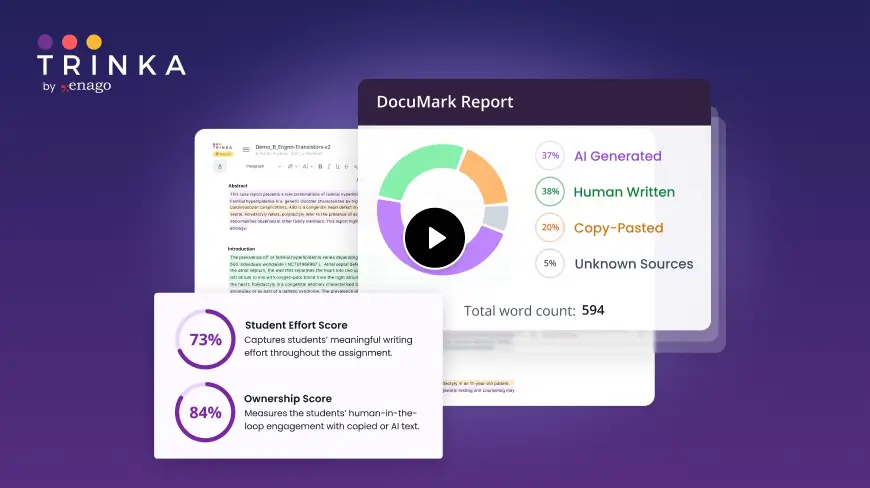
DocuMark: Responsible AI Use for Academic Integrity
Knowing your institution's AI policy is step one. DocuMark helps enforce it fairly by empowering universities to manage AI-generated content, prevent cheating, and support student writing through responsible AI use.
Common Questions About Lafayette College's AI Policies
Lafayette College has defined AI policies in 12 of 12 categories, with an overall coverage score of 100%.
Lafayette requires attribution of AI use in some department and program policies. Biology requires students to cite the use of generative AI tools, and Environmental Science & Studies requires students with permission to document, cite, and briefly explain any AI assistance in assignments.
Lafayette enforces unauthorized AI use through its academic integrity process, and sanctions can reach suspension or expulsion. At the same time, the College Writing Program states that it does not support or recommend AI detection software and that Writing Associates are not trained to detect AI.
Lafayette identifies institutionally provided AI platforms for faculty and staff and ties their use to college credentials and licensing-based data protections. The sources also warn users not to put private or confidential information into AI tools generally, and the college’s data stewardship policy requires all community members to protect sensitive information, including student records and regulated data.