Teaching & Learning
- The university also positions students as responsible for understanding and following instructor-specific AI expectations
- Lehigh states it does not have a uniform course policy on allowable AI use; instead, AI rules for coursework are set at the course/instructor level and students are expected to follow those rules
Lehigh does not have a uniform policy about the allowable use of AI in courses. Instructors are encouraged to develop their own policies and, importantly, to be clear and transparent about these policies in their syllabi.
Students are expected to follow course-specific rules set by their instructors as well as academic integrity rules set by the university, as captured in the Student Code of Conduct.
Be sure you understand your instructor's rules on how AI may and may not used in your classes. If you are unsure, ask.
- No exam-specific AI allowance/prohibition is defined in the provided sources beyond this instructor-discretion approach
- Lehigh does not define a uniform university-wide rule for AI use in courses, which includes assessments; instructors are encouraged to set and clearly communicate their own AI policies in syllabi
Lehigh does not have a uniform policy about the allowable use of AI in courses. Instructors are encouraged to develop their own policies and, importantly, to be clear and transparent about these policies in their syllabi.
- The provided sources do not define a university-wide permission/prohibition specifically for non-graded study assistance beyond this general guidance
- Lehigh provides general encouragement for students to engage with AI tools and to consult faculty about appropriate use, while emphasizing that AI rules vary by instructor and students should ask when unsure
Be sure you understand your instructor's rules on how AI may and may not used in your classes. If you are unsure, ask.
Ask your professor if they have a Course-specific AI tutor you can use or other recommended research or learning tools.
- The provided sources do not specify rules for AI code generation in programming assignments beyond this instructor-discretion approach
- Lehigh does not define a uniform university-wide policy for allowable AI use in courses, and instead expects instructor/course-specific policies to govern use
Lehigh does not have a uniform policy about the allowable use of AI in courses. Instructors are encouraged to develop their own policies and, importantly, to be clear and transparent about these policies in their syllabi.
Students are expected to follow course-specific rules set by their instructors as well as academic integrity rules set by the university, as captured in the Student Code of Conduct.
Research
- Lehigh’s provided AI guidance includes a best-practice expectation to cite generative AI tools when they assist with work, which can apply to research writing
- The sources also indicate that faculty are expected to follow the university’s ethical conduct policy for research; however, the provided text does not define detailed rules specific to AI drafting/editing of manuscripts
Understand citation practices in your context and appropriately cite any Generative AI tools that assisted in your work.
Faculty are expected to follow University Policy on Ethical Conduct in Academic Research, Scholarship and Creative Activities (Contact the Office of Research if you have questions about specific use cases).
- The university directs community members to seek consultation if their AI use case involves such data
- Lehigh’s AI guidance primarily addresses data handling and security constraints when using generative AI systems: institutional data, restricted data, and critical data may not be submitted to online information systems (including generative AI tools)
Those who provide the university with private, protected data trust that we will treat that data ethically and in accordance with legal requirements and guidelines. This guidance applies to any online information system, not just to those that use Generative AI tools.
For this reason you may not submit institutional data, restricted data, or critical data–this restriction is covered by Lehigh’s Acceptable Use of Computing Systems Policy.
If you have a use case for Generative AI that involves such data, submit an LTS consultation request so we can advise you and help you ensure data safety and legal compliance.
- In addition, the university’s AI guidance emphasizes ethical treatment of private/protected data for any online information system (including generative AI tools)
- Lehigh states that faculty are expected to follow the university policy on ethical conduct in academic research, scholarship, and creative activities for AI-related use cases
Faculty are expected to follow University Policy on Ethical Conduct in Academic Research, Scholarship and Creative Activities (Contact the Office of Research if you have questions about specific use cases).
Those who provide the university with private, protected data trust that we will treat that data ethically and in accordance with legal requirements and guidelines. This guidance applies to any online information system, not just to those that use Generative AI tools.
Academic Integrity
- Lehigh’s AI best practices recommend citing generative AI tools that assisted in work, with citation practices expected to follow the norms of the relevant context
- The sources provided do not define a single mandatory, university-wide AI disclosure statement for student submissions; instead, course AI rules are described as course/instructor-specific
Understand citation practices in your context and appropriately cite any Generative AI tools that assisted in your work.
Lehigh does not have a uniform policy about the allowable use of AI in courses. Instructors are encouraged to develop their own policies and, importantly, to be clear and transparent about these policies in their syllabi.
- Lehigh states that violations of academic integrity standards will be handled through the university’s Student Conduct System
- The Student Code of Conduct outlines processes for academic integrity violations and describes the authority of Academic Integrity Conference panels to determine sanctions and educate respondents; however, the provided sources do not define AI-detection tool use (e.g., Turnitin AI detection) for enforcement
Violations of academic integrity standards will not be tolerated and will be handled according to the guidelines in the University’s Student Conduct System.
PROCESS FOR ACADEMIC INTEGRITY VIOLATIONS
The Academic Integrity Conference shall have the authority, in a particular case, to:
1. affirm or deny the respondent's claim of responsibility;
2. determine appropriate sanctions for the respondent; and
3. educate the respondent on issues related to academic integrity.
Institutional & Administrative
- Lehigh’s AI policies/best practices also state that professional use of generative AI should include reviewing outputs for accuracy and bias
- Lehigh’s AI advisory report describes faculty and staff using AI for instructional materials, writing enhancement, administrative task automation, and operational communications/efficiency, while expressing caution about issues including data security and bias
Faculty are using AI to enhance writing, create instructional materials, and automate administrative tasks,
Operationally, staff are leveraging AI for enhanced communication, efficiency, and user support, but remain cautious about data security, bias, and loss of human connection.
If you are using Generative AI for professional work, always check the output for accuracy and bias. Using output from Generative AI tools without reviewing it for accuracy and bias may place you and the university at risk.
- Additionally, Lehigh requires reporting potential breaches of data protection or confidentiality related to generative AI tools
- Lehigh states that institutional data, restricted data, and critical data may not be submitted to online information systems, including generative AI tools, and provides examples (e.g., student records, financial/health records)
- Lehigh also states that the safest way to avoid sharing or training on submitted data is to use approved tools available through campus Google Workspace (e.g., Gemini and other Google AI tools), and warns that free tools like ChatGPT or Gemini via personal accounts may collect/store submitted content unless users opt out
For this reason you may not submit institutional data, restricted data, or critical data–this restriction is covered by Lehigh’s Acceptable Use of Computing Systems Policy.
Examples of data that may not be submitted to such systems include Social Security Numbers, credit card numbers, student records, financial records, health care records; data that fall under export control or ITAR regulations; employment records, legal records; and intellectual property you do not have the right to distribute.
Any member of the Lehigh community who learns of a potential breach of data protection or confidentiality— through the use of Generative AI tools or otherwise —is required by Section 5 of Lehigh’s Acceptable Use Policy to report the incident to the Office of Information Security at security@lehigh.edu.
The safest way to ensure data you submit to an AI system is not shared or used to train models is to use an approved AI tool like Gemini and other Google AI tools that are available to campus users through your Google Workspace account.
If you use free Generative AI tools such as ChatGPT (or Gemini accessed through a personal/non-Lehigh account) anything you submit may be collected and stored to train their models. For this reason, we recommend you always opt out of sharing data when using such systems.
- Lehigh states it established a Generative AI Advisory Group in January 2025 to assess opportunities, support needs, and policy gaps across education, research, and operations
- Lehigh also publishes draft guiding principles intended to be living principles encompassing education, research, and administrative operations, and the advisory report recommends institution-level structures such as an interdisciplinary AI hub and appointing a Provost Faculty Fellow for AI
In January 2025, Lehigh University established a Generative AI Advisory Group to assess the opportunities, support needs, and policy gaps related to generative AI across education, research, and operations.
The draft Guiding Principles for Artificial Intelligence below are the result of an ongoing, campus-wide conversation and now encompass the full breadth of university life, including education, research, and administrative operations. At the same time, they are designed to be living principles that allow us to remain agile as this technology develops and our understanding of its myriad applications continues to evolve.
As a first step, appoint a new Provost Faculty Fellow for AI to partner with the LTS/CITL AI Readiness Specialist
DocuMark: Responsible AI Use for Academic Integrity
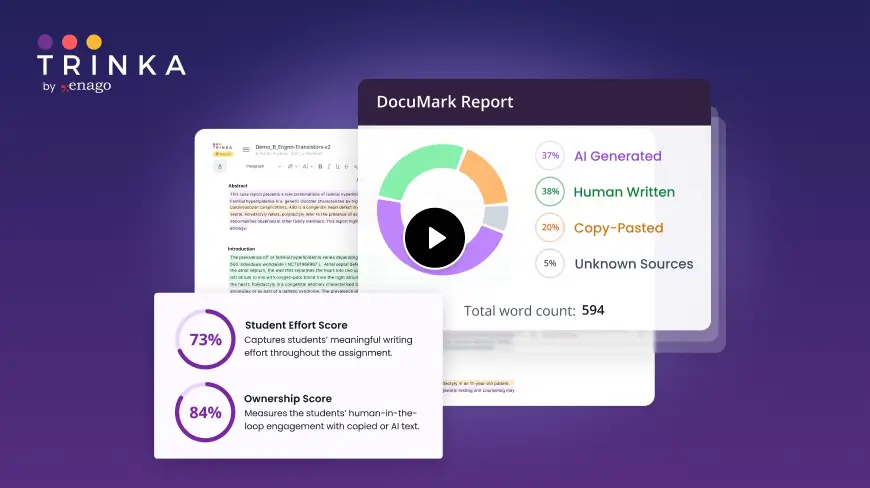
Knowing your institution's AI policy is step one. DocuMark helps enforce it fairly by empowering universities to manage AI-generated content, prevent cheating, and support student writing through responsible AI use.
Common Questions About Lehigh University's AI Policies
Lehigh University has defined AI policies in 12 of 12 categories, with an overall coverage score of 100%.
Lehigh’s AI best practices recommend citing generative AI tools that assisted in work, with citation practices expected to follow the norms of the relevant context. The sources provided do not define a single mandatory, university-wide AI disclosure statement for student submissions; instead, course AI rules are described as course/instructor-specific.
Lehigh states that violations of academic integrity standards will be handled through the university’s Student Conduct System. The Student Code of Conduct outlines processes for academic integrity violations and describes the authority of Academic Integrity Conference panels to determine sanctions and educate respondents; however, the provided sources do not define AI-detection tool use (e.g., Turnitin AI detection) for enforcement.
Lehigh states that institutional data, restricted data, and critical data may not be submitted to online information systems, including generative AI tools, and provides examples (e.g., student records, financial/health records). Lehigh also states that the safest way to avoid sharing or training on submitted data is to use approved tools available through campus Google Workspace (e.g., Gemini and other Google AI tools), and warns that free tools like ChatGPT or Gemini via personal accounts may collect/store submitted content unless users opt out. Additionally, Lehigh requires reporting potential breaches of data protection or confidentiality related to generative AI tools.