Teaching & Learning
- For student coursework, AI use is generally prohibited unless an instructor expressly permits it in written assignment instructions
- The university allows AI as a support tool for feedback, inspiration, suggestions, and similar assistance, but students must personally author their submitted work and may not use AI to generate assignment content for credit
The standard is that students should not use AI to generate content for their assignments in a manner that compromises originality and authenticity. This largely prohibits the use of generative text AI features/programs specifically.
The university does not ban the use of AI tools as a whole and does not restrict access to AI products/platforms like ChatGPT on university servers. What is prohibited are AI-enabled acts that may compromise our long-standing expectations of academic integrity in student work.
The university’s expectations, as stated in the Liberty Way, are that students cannot use AI writing aids to generate content for their assignments.
However, The Liberty Way does authorize professors to set parameters and allow students to use resources including AI. In those cases, the written assignment instructions will clearly delineate the permitted use and limitations of AI.
If your written instructions do not expressly permit AI use, then be warned that you are not permitted to do so.
- The university does not provide AI rules specifically for exams, quizzes, or tests in the provided sources
- The only explicit assessment-related statement is that faculty must judge whether AI use compromised assignment originality or authenticity when alleging misconduct
A professor’s decision to allege academic misconduct due to AI misuse should involve informed judgments on whether the AI-involved conduct compromised assignment originality and/or authenticity beyond what is reasonably acceptable.
- AI is allowed as a learning support tool for non-submitted assistance such as feedback, inspiration, suggestions, and alternatives
- Liberty states that AI can help students while crafting coursework, but students must still create and author the work they submit themselves
ChatGPT can be very useful for helping students overcome various barriers that may occur when crafting their coursework. ChatGPT can be viewed as a tool that is available to give feedback, inspiration, suggestions, alternatives, etc.
Liberty University does not ban the use of AI, but we do have expectations that using any AI tool, like ChatGPT, be done in alignment with our values. AI can be very useful for helping students overcome various barriers that may occur when crafting their coursework. AI can be viewed as a tool that is available to give feedback, inspiration, suggestions, alternatives, etc. However, students must author and create all work themselves.
Research
- The sources explicitly tie research by faculty, staff, and students to federal regulations and university policy, but do not state the AI requirements themselves
- The provided sources state that Liberty has an IRB process and a separate policy on the ethical use of AI tools in human subjects research, but the actual AI rules are not provided in the accessible source text here
The Institutional Review Board (IRB) must review all proposals for research that will involve human participants to ensure the safety and privacy of participants and the confidentiality of the information that will be collected from and about them.
The IRB is part of Liberty University’s Research Ethics Office , which is responsible for ensuring that all research conducted by Liberty University faculty, staff, and students is done in accordance with federal regulations and university policy.
Ethical Use of AI Tools in Human Subjects Research Policy
Academic Integrity
- In marketing and communications workflows, employees must disclose AI use when seeking approvals, and human review is required before publishing
- When AI use is permitted by an instructor, students must cite it as a source, and Liberty’s writing center provides APA, MLA, and Turabian citation guidance
Since some Liberty University instructors allow certain uses of AI and since generative AI is a source like any other, it must be cited accordingly.
Therefore, the Liberty writing center is sharing the formatting rules published by APA, MLA, and Turabian for how to cite and reference such content.
DO disclose AI usage when seeking approvals.
DO ensure there is always a human review before publishing.
- Liberty requires academic misconduct incidents to be reported in Beacon when the evidence meets the preponderance standard
- Turnitin's AI detector is the only permitted AI detection tool for misconduct investigations, but detection results alone are not treated as proof and must be considered alongside other evidence; severe or repeated misconduct can lead to suspension or expulsion
Any academic misconduct incident should be reported in Beacon when the incident meets the evidence stand of ‘preponderance.’ The Liberty Way states: “The preponderance of the evidence standard means the allegation must be proven by the greater weight of the evidence, in other words, a determination of what is more likely than not to have occurred.”
The Turnitin AI detector is a tool that provides information to assist faculty in making informed decisions about academic misconduct.
AI detection results alone are not an indictment regarding the student’s conduct. All factors that may reasonably influence the AI detector’s results should be considered.
No other AI detector may be used when investigating possible academic misconduct. This is due to the high reliability of Turnitin’s AI detector. Additionally, submitting assignments outside of the secure Canvas/Turnitin platforms presents concerns related to student privacy.
In cases of severe and/or reoccurring academic misconduct, the sanctions of suspended or expulsion may be considered.
Institutional & Administrative
- For employees, Liberty says AI should be used to enhance productivity and support employees rather than replace human judgment, creativity, accountability, or professional judgment
- In marketing and communications, approved tools are identified, AI-generated work is not allowed in final public-facing deliverables, creators remain fully responsible for AI-assisted content, disclosure is required in approvals, and human review is required before publishing
In general, AI should be used to enhance productivity and support employees. Human oversight is key, and AI technologies should be treated as assistive tools, not as replacements for human judgment, creativity, or accountability.
Additionally, the human author retains full responsibility for the accuracy, validity, and final presentation of the information provided by AI.
AI tools may be used to support the creative process, but AI-generated work is not approved for public-facing or final deliverables.
Creators are fully responsible for all content produced using AI.
AI tools do not replace professional judgment.
DO disclose AI usage when seeking approvals.
DO ensure there is always a human review before publishing.
- Liberty directs users to follow its data storage, data classification, and employee confidentiality policies when using AI tools
- The university identifies approved or recommended tools in certain contexts, including Microsoft Copilot and Adobe Firefly for marketing and communications, provides Copilot under LU credentials and licensing, warns not to upload confidential or protected information, prohibits use of personal AI accounts for official university projects, and notes privacy concerns with submitting assignments outside Canvas/Turnitin
Please be aware that the landscape for AI is ever-evolving. The Data Storage and Data Classification policies, along with the Employee handbook re: Confidentiality and Quality, should be considered when meetings are transcribed and shared or other content used in or generated by AI tools.
Liberty University-approved and recommended AI tools for marketing and communications:
Microsoft CoPilot
Adobe Firefly and Firefly features within the Adobe Creative Suite
When logged in with LU credentials
This comparison showcases how Copilot aligns with Liberty's existing data security framework.
DON’T upload confidential, personal, or protected information, or any student records, private communications, or internal-only data.
DON’T use personal AI accounts for official university projects.
Additionally, submitting assignments outside of the secure Canvas/Turnitin platforms presents concerns related to student privacy.
- The university also states that AI guidance is evolving and that additional policies or procedures will be added as they are finalized
- Liberty presents an institutional AI adoption posture centered on productivity, human oversight, and data integrity, with licenses assigned by role and business need to support teaching, research, administrative work, and operations
Artificial Intelligence has the opportunity to transform aspects of Liberty University while maintaining high data integrity.
Licenses have been assigned based on role and business needs to support teaching, research, administrative work, and university operations.
With AI constantly being added across many enterprise software solutions, it is important to set guidelines in place. As new policies or procedures are finalized, they’ll be added here.
In general, AI should be used to enhance productivity and support employees. Human oversight is key, and AI technologies should be treated as assistive tools, not as replacements for human judgment, creativity, or accountability.
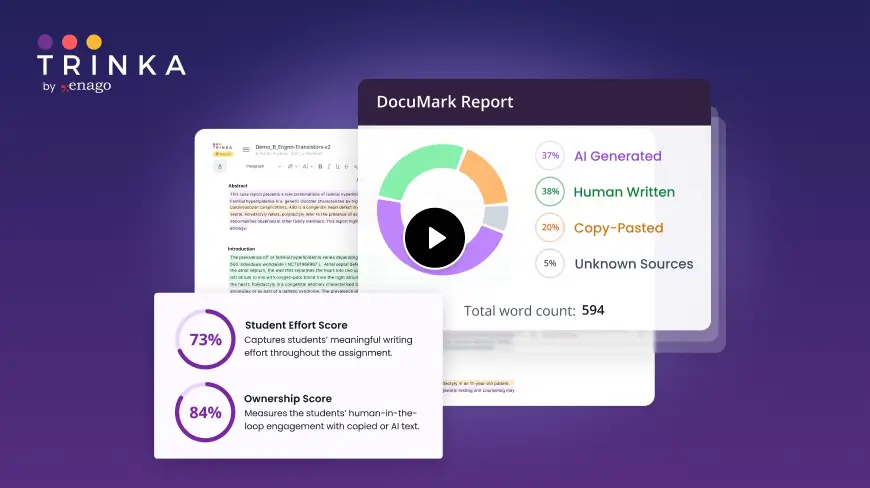
DocuMark: Responsible AI Use for Academic Integrity
Knowing your institution's AI policy is step one. DocuMark helps enforce it fairly by empowering universities to manage AI-generated content, prevent cheating, and support student writing through responsible AI use.
Common Questions About Liberty University's AI Policies
Liberty University has defined AI policies in 9 of 12 categories, with an overall coverage score of 75%.
When AI use is permitted by an instructor, students must cite it as a source, and Liberty’s writing center provides APA, MLA, and Turabian citation guidance. In marketing and communications workflows, employees must disclose AI use when seeking approvals, and human review is required before publishing.
Liberty requires academic misconduct incidents to be reported in Beacon when the evidence meets the preponderance standard. Turnitin's AI detector is the only permitted AI detection tool for misconduct investigations, but detection results alone are not treated as proof and must be considered alongside other evidence; severe or repeated misconduct can lead to suspension or expulsion.
Liberty directs users to follow its data storage, data classification, and employee confidentiality policies when using AI tools. The university identifies approved or recommended tools in certain contexts, including Microsoft Copilot and Adobe Firefly for marketing and communications, provides Copilot under LU credentials and licensing, warns not to upload confidential or protected information, prohibits use of personal AI accounts for official university projects, and notes privacy concerns with submitting assignments outside Canvas/Turnitin.