Teaching & Learning
- For assessed coursework, use of generative AI is not universally banned, but students must follow the specific rules set for the assessment or module
- The university states that AI-generated material presented as a student's own work can amount to academic misconduct, and students are directed to disclose and reference AI use where permitted
It is important that you use Generative AI tools responsibly and ethically in your studies. There are several important things to remember:
• Follow any instructions from your tutors regarding what use of Generative AI is and isn’t acceptable in your assignments.
• If you do use Generative AI, you should acknowledge this and reference this correctly in your work.
• You are still responsible for the accuracy of any work you submit, including any ideas or text generated by AI.
Using Generative AI in ways not permitted by your tutor or programme could be considered academic misconduct.
Academic misconduct may occur if a student:
Includes in their work material generated by Artificial Intelligence (AI) where not explicitly permitted. AI generated content may include text and images and may also be embedded in editing tools such as Grammarly and QuillBot.
If tools such as Grammarly and QuillBot are used in line with a student's support plan or with explicit permission from the department, then this should be acknowledged and correctly referenced.
Presenting work generated by AI as if it were your own could be considered a form of plagiarism and may result in disciplinary action.
- Use of AI in formal examinations is prohibited where it would involve unauthorized access to information or communication technology
- The examination rules ban electronic devices and communication tools unless specifically authorized, which would encompass unapproved AI-enabled tools during exams
No candidate shall bring any written, printed or electronic information into an examination room without the explicit authority of the examiner.
No candidate shall communicate or seek to communicate in any way with any person other than an invigilator during the examination.
No candidate shall have in his or her possession, use or seek to use a mobile phone or any other device making communication possible, in an examination room during the examination or in any room to which candidates are admitted while they are waiting to enter the examination room.
- However, students are warned to use it responsibly, verify accuracy, avoid entering personal information, and remember that AI outputs may be biased or incorrect
- The university permits students to use generative AI as a study aid for tasks such as brainstorming, planning, explanations, revision support, and feedback on drafts
It can be used in many useful ways as part of your studies, for example:
• Brainstorming ideas or starting points for assignments
• Clarifying concepts or explaining difficult topics
• Structuring essays or creating revision aids
• Getting feedback on writing (e.g. grammar, tone, clarity)
• Generating examples, summaries or practice questions
You should think of Generative AI as a support tool, not a substitute for your own learning or academic judgement.
Generative AI can make mistakes. It may provide:
• Incorrect or misleading information
• Fake references or sources that do not exist
• Biased, offensive or inappropriate content
Always check any output carefully before using it and compare it with reliable academic sources.
Do not enter:
• Personal details
• Sensitive information
• Confidential university or placement-related material
- The university does not publish a coding-specific AI rule in the provided sources
- Programming-related AI use falls under the general assessment rule that students must follow tutor or programme instructions, disclose use where required, and avoid unpermitted AI-generated content in submitted work
• Follow any instructions from your tutors regarding what use of Generative AI is and isn’t acceptable in your assignments.
• If you do use Generative AI, you should acknowledge this and reference this correctly in your work.
Includes in their work material generated by Artificial Intelligence (AI) where not explicitly permitted. AI generated content may include text and images and may also be embedded in editing tools such as Grammarly and QuillBot.
Research
- For dissertations and research projects, students may use AI tools only when the module leader permits it, and any permitted use must be acknowledged and referenced
- The university also states that generative AI should not be listed as an author on research outputs and that authors remain responsible for the integrity and originality of the work
Use of AI in writing should be discussed with your module leader, and if used, must be acknowledged and referenced appropriately.
Authors should not list AI and AI-assisted technologies as an author or co-author, nor cite AI as an author. Authorship implies responsibilities and tasks that can only be attributed to and performed by humans.
Authors are ultimately responsible and accountable for the contents of the work. This includes ensuring that the work is original, does not infringe third-party rights, and that any use of AI tools is properly disclosed, sourced, and compliant with all relevant regulations and ethical standards.
- The closest statement is a general warning not to enter sensitive or confidential material into AI tools
- The provided sources do not set a detailed university-wide policy on using AI for research data collection, analysis, statistics, synthetic data generation, or interpretation of results
Do not enter:
• Personal details
• Sensitive information
• Confidential university or placement-related material
- The university requires researchers to disclose AI use in research outputs and makes clear that humans, not AI systems, bear authorship responsibility
- Its research integrity guidance also states that the improper representation of AI-generated content as original work is unacceptable and may breach research integrity expectations
Authors should not list AI and AI-assisted technologies as an author or co-author, nor cite AI as an author. Authorship implies responsibilities and tasks that can only be attributed to and performed by humans.
Authors are ultimately responsible and accountable for the contents of the work. This includes ensuring that the work is original, does not infringe third-party rights, and that any use of AI tools is properly disclosed, sourced, and compliant with all relevant regulations and ethical standards.
The use of GenAI in academic work should be acknowledged and appropriately referenced. The failure to acknowledge and correctly reference the use of GenAI in work may amount to plagiarism. Inappropriate and unethical use of GenAI, such as presenting generated content as if it were original research or scholarship, can compromise academic standards and may lead to academic sanctions.
Academic Integrity
- Disclosure of AI use is required whenever students or staff use generative AI in academic work where such use is allowed
- The university directs users to acknowledge and reference AI correctly, and warns that failure to do so may amount to plagiarism or academic misconduct
• If you do use Generative AI, you should acknowledge this and reference this correctly in your work.
If tools such as Grammarly and QuillBot are used in line with a student's support plan or with explicit permission from the department, then this should be acknowledged and correctly referenced.
The use of GenAI in academic work should be acknowledged and appropriately referenced. The failure to acknowledge and correctly reference the use of GenAI in work may amount to plagiarism.
Use of AI in writing should be discussed with your module leader, and if used, must be acknowledged and referenced appropriately.
- Undisclosed or unauthorized AI use can be treated as academic misconduct, including as a form of plagiarism, and may lead to disciplinary action
- The provided sources do not set out a specific institutional position on AI detection software, but they do define misconduct categories and enforcement consequences for improper AI use
Using Generative AI in ways not permitted by your tutor or programme could be considered academic misconduct.
Presenting work generated by AI as if it were your own could be considered a form of plagiarism and may result in disciplinary action.
Includes in their work material generated by Artificial Intelligence (AI) where not explicitly permitted. AI generated content may include text and images and may also be embedded in editing tools such as Grammarly and QuillBot.
The failure to acknowledge and correctly reference the use of GenAI in work may amount to plagiarism. Inappropriate and unethical use of GenAI, such as presenting generated content as if it were original research or scholarship, can compromise academic standards and may lead to academic sanctions.
Institutional & Administrative
- The university provides staff guidance encouraging careful, transparent use of generative AI in teaching and academic work
- Staff are told to review AI outputs critically, protect confidentiality, avoid entering personal or sensitive data, and ensure any academic use is disclosed where appropriate
Generative AI can be a useful tool to support learning, teaching, research and administration. However, its use also raises important questions about accuracy, authorship, ethics and academic integrity.
Staff and students should ensure they critically review all GenAI outputs and use these tools in a responsible, transparent and ethically informed manner.
Do not input personal, confidential or sensitive university data into publicly available GenAI tools.
Any use of GenAI in academic work should be appropriately disclosed and referenced, where relevant.
- The university prohibits users from entering personal, sensitive, confidential, or placement-related information into publicly available AI tools
- The provided sources do not identify a university-approved AI platform list, but they do set clear privacy limits on what data may be shared with AI systems
Do not enter:
• Personal details
• Sensitive information
• Confidential university or placement-related material
Do not input personal, confidential or sensitive university data into publicly available GenAI tools.
- However, the provided sources do not set out a detailed formal AI strategy, governance committee structure, or roadmap for adoption
- The university has published institution-level guidance framing generative AI as a tool that can support learning, teaching, research, and administration, while emphasizing ethical, transparent, and critically reviewed use
Generative AI can be a useful tool to support learning, teaching, research and administration. However, its use also raises important questions about accuracy, authorship, ethics and academic integrity.
Staff and students should ensure they critically review all GenAI outputs and use these tools in a responsible, transparent and ethically informed manner.
Liverpool Hope University recognises that generative AI tools such as ChatGPT, Copilot, Grammarly and others are becoming increasingly common in education. These tools can support learning in useful ways when used appropriately, but they also raise important questions around accuracy, authorship, fairness and academic integrity.
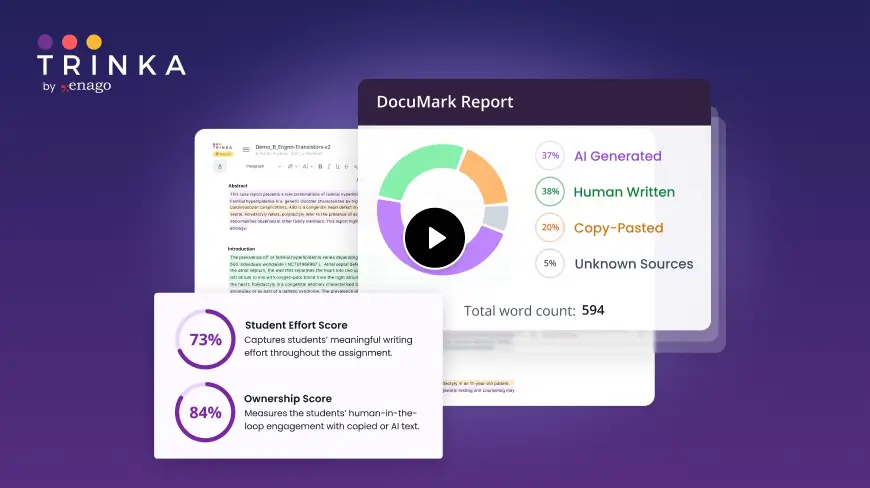
DocuMark: Responsible AI Use for Academic Integrity
Knowing your institution's AI policy is step one. DocuMark helps enforce it fairly by empowering universities to manage AI-generated content, prevent cheating, and support student writing through responsible AI use.
Common Questions About Liverpool Hope University's AI Policies
Liverpool Hope University has defined AI policies in 12 of 12 categories, with an overall coverage score of 100%.
Disclosure of AI use is required whenever students or staff use generative AI in academic work where such use is allowed. The university directs users to acknowledge and reference AI correctly, and warns that failure to do so may amount to plagiarism or academic misconduct.
Undisclosed or unauthorized AI use can be treated as academic misconduct, including as a form of plagiarism, and may lead to disciplinary action. The provided sources do not set out a specific institutional position on AI detection software, but they do define misconduct categories and enforcement consequences for improper AI use.
The university prohibits users from entering personal, sensitive, confidential, or placement-related information into publicly available AI tools. The provided sources do not identify a university-approved AI platform list, but they do set clear privacy limits on what data may be shared with AI systems.