Teaching & Learning
- Use of generative AI in coursework is not uniformly prohibited university-wide
- Submitting AI-generated work as if it were a student's own work is treated as academic misconduct
- The university states that whether AI can be used in assessed work depends on the assessment brief and module guidance, and students are responsible for ensuring any use complies with those instructions
When preparing assessments, you should remember that as a student, your output should always represent your own understanding and learning. If you decide to use GenAI to support your work then you should ask yourself whether your assessment is designed to test your own skills and understanding in a way that would make the use of GenAI inappropriate. Guidance on this may be provided in your assessment brief.
In some cases, modules may permit the use of GenAI to support your learning and work preparation. However, in other cases, your module guidance may explain that the use of GenAI in an assessment would be inappropriate as it would not allow you to demonstrate your own knowledge and skills.
Copying directly from an AI generated response and using this in your work as if it was your own original content is a form of plagiarism and is a breach of academic integrity.
use of unauthorised technology or software including, but not limited to, AI generated response software such as ChatGTP or software able to change text to beat AI generated response detectors, where not permitted in the module guidance or other information and provided to students
- AI use in examinations and assessments is prohibited when it is not permitted by module or assessment guidance
- The university classifies use of unauthorized AI software in assessments as cheating or academic misconduct, including using tools to evade AI detection
use of unauthorised technology or software including, but not limited to, AI generated response software such as ChatGTP or software able to change text to beat AI generated response detectors, where not permitted in the module guidance or other information and provided to students
You should always ensure that if you use GenAI in support of your work that you use it critically and responsibly. It is likely to be more appropriate to use in assessments that test your application of skills and understanding than in those requiring you to present your own ideas.
Guidance on this may be provided in your assessment brief.
- The university permits students to use generative AI to support learning and work preparation, but expects it to be used critically and responsibly
- Students are told to make sure any use still allows them to demonstrate their own understanding and to follow module or assessment-specific guidance
In some cases, modules may permit the use of GenAI to support your learning and work preparation.
You should always ensure that if you use GenAI in support of your work that you use it critically and responsibly.
When preparing assessments, you should remember that as a student, your output should always represent your own understanding and learning.
Research
Academic Integrity
- This is a mandatory transparency requirement for any AI-supported content included in submitted work
- When students use generative AI in assessed work, the university requires them to acknowledge that use and cite the AI-generated content in line with the recommended referencing style
If you use GenAI to support the development of your assessed work then you should acknowledge this use and cite the AI generated content according to the referencing style advised by your School.
- The university treats undisclosed or unauthorized AI use as academic misconduct when AI tools are not permitted by module guidance
- Its misconduct examples explicitly mention AI-generated response software and software intended to defeat AI detectors, and the academic misconduct framework applies penalties and formal procedures to such cases
use of unauthorised technology or software including, but not limited to, AI generated response software such as ChatGTP or software able to change text to beat AI generated response detectors, where not permitted in the module guidance or other information and provided to students
Copying directly from an AI generated response and using this in your work as if it was your own original content is a form of plagiarism and is a breach of academic integrity.
Academic misconduct is any action or attempted action that may result in creating an unfair academic advantage for self or an unfair academic advantage or disadvantage for any other member or members of the academic community.
Institutional & Administrative
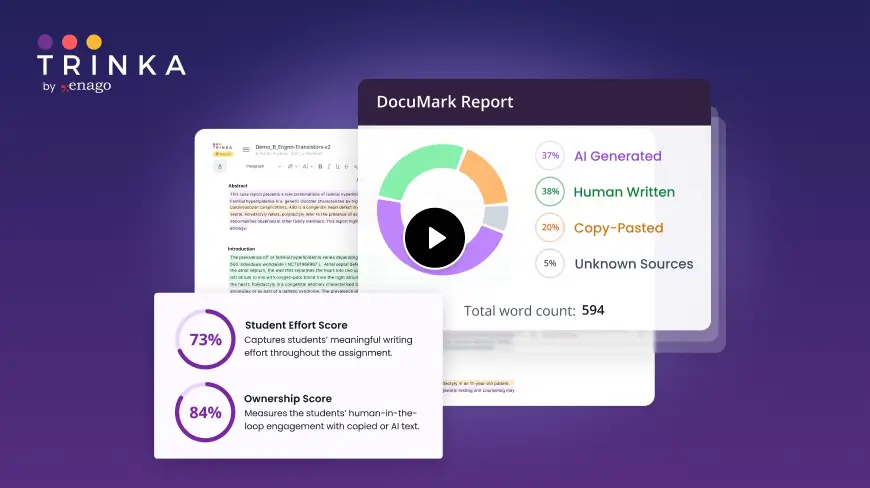
DocuMark: Responsible AI Use for Academic Integrity
Knowing your institution's AI policy is step one. DocuMark helps enforce it fairly by empowering universities to manage AI-generated content, prevent cheating, and support student writing through responsible AI use.
Common Questions About Liverpool John Moores University's AI Policies
Liverpool John Moores University has defined AI policies in 5 of 12 categories, with an overall coverage score of 42%.
When students use generative AI in assessed work, the university requires them to acknowledge that use and cite the AI-generated content in line with the recommended referencing style. This is a mandatory transparency requirement for any AI-supported content included in submitted work.
The university treats undisclosed or unauthorized AI use as academic misconduct when AI tools are not permitted by module guidance. Its misconduct examples explicitly mention AI-generated response software and software intended to defeat AI detectors, and the academic misconduct framework applies penalties and formal procedures to such cases.
No explicit data protection or approved AI platform policy is currently defined in the available policy sources.