Teaching & Learning
- Students may use generative AI in an appropriate and responsible way, but submitted assessment work must remain their own work and must appropriately reference any AI use
- An exception is allowed where extensive and critical use of a specific AI tool is part of the assessment brief, and subject-specific guidance is left to course leaders or teaching staff
- Using AI to generate work or ideas and presenting them as the student's own work is treated as academic misconduct, and creating a complete assignment with AI is treated as contract cheating
Your assessment submissions must therefore always be entirely your own work, based on your own learning and appropriately referenced including how you have used Generative AI.
The University regards the use of Generative AI applications by students to deceive to gain unfair advantage as academic misconduct.
* Plagiarism, where AI tools are used to generate output and ideas that are presented or submitted as if they were the student's own work, without proper citation or references.
* Where a complete assignment is created using Generative AI and represented as a student's own work, this will be regarded as contract cheating in the same way as commissioning an 'Essay Mill' or other third party to complete your work.
The exception will be for tasks where the extensive and critical use of a specific AI tool is part of the assessment brief.
For specific guidance related to your subject speak to your course leader or any member of the teaching staff.
- The university does not set a separate AI rule specifically for exams, quizzes, or tests in the provided sources
- Its stated position is that assessment standards and fairness must be maintained, that students may be required to document AI use in assessment submissions, and that course- or subject-specific guidance should be sought from teaching staff
5. We will ensure and maintain fairness in assessment while accommodating our students' access to and innovation with emerging technologies. This will include the use of varied and creative assessments, the active use of version histories where relevant, critical, and creative engagement with AI in class including to explain its unreliability and a focus on subject specific implications within the curriculum.
7. London Metropolitan University Students will be expected, when required, to document or reference their use of Generative AI for assessment submissions.
For guidance related to your subject speak to your course leader or any member of the teaching staff.
- The university permits appropriate and responsible student use of generative AI for learning support
- It also says students will be supported in developing AI literacy and warns that AI research outputs may be unreliable
- It explicitly recognizes uses such as structuring existing work, overcoming writer's block, spelling and grammar checks, language support, support for specific learning requirements, summaries, and creative tasks
1. We permit the appropriate and responsible use of Generative AI applications by our students.
2. We recognise that generative AI applications can be useful tools in specific aspects of learning, including:
* assisting in the structuring or organising existing work.
* getting inspiration / overcoming 'writer's block'.
* spelling and grammar checks.
* supporting international students with language challenges.
* aiding students with specific learning requirements.
* producing quick summaries / synopses of large documen t s
6. We will support students in their Generative AI literacy within wider learning skills development, assessment literacy, information literacy, digital literacy, and awareness of academic misconduct.
We also urge caution when it comes to the use of generative AI apps as research tools because the information, they present is not always trustworthy or accurate
* AI tools sometimes invent information and references when they cannot find it. This is called 'hallucinating.'
- The university permits appropriate and responsible student use of generative AI and explicitly identifies debugging code as a useful subject-specific task
- However, programming-related assessment work still falls under the rule that submissions must be the student's own work, unless extensive and critical use of a specific AI tool is required by the assessment brief
1. We permit the appropriate and responsible use of Generative AI applications by our students.
* other subject specific tasks such as debugging code.
Your assessment submissions must therefore always be entirely your own work, based on your own learning and appropriately referenced including how you have used Generative AI.
The exception will be for tasks where the extensive and critical use of a specific AI tool is part of the assessment brief.
Research
- The provided sources do not define a specific AI policy for drafting, editing, or formatting research papers, theses, dissertations, or manuscripts
- The research integrity materials instead require researchers to be honest, rigorous, transparent, and to cite the work of others when presenting research
researchers to be honest, rigorous, and transparent in conducting their research and presenting their research, regardless of the form in which such work appears publicly. Scholars must be rigorous and honest working to conventional disciplinary expectations; in citing the work of others; in declaring conflicts of interest; in maintaining confidential materials properly and in line with the expectations of providers of data; and when communicating results to peers and the public.
- The provided sources do not define any AI-specific rules for research data collection, analysis, synthetic data, or interpretation
- The research integrity policy instead sets general requirements that research data be managed securely, stored on university internal systems, and handled in line with data security, data usage, and GDPR obligations
3.1. London Metropolitan believes that data management is vital to research integrity.
3. Research data should be stored securely, and researchers must be familiar with our data management policy and must adhere to it (see 8.1.3 below).
4. Research data must be stored securely on University’s internal data storage systems and sharing of data within this system.
Researchers must familiarise themselves with our guidance on data security and data usage.
3.2. Researchers must also be aware of our policy on research and GDPR, including the relationship between us and our data providers, in terms of our obligations and their rights (see below 8.1.4).
- The university does not provide an AI-specific rule for grant proposals, IRB applications, or ethics declarations in the provided sources
- It does require staff and postgraduate research students to obtain ethics clearance before research begins, requires all projects to gain ethics approval, and requires researchers to follow research integrity standards with disciplinary procedures for breaches
London Metropolitan University is committed to ensuring the highest possible ethical standards in the research conducted by its staff and students. Staff and postgraduate research students must obtain ethics clearance before embarking upon research projects.
Research students should in all cases complete the Student Research Ethics Application form.
All projects must gain ethics approval from School Ethics Committees, regardless of the funder, and whether or not the same project will go through the Ethics procedures of another institution.
We require researchers to familiarise themselves with all of our research policies and to adhere to them in both principle and action.
1.3. We will use University disciplinary procedures where breaches of such expectations occur.
Academic Integrity
- The requirement is tied to assessment submissions rather than stated as a blanket disclosure rule for all work
- Students must appropriately reference how they used generative AI in submitted assessment work, and they are expected to document or reference AI use when required
Your assessment submissions must therefore always be entirely your own work, based on your own learning and appropriately referenced including how you have used Generative AI.
7. London Metropolitan University Students will be expected, when required, to document or reference their use of Generative AI for assessment submissions.
* Plagiarism, where AI tools are used to generate output and ideas that are presented or submitted as if they were the student's own work, without proper citation or references.
- The provided sources do not state a position on AI detection tools
- Undisclosed or deceptive AI use can be treated as academic misconduct, including plagiarism and contract cheating
- The university states that academic misconduct carries graduated penalties from reprimand to expulsion, uses university disciplinary procedures where research integrity breaches occur, and provides staff forms for reporting suspected academic misconduct
The University regards the use of Generative AI applications by students to deceive to gain unfair advantage as academic misconduct.
* Plagiarism, where AI tools are used to generate output and ideas that are presented or submitted as if they were the student's own work, without proper citation or references.
* Where a complete assignment is created using Generative AI and represented as a student's own work, this will be regarded as contract cheating in the same way as commissioning an 'Essay Mill' or other third party to complete your work.
The University takes academic misconduct very seriously and seeks at all times to rigorously protect its academic standards. Plagiarism, collusion and other forms of cheating constitute academic misconduct, for which there is an explicit range of graduated penalties depending on the particular type of academic misconduct. The penalties that can be applied if academic misconduct is substantiated range from a reprimand to expulsion in very serious cases and for repeated instances of misconduct.
Staff are asked to complete the below form where there are concerns of Academic Misconduct.
1.3. We will use University disciplinary procedures where breaches of such expectations occur.
Institutional & Administrative
- It also states that the Digital Education Unit supports staff in using technology to enhance student learning
- The provided sources do not define specific rules for staff use of AI in grading, feedback, recommendation letters, or administrative communications
- The university says it will provide staff with training, development, support, and resources to engage with generative AI, including academic misconduct issues
10. The University will provide its staff with appropriate training, development, support, and resources to engage with Generative AI, and related issues including Academic Misconduct.
The Digital Education Unit is responsible for leading on the strategy, policy and practice for digital education.
* supporting staff in using technology to enhance student learning through workshops, individual advice and involvement in School-wide and University-wide initiatives
- The provided sources do not define approved AI platforms or a dedicated AI data-classification policy
- They do identify examples of AI applications and set general research data protection requirements: confidential materials must be maintained properly, research data must be stored securely on university internal systems, and researchers must follow data security, data usage, and GDPR-related policies
These include MS Copilot, ChatGPT and Google Gemini, Claude and Grok for text and Adobe Firefly, Midjourney and DALL-E for images, although many platforms are able to generate both.
Scholars must be rigorous and honest working to conventional disciplinary expectations; in citing the work of others; in declaring conflicts of interest; in maintaining confidential materials properly and in line with the expectations of providers of data; and when communicating results to peers and the public.
3. Research data should be stored securely, and researchers must be familiar with our data management policy and must adhere to it (see 8.1.3 below).
4. Research data must be stored securely on University’s internal data storage systems and sharing of data within this system.
Researchers must familiarise themselves with our guidance on data security and data usage.
3.2. Researchers must also be aware of our policy on research and GDPR, including the relationship between us and our data providers, in terms of our obligations and their rights (see below 8.1.4).
- The university has an institutional AI governance and strategy function for teaching and learning
- Its approach is to engage with and adapt to AI with a focus on appropriate and responsible use, and the Digital Education Unit leads strategy, policy, and practice for digital education
- The university also states that it coordinates staff and student guidance, webinars, a staff forum, and a university-wide GAI steering group with representation from all schools and key professional services
Our approach to AI is to engage with and adapt to these new technologies, with a focus on appropriate and responsible use.
The Digital Education Unit is responsible for leading on the strategy, policy and practice for digital education.
These recent developments present a number of opportunities and challenges for teaching, learning and assessment. The Centre for Teaching Enhancement (CTE) team has contributed to the ongoing debate raising awareness among colleagues with a number of initiatives:
* co-ordinating the development of staff and student guidance on the use of GAI
* running a series of webinars on GAI Basics, the implications of GAI on teaching, learning and assessment and the GAI tools available at London Met
* facilitating a staff forum on the topic of GAI
* co-ordinating a university-wide GAI steering group with representation from all schools and key professional services (Library, Academic Integrity, Academic Quality Department)
9. The University commits to engage with the broader legal, ethical, and philosophical issues surrounding the use of Generative AI in teaching and learning contexts and other relevant student facing spaces.
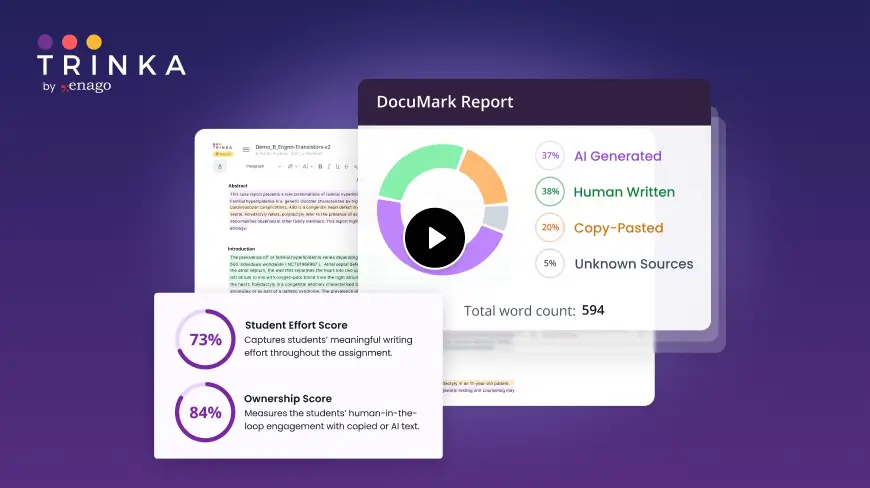
DocuMark: Responsible AI Use for Academic Integrity
Knowing your institution's AI policy is step one. DocuMark helps enforce it fairly by empowering universities to manage AI-generated content, prevent cheating, and support student writing through responsible AI use.
Common Questions About London Metropolitan University's AI Policies
London Metropolitan University has defined AI policies in 12 of 12 categories, with an overall coverage score of 100%.
Students must appropriately reference how they used generative AI in submitted assessment work, and they are expected to document or reference AI use when required. The requirement is tied to assessment submissions rather than stated as a blanket disclosure rule for all work.
Undisclosed or deceptive AI use can be treated as academic misconduct, including plagiarism and contract cheating. The university states that academic misconduct carries graduated penalties from reprimand to expulsion, uses university disciplinary procedures where research integrity breaches occur, and provides staff forms for reporting suspected academic misconduct. The provided sources do not state a position on AI detection tools.
The provided sources do not define approved AI platforms or a dedicated AI data-classification policy. They do identify examples of AI applications and set general research data protection requirements: confidential materials must be maintained properly, research data must be stored securely on university internal systems, and researchers must follow data security, data usage, and GDPR-related policies.