Teaching & Learning
- Unauthorized use can be treated as plagiarism or another academic integrity violation
- Student use of generative AI in coursework is not uniformly allowed or banned university-wide; it is at instructor discretion and may vary by assignment
- When an instructor permits use, students remain responsible for the accuracy of the work, must not submit AI-generated material as their own, and must disclose and cite use according to faculty directions
Unless otherwise specified by your course instructor, students may not submit content generated by AI as their own work. Any use of AI tools in coursework must be appropriately acknowledged and cited in accordance with instructor guidelines.
Faculty should clearly communicate to students, in writing and at the outset of a course or assignment, whether AI is permitted and under what conditions.
When permitted by the instructor, AI may be used as a learning support tool—for example, to brainstorm ideas, check grammar, practice problems, or review explanations—provided that students critically evaluate any output and independently verify facts, sources, and reasoning.
The use of AI in any graded work without explicit instructor permission may be considered academic misconduct and may fall under existing policies concerning plagiarism, unauthorized assistance, or falsification.
Presenting ideas, words, data, code, or any academic work generated by artificial intelligence, or another person, without proper acknowledgment, citation, or explicit authorization from the instructor.
- If AI is used in graded work without explicit permission, the university states that this may constitute academic misconduct
- AI use in exams and assessments is not separately governed by a distinct exam-specific AI rule in the provided sources, but faculty are directed to specify whether AI is allowed for each course or assignment
Faculty should clearly communicate to students, in writing and at the outset of a course or assignment, whether AI is permitted and under what conditions.
The use of AI in any graded work without explicit instructor permission may be considered academic misconduct and may fall under existing policies concerning plagiarism, unauthorized assistance, or falsification.
- Use of AI for studying and learning support is permitted when the instructor allows it
- The university gives examples such as brainstorming, grammar help, practice problems, and reviewing explanations, but requires students to critically evaluate outputs and independently verify facts, sources, and reasoning
When permitted by the instructor, AI may be used as a learning support tool—for example, to brainstorm ideas, check grammar, practice problems, or review explanations—provided that students critically evaluate any output and independently verify facts, sources, and reasoning.
- AI-generated code is not uniformly permitted; its use in programming work depends on explicit instructor authorization
- If used, students may not present AI-generated code as their own without proper acknowledgment, citation, or instructor approval, and such conduct can be treated as academic misconduct
Presenting ideas, words, data, code, or any academic work generated by artificial intelligence, or another person, without proper acknowledgment, citation, or explicit authorization from the instructor.
The use of AI in any graded work without explicit instructor permission may be considered academic misconduct and may fall under existing policies concerning plagiarism, unauthorized assistance, or falsification.
Research
- The provided sources do not define a specific university policy on using AI to draft, edit, format, or improve research papers, theses, dissertations, or manuscripts as research outputs
not defined
- Any use must still comply with the university's data classification and privacy restrictions
- The university's IT AI policy permits limited institutional uses such as summarization, language generation, analysis, and ideation, but it does not define a specific research policy governing AI for research data collection, analysis, synthetic data generation, or interpretation of results
Long Island University’s Use of Artificial Intelligence (“AI”) Policy is designed to ensure employees use AI systems appropriately and in a way that protects LIU data. This Policy applies to all University Employees, staff and faculty as they perform work on behalf of Long Island University.
Some use cases where AI applications can be used to support work include but are not limited to:
• summarization
• language generation
• search and retrieval
• coding support
• data analytics and visualization
• ideation and planning support
University Employees shall not enter any Internal, Confidential, or Restricted data into AI tools that are not approved by Long Island University.
- The provided sources do not define AI-specific rules for grant proposals, IRB applications, research ethics declarations, or research integrity processes
not defined
Academic Integrity
- Disclosure and attribution are required when AI is used in student academic work
- Students must acknowledge and cite AI use according to instructor guidelines, and submitting AI-generated work without proper acknowledgment, citation, or explicit instructor authorization is prohibited
Any use of AI tools in coursework must be appropriately acknowledged and cited in accordance with instructor guidelines.
Presenting ideas, words, data, code, or any academic work generated by artificial intelligence, or another person, without proper acknowledgment, citation, or explicit authorization from the instructor.
- Undisclosed or unauthorized AI use in graded academic work may be enforced under existing academic misconduct rules
- The provided sources describe AI-related misconduct as potentially falling under plagiarism, unauthorized assistance, falsification, or other dishonest acts, but they do not define a university position on AI detection tools
The use of AI in any graded work without explicit instructor permission may be considered academic misconduct and may fall under existing policies concerning plagiarism, unauthorized assistance, or falsification.
Academic dishonesty may involve, but is not necessarily limited to one or more of the following examples:
A. Plagiarism: presenting another’s ideas, words, formulations or work as one’s own without acknowledgment.
B. Cheating: using unauthorized notes, study aids, electronic devices, assistance from others, or obtaining examination answers dishonestly.
C. Fabrication: falsifying or inventing data, information, citations, or academic records.
D. Misrepresentation: misusing circumstances for academic advantage, including submitting the same work in more than one course without prior approval.
E. Theft or interference: stealing or obstructing another person’s academic materials or work.
F. Other dishonest acts: engaging in conduct that violates the principles of academic integrity or the instructions of the instructor.
Institutional & Administrative
- In teaching, faculty are also expected to tell students in writing whether AI is allowed and under what conditions
- The university has an employee AI policy that applies to faculty and staff performing work on behalf of the institution
- It allows work-support uses such as summarization, language generation, coding support, analytics, and planning, while requiring employees to review AI outputs for accuracy and bias and to take responsibility for decisions or materials produced with AI
Long Island University’s Use of Artificial Intelligence (“AI”) Policy is designed to ensure employees use AI systems appropriately and in a way that protects LIU data. This Policy applies to all University Employees, staff and faculty as they perform work on behalf of Long Island University.
Some use cases where AI applications can be used to support work include but are not limited to:
• summarization
• language generation
• search and retrieval
• coding support
• data analytics and visualization
• ideation and planning support
University Employees should use AI applications as decision support tools and not as final authority. Human oversight and review remain necessary to ensure outputs align with LIU values, legal obligations and institutional priorities.
University Employees are responsible for the output generated by AI systems that they use in their work. Outputs should be reviewed for accuracy, appropriateness, and bias before being relied on or shared.
Faculty should clearly communicate to students, in writing and at the outset of a course or assignment, whether AI is permitted and under what conditions.
- The university sets explicit data protection limits for employee AI use
- Employees may only enter public data into non-approved AI tools, while Internal, Confidential, and Restricted data are barred from unapproved tools; the policy also references institutionally approved AI tools and requires compliance with existing privacy, data security, and acceptable use policies
University Employees may use publicly available AI tools only with Public data unless the tool has been reviewed and approved by Long Island University.
University Employees shall not enter any Internal, Confidential, or Restricted data into AI tools that are not approved by Long Island University.
Examples of data that shall not be entered into unapproved AI systems include but are not limited to:
• Student records protected under FERPA
• Human Resources records and employee data
• Financial aid and tax information
• Protected health information (PHI)
• Legal or contract documents
• Internal strategy or planning materials
• Security related information and credentials
University Employees must continue to comply with all existing University policies concerning privacy, confidentiality, data security, acceptable use, and records retention when using AI systems.
Long Island University approved tools for use with Internal, Confidential or Restricted data include those AI tools listed on the approved systems list. For the latest approved list, contact the Office of Information Technology.
- The policy states goals of appropriate use, data protection, human oversight, fairness, transparency, accountability, legal compliance, and continuous monitoring of AI use
- Long Island University has an institution-level AI governance approach expressed through guiding principles and operating requirements rather than a detailed public roadmap in the provided sources
Long Island University’s Use of Artificial Intelligence (“AI”) Policy is designed to ensure employees use AI systems appropriately and in a way that protects LIU data.
The following principles shall guide responsible use of AI at LIU:
• Privacy and Confidentiality. AI use must protect personal and institutional information.
• Human Oversight. AI should assist, not replace, professional judgment.
• Fairness and Bias Mitigation. AI outputs should be reviewed for bias and unintended consequences.
• Transparency. When AI significantly informs institutional decisions or communications, employees should ensure its use is appropriate and, when relevant, disclosed.
• Accountability. University employees remain accountable for decisions and materials produced with the aid of AI.
• Legal and Ethical Compliance. AI use must comply with applicable laws, regulations, contractual obligations, and University policy.
The Office of Information Technology and relevant departments may monitor the use of AI systems to ensure compliance with University policy, legal obligations, and information security requirements.
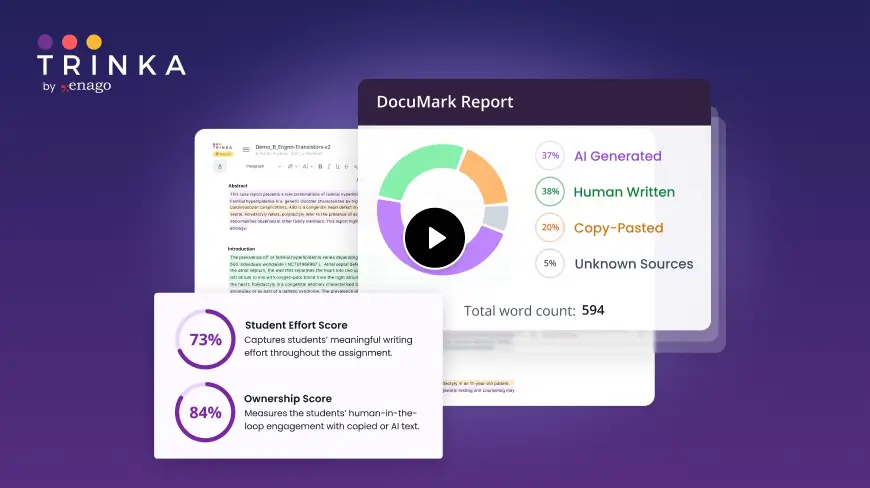
DocuMark: Responsible AI Use for Academic Integrity
Knowing your institution's AI policy is step one. DocuMark helps enforce it fairly by empowering universities to manage AI-generated content, prevent cheating, and support student writing through responsible AI use.
Common Questions About Long Island University's AI Policies
Long Island University has defined AI policies in 12 of 12 categories, with an overall coverage score of 100%.
Disclosure and attribution are required when AI is used in student academic work. Students must acknowledge and cite AI use according to instructor guidelines, and submitting AI-generated work without proper acknowledgment, citation, or explicit instructor authorization is prohibited.
Undisclosed or unauthorized AI use in graded academic work may be enforced under existing academic misconduct rules. The provided sources describe AI-related misconduct as potentially falling under plagiarism, unauthorized assistance, falsification, or other dishonest acts, but they do not define a university position on AI detection tools.
The university sets explicit data protection limits for employee AI use. Employees may only enter public data into non-approved AI tools, while Internal, Confidential, and Restricted data are barred from unapproved tools; the policy also references institutionally approved AI tools and requires compliance with existing privacy, data security, and acceptable use policies.