Teaching & Learning
- Use of generative AI in assessed coursework is at instructor or assessment-brief discretion rather than uniformly allowed or banned
- When students use AI in work for assessment, they must acknowledge it, describe how it was used, and retain copies of outputs and drafts; failure to acknowledge use is treated as academic misconduct
Before you start each assignment, always check the assessment brief which will outline how you are and aren’t allowed to use GenAI in that particular piece of work. You can contact your Module Leader if you have any questions about this.
If you have used Generative AI tools when producing your work, it is important that you acknowledge this when submitting your work for assessment. This includes if you have used it to generate materials for background research and independent study, or if you have used it to produce materials which you have subsequently adapted and included in your work.
If you are suspected of inappropriately using AI or have failed to acknowledge its use, this will be regarded as academic misconduct by the University and you will be referred to one of its Academic Misconduct Committees.
For example, if you used Generative AI tools as your initial background search, you must keep the outputs they generated and (if requested) be able to show through a version history how you developed and moved on from the content to create your own independent work.
If you have used Generative AI tools when producing your work for assessment, you must include a statement in your work, acknowledging their use by naming the tool(s) and how it was used, using the following statement:
- For assessed submissions where AI is used, acknowledgment is required, and undisclosed or inappropriate use is handled as academic misconduct
- The university does not set one blanket AI rule for all assessments; students must follow the specific assessment brief for each piece of assessed work
Before you start each assignment, always check the assessment brief which will outline how you are and aren’t allowed to use GenAI in that particular piece of work. You can contact your Module Leader if you have any questions about this.
If you have used Generative AI tools when producing your work for assessment, you must include a statement in your work, acknowledging their use by naming the tool(s) and how it was used, using the following statement:
If you are suspected of inappropriately using AI or have failed to acknowledge its use, this will be regarded as academic misconduct by the University and you will be referred to one of its Academic Misconduct Committees.
- The university explicitly recognizes student use of generative AI for background research and independent study
- When that use connects to assessed work, students must acknowledge it and may need to demonstrate how they developed independent work from the AI outputs
If you have used Generative AI tools when producing your work, it is important that you acknowledge this when submitting your work for assessment. This includes if you have used it to generate materials for background research and independent study, or if you have used it to produce materials which you have subsequently adapted and included in your work.
For example, if you used Generative AI tools as your initial background search, you must keep the outputs they generated and (if requested) be able to show through a version history how you developed and moved on from the content to create your own independent work.
I acknowledge the use of (insert name of AI tool(s) and link) to generate materials for background research and independent study and/or that I have adapted to include within the work submitted for assessment. I confirm that all use of AI content is acknowledged and referenced appropriately.
- For programming-related assessed work, AI use is governed by the relevant assessment brief rather than a single university-wide permission rule
- If students use AI-generated code in assessed work, they must describe how the material was generated, including prompts and how they changed the output
Before you start each assignment, always check the assessment brief which will outline how you are and aren’t allowed to use GenAI in that particular piece of work. You can contact your Module Leader if you have any questions about this.
You must describe how the information or material (including images, computer code, video content etc) was generated, including the prompts you used, and how the output was changed by you. You do not need to submit the AI outputs as part of your declaration, however you must keep copies of these as outlined in Step 1.
Research
- Within the cited UKRIO code, generative AI cannot be listed as a co-author on research outputs
- The university does not provide a Loughborough-specific AI writing policy in the cited research code, but it binds researchers to the UKRIO Code of Practice for Research across all stages of research
All those engaged in research at the University are responsible for observing the principles in the UK Research Integrity Office (UKRIO) Code of Practice for Research (2009) in all aspects of their research from initial concepts through to final dissemination of outcomes.
responsibility for that work and ensure its accuracy and be able to identify their contribution to it. For this reason, the use of generative AI as co-author is unacceptable.
- The cited materials do not set a detailed Loughborough-only rule for AI-assisted analysis, but they do require secure data handling and transparency/accountability expectations around data and metadata
- The university's cited research code requires researchers to follow UKRIO principles in all aspects of research, and the cited UKRIO code specifically says organizations should address AI-related challenges for research integrity and intellectual property
All those engaged in research at the University are responsible for observing the principles in the UK Research Integrity Office (UKRIO) Code of Practice for Research (2009) in all aspects of their research from initial concepts through to final dissemination of outcomes.
3.11.6 ORGANISATIONS should have in place procedures, resources (including physical space), and administrative support to assist researchers in the accurate and efficient collection of data and metadata, and its storage in a secure and accessible form. Guidelines should be in place to fulfil open data requirements and expectations for transparency and accountability.
3.11.7 Organisations should consider the challenges posed by artificial intelligence (AI)-generated content for intellectual property rights and other research integrity concerns, and have clear policy and guidance in place to effectively regulate technology that have potential for harm across all disciplines and wider society.
3.11.8 RESEARCHERS should consider how data will be gathered, analysed, and managed, and how and in what form relevant data will be made available to
- Loughborough requires all researchers to follow research integrity principles and places accountability on research leaders for adherence to the ethical framework
- The cited UKRIO code also states that organizations should have clear policy and guidance on generative AI in research and define responsibility and accountability for its use
The University is committed to maintaining the highest standards of rigour and integrity in the conduct of its research as embodied in the Concordat to Support Research Integrity (2019). All those engaged in research at the University are responsible for observing the principles in the UK Research Integrity Office (UKRIO) Code of Practice for Research (2009) in all aspects of their research from initial concepts through to final dissemination of outcomes.
The UUK Concordat and the UKRIO Code of Practice are integral to the University’s Ethical Policy Framework which applies to all of the University’s activities and all members of the University community.
Research leaders are accountable for ensuring adherence to this framework in respect of the nature, conduct, dissemination and foreseeable end-use of research and the behaviour of researchers.
3.11.7 Organisations should consider the challenges posed by artificial intelligence (AI)-generated content for intellectual property rights and other research integrity concerns, and have clear policy and guidance in place to effectively regulate technology that have potential for harm across all disciplines and wider society. The policy should define who is responsible and accountable for the use of generative AI in research conducted under the auspices of the organisation.
Academic Integrity
- Disclosure of AI use in assessed work is required
- Students must include a statement naming the AI tool and how it was used, must describe how outputs were generated and modified, and must keep copies of AI outputs and drafts; the university also says AI-assisted spelling and grammar correction should be acknowledged
If you have used Generative AI tools when producing your work, it is important that you acknowledge this when submitting your work for assessment.
If using AI tools to correct spelling and grammar, you must follow the Guidance note for Proofreading Written Work and you should acknowledge their use when submitting your work for assessment.
If you have used Generative AI tools when producing your work for assessment, you must include a statement in your work, acknowledging their use by naming the tool(s) and how it was used, using the following statement:
I acknowledge the use of (insert name of AI tool(s) and link) to generate materials for background research and independent study and/or that I have adapted to include within the work submitted for assessment. I confirm that all use of AI content is acknowledged and referenced appropriately.
You must describe how the information or material (including images, computer code, video content etc) was generated, including the prompts you used, and how the output was changed by you.
You do not need to submit the AI outputs as part of your declaration, however you must keep copies of these as outlined in Step 1.
- The provided sources do not define any university position on AI detection software tools
- The university states that inappropriate AI use or failure to acknowledge AI use in assessed work is academic misconduct and will be referred to Academic Misconduct Committees
If you are suspected of inappropriately using AI or have failed to acknowledge its use, this will be regarded as academic misconduct by the University and you will be referred to one of its Academic Misconduct Committees.
Institutional & Administrative
- The university provides staff-facing AI guidance and training rather than detailed role-specific rules for grading, recommendation letters, or teaching preparation in the cited sources
- Staff are directed to use AI effectively and responsibly, including through the approved Microsoft Copilot platform, and the university states that AI should support rather than replace human judgment
This page provides access to a growing list of curated training resources to help staff build knowledge and apply AI tools, like our approved Microsoft Copilot platform, effectively and responsibly.
For staff from all areas to expand on AI knowledge and discuss ethical considerations. Includes workshops and a Community of Practice to share best practices in teaching and learning.
We commit to keeping humans at the centre of our deployment of AI. AI systems will support, inform, and enhance human judgement—not replace it.
- The university instructs staff and students to be cautious with non-university AI tools and to protect sensitive, personal, and confidential data and intellectual property
- It also identifies Microsoft Copilot as an approved platform for staff training and says users are responsible for knowing when data provided to AI services requires protection and safeguarding
This page provides access to a growing list of curated training resources to help staff build knowledge and apply AI tools, like our approved Microsoft Copilot platform, effectively and responsibly.
Handling sensitive, personal, or confidential data
Protecting intellectual property
Be especially cautious when using non-University AI tools, as they may not offer the same safeguards. More info on data protection .
Be a data custodian You are responsible for knowing when the data you provide to AI services requires protection, ensuring its appropriate use and safeguarding as needed.
Good information governance practice is therefore of paramount importance, including the adoption of appropriate policies, procedures and structures which enable the secure, efficient and effective use of data whilst protecting the privacy of data subjects.
Data and information are a vital asset for the University, they require adequate protection regardless of form (digital or physical) or means by which they are shared.
Individual’s handling personal data must follow the University’s policies and procedures in respect of Data Protection when applying this policy.
- Its principles commit the university to academic integrity, safety and ethics, human-centered deployment, and ongoing review of its AI vision, strategies, and practices
- Loughborough has an institutional AI guidance hub, a stated ethical principles framework for AI use, staff/student-wide practices, staff training, and named AI communities and working groups
Welcome to the hub for Artificial Intelligence guidance at Loughborough University. As AI tools evolve, we are committed to providing a clear framework that empowers our community to use these technologies creatively, efficiently, and ethically.
Practices for everyone Everyday actions, “do's and don'ts”, and safe protocols. This guidance applies to all staff and students using AI tools.
Our AI principles Read the core ethical framework and values that underpin all AI usage at the university. Start here to understand the ‘why’.
Professional Services AI Working Group
For Professional Services colleagues interested in exploring AI's impact on their day-to-day roles. A practical space to share experiences, stayed informed, and collaborate on smaller AI projects.
AI in Education (AIED) Community
For staff from all areas to expand on AI knowledge and discuss ethical considerations. Includes workshops and a Community of Practice to share best practices in teaching and learning.
We will protect academic standards by clearly articulating how AI should and should not be used, and by thoughtfully designing learning, assessment, and research activities to uphold integrity.
We commit to safe, responsible, and ethical use of AI tools, both in their application and in selecting technologies.
We commit to keeping humans at the centre of our deployment of AI. AI systems will support, inform, and enhance human judgement—not replace it.
We pledge to regularly evaluate and review our AI vision, strategies, and practices.
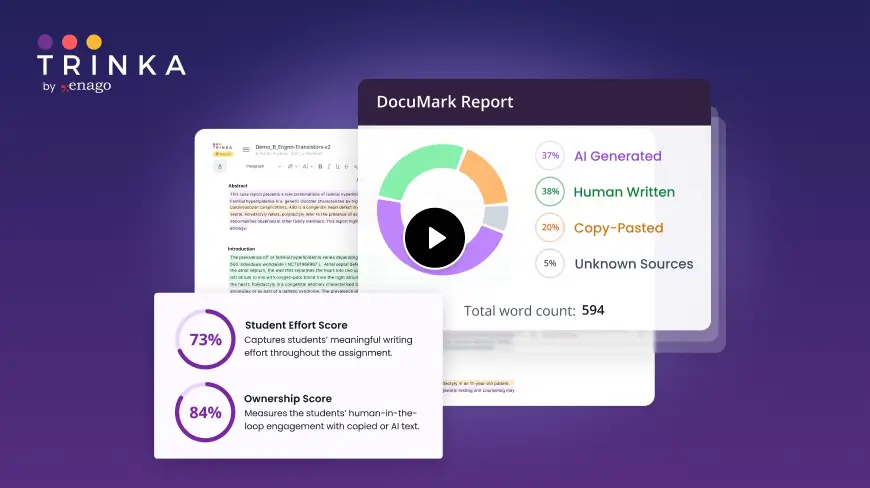
DocuMark: Responsible AI Use for Academic Integrity
Knowing your institution's AI policy is step one. DocuMark helps enforce it fairly by empowering universities to manage AI-generated content, prevent cheating, and support student writing through responsible AI use.
Common Questions About Loughborough University's AI Policies
Loughborough University has defined AI policies in 12 of 12 categories, with an overall coverage score of 100%.
Disclosure of AI use in assessed work is required. Students must include a statement naming the AI tool and how it was used, must describe how outputs were generated and modified, and must keep copies of AI outputs and drafts; the university also says AI-assisted spelling and grammar correction should be acknowledged.
The university states that inappropriate AI use or failure to acknowledge AI use in assessed work is academic misconduct and will be referred to Academic Misconduct Committees. The provided sources do not define any university position on AI detection software tools.
The university instructs staff and students to be cautious with non-university AI tools and to protect sensitive, personal, and confidential data and intellectual property. It also identifies Microsoft Copilot as an approved platform for staff training and says users are responsible for knowing when data provided to AI services requires protection and safeguarding.